Earlier posts

Earlier posts
This blog is a continuation of an older one. To explore previous posts please click the photo above.

Tuesday, 15 March 2022

Picture this


Waste no opportunity for a photo...! I went with a friend to see a film at the Pictureville cinema attached to the National Science and Media Museum in Bradford. It was dark and, as I was hanging about in the lobby before the film started, I noticed the modern glass and steel atrium at the front of the museum looked rather interesting and somewhat industrial yin and yang, with all its curves, angles and lights. Just a phone snap but I quite like it. 

By the way, the film we saw was 'Ali and Ava', a multi-faceted love story from writer-director Clio Barnard, set in and filmed in Bradford. I really enjoyed it and would recommend it. I would also recommend the Pictureville experience. They often show films with subtitles for the hard of hearing, which means that I can go along and enjoy a movie the same as anyone else. It's rarely busy either, which is a bonus as far as I'm concerned.

Monday, 14 March 2022

Out of place?


My online photo group theme for February was 'Out of Place', which I found quite a challenge as a subject. I guess I could have set up a shot inside but I was looking for a suitable image whilst I was out and about. I did find this one. The juxtaposition of classical church spire and modern shopping mall always strikes me as somewhat incongruous - not to mention the flying horse! 

The church is Holy Trinity, Boar Lane in Leeds, a Grade I listed building dating back to the 1720s (although the 'wedding cake' spire was added in 1839). Its status has ensured that it has survived, nestled nowadays among the modern buildings that make up Trinity Leeds. I think it looks quite attractive and inspiring glimpsed through the domed glass roof of the mall, although the rain and sleet lashing on to the roof at the time has rather obscured the detail in the photo.

The horse, meanwhile, is a steel sculpture called 'Equus Altus' ('High Horse') by Scottish sculptor Andy Scott (who also designed The Kelpies, Scotland's two famous horses' heads in Falkirk). Equus represents a packhorse carrying a roll of cloth - a reference of course to the local textile trade and the use of packhorses to transport goods, the HGV of the time. 

Sunday, 13 March 2022

In the potting shed


We had some horrible weather in February - wet and very windy - so that I didn't go out as much as I'd have liked. (Since the Met Office started naming storms, a few years ago, said storms seem to have got a little above themselves!) With the enforced time at home, I spent a bit of time playing with processing. This was a photo I took at Harlow Carr Gardens, in the little potting shed. I felt it needed 'enriching' a bit so I've added a couple of texture layers to it - and a gerbil! (Well, it was either that or a cow.... I find I don't have many 'animal' photos. The jury is out on whether that has helped or hindered! I can never decide, but it's fun playing. 

Saturday, 12 March 2022

Slow the Flow


Landowners, various authorities and community groups have been doing a lot of work in Calderdale since the devastating floods of 2015 and 2020, to mitigate the potential for flooding. That extends to Hardcastle Crags, where the National Trust and 'Slow the Flow' volunteers are carrying out intensive woodland management efforts. There are areas of beech woods where the deep shade of the thick leaf canopy doesn't allow any scrub or plants to thrive. They are therefore reducing some of the trees to 'monoliths' by pruning the branches, to allow a greater variety of plants to grow underneath, which slows the flow of water across the land as well as increasing bio-diversity. The pruned branches are used to build 'leaky dams' like those in my photo above - upwards of 600 of them have now been laid throughout the estate. They are designed to slow the run-off of water by creating pools and allowing water to percolate through the barriers slowly. The science behind such schemes seems to be somewhat experimental but, considering the scale of the problems that we are having locally and the increase in violent weather, anything that mitigates even a little bit must surely be welcomed. It does sound as though the project is working quite effectively here at Hardcastle Crags. 

The post in my photo is a 'fixed point photography post'. The idea of this is to provide information over the seasons and in all weathers as to how the flood alleviation measures are working. Photographers are invited to stand at these points and take photos to submit to the National Trust as feedback on the conditions.  See HERE.

Read more about the overall project HERE. 

Friday, 11 March 2022

Little Switzerland?

Hardcastle Crags has sometimes been called 'Little Switzerland', due to its steep sided valley and ravines and the upland meadows surrounding it. I think that's stretching it a bit! Nevertheless, it's a scenic area. This time I ventured a bit further up the valley than I have explored before, beyond Gibson Mill. The valley widens out slightly and there is a rocky outcrop: Hardcastle Crags itself - with good views from the top.  

From here you can see some of the rolling meadows that characterise the belt above the valleys and below the higher moorland.

The valley at this side of Gibson Mill has some open play and picnic areas, with space and materials for den-building. There's also a rather nice willow sculpture of a heavy horse, a reminder of the horse power that used to be central to the trade in wool cloth and other commodities in these valleys. 

There are waterfalls too, cascading down into the ravine in a spectacular fashion after our recent storms. 


There's plenty to explore at Hardcastle Crags, so I'm hoping my camera club outing in May will be successful. So much depends on the weather... 

Thursday, 10 March 2022

Gibson Mill

Behind Gibson Mill (Hardcastle Crags NT) there are a couple of mill ponds that offer various photo opportunities and, if you're lucky, some rather good reflections. The valley is deep and steep-sided so the winter sun doesn't penetrate far but at least in the winter the leafless trees offer some views through. 

The water-powered mill, built in 1800, was one of the first mills of the Industrial Revolution and produced cotton cloth until 1890. In the early 1900s it was used as an 'entertainment emporium', popular with local people, offering dining, dancing and a roller-skating rink. It was disused after WWII and passed into the care of the National Trust in 1950. It is now run sustainably and completely 'off-grid' with solar panels, wood-powered boilers, water from a local spring and composting toilets. (Having said that, I did notice a diesel generator out the back. Perhaps is not sunny enough in winter to power the café.) 

It's not only the mill that provides interesting reflections - hooray for the red jacket! 

Wednesday, 9 March 2022

Hardcastle Crags

I'm planning a camera club outing in the spring to Hardcastle Crags, a wooded valley near Hebden Bridge managed by the National Trust. It needed an exploratory recce and I happened to choose a rather lovely day for it: much warmer than of late, dry, sunny and with no wind. Perfect! The river (Hebden Water) was running fast after recent rain and that added to the beauty and atmosphere. 

There are various clues that the past, in this valley, was rather different from now. Old gateposts and walls, flagged packhorse trails, weirs and stepping stones across the river remind you that at one time the area was a hive of industry...

... and eventually you arrive at Gibson Mill, nestled deep in the valley, once a 19th century cotton mill, later an entertainment emporium and now a café and exhibition space.  

Tuesday, 8 March 2022

A clear up


The owners of the site alongside Hirst Lock have, I gather, been ordered by the Council to clear it. It was, for a while, a garden centre with greenhouses. That closed down and became derelict, with rubble, brambles and broken glass all over the place - rather dangerous. There have been applications to build housing on the site but these have been turned down because of the amenity value (right beside the lock) and the fact that the only access is over a narrow swing bridge over the canal. Although there are a few dwellings on that side (there used to be cottages and a mill, now residential) they have decided it cannot support more development of that kind. I'm not sure what the long term plans for the site will be, but at least someone appears to have made a start on clearing the debris. I posted photos of what it used to look like HERE

Monday, 7 March 2022

Apperley Bridge Marina


Crossing Apperley Lane from Dobson's Lock, you arrive at the Apperley Bridge Marina. It was purpose-built, relatively recently, as part of a large waterside residential development. It provides short and long term mooring, as well as services for canal boats. Bear Boating, a boat hire company, have their base here. Compared to many places along the canal, it is very smart and orderly. It makes for some colourful photos, especially when there's hint of sunshine. I always think it has a bit of a European holiday feel to it.  

Sunday, 6 March 2022

Dobson's Lock

Different stretches of the Leeds-Liverpool Canal have different 'flavours'. Situated about four miles east from Saltaire, the area around Dobson's Lock in Apperley Bridge is open, with far-reaching views. 

Dobson's Lock, a two-rise staircase lock, was a hub of activity in the early 1800s, with warehouses to hold the merchandise being transported on the canal, a workshop that made lock gates and swing bridges, and a blacksmith to shoe the horses that pulled the barges. There's also a sweet little row of cottages, presumably built to house the blacksmith and other workers. 

In the thin winter sunshine, there were few people around to disturb the peace, though several swans seem to have this area as their base. 

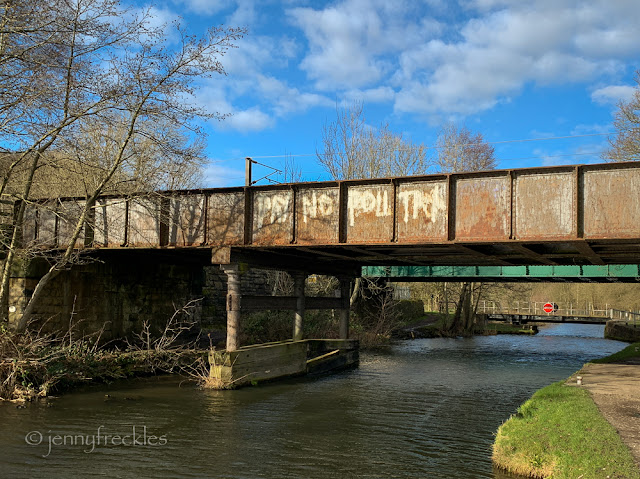
The Leeds to Skipton railway passes over the canal nearby. There's some graffiti on the bridge that begins to look quite historic from today's perspective. It was 1990 when the much hated Poll Tax was introduced by Thatcher's government. It was a per capita Community Charge to replace the previous 'rates', which were a levy on property. Quite a few folk decided to 'Pay No Poll Tax' and there were widespread riots, which led to its repeal in favour of Council Tax (again a levy on property value) in 1993. 


Saturday, 5 March 2022

Blue and yellow


As the world reels from Putin's aggression in invading Ukraine, we weep for the needless destruction, loss of life and displacement of its people, for the terror and pain, worried too about the implications for Europe and the world as a whole. I guess a lot of us have been thinking about how we can help. I've been hunting through my picture files for blue and yellow, and for sunflowers, which I gather are Ukraine's national flower. I've found a few images. I did wonder whether to get some greetings cards made to sell, to raise money for the Disasters Emergency Committee appeal, but I think it's hardly cost effective to make just a few and selling more than a few would need more time and organisation than I can muster at present. I think I'll just have to keep making my own donations and hope others will too. 

Anyway, here are the images I found, offered in solidarity with the people of Ukraine and with fervent prayers for an end to this madness. 

Love Ukraine by Volodymyr Sosiura (1944)

Love your Ukraine, love as you would the sun,
The wind, the grasses and the streams together…
Love her in happy hours, when joys are won,
And love her in her time of stormy weather.

Love her in happy dreams and when awake,
Ukraine in spring’s white cherry-blossom veil.
Her beauty is eternal for your sake ;
Her speech is tender with the nightingale.....

....Love her in love, in labour, and in fight,
As if she were a song at heaven’s portal…
Love her with all your heart and all your might,
And with her glory we shall be immortal.

Friday, 4 March 2022

Ghostly goings-on!


Whilst I was walking at Fewston recently, I took a photo of the attractive little church of St Andrew's. From a distance it reminds me a bit of the churches I saw in Iceland, which often have a boxy spire. I decided it could stand a bit of 'playing' - so here I've removed some of the trees and telegraph wires around it and added a grave, birds and some textures, just for fun. It makes it look a good deal more spooky than the reality. 

Thursday, 3 March 2022

Stop and look

It's easy enough to take attractive photos of conventional beauty spots and tourist destinations; perhaps it's more of a challenge to find the beauty in our old industrial heritage. It does 'speak' to me, however, and I could have happily spent an hour or two exploring the angles and hidden corners of Sunny Bank Mills. 

It started out as a scribbling (combing wool fibres) and fulling mill (pounding and wetting the cloth in water or urine to thicken and felt it). Gradually other buildings were added to carry out spinning and weaving, so that in time the complex became a renowned manufacturer of fine worsted cloth. The colonnade (above) started life as a yarn winding and twisting shed. 

All of the buildings have now been repurposed into small business, creative and retail outlets. The 1912 mill (above) was built when James Ives and Co took over the business. It was recently used to film the Christmas and New Year 'celebrity special' episodes of the BBC's Great British Sewing Bee. 


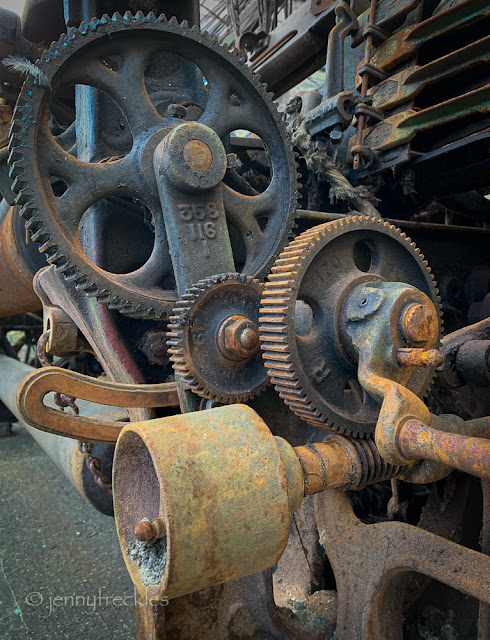
Rough stonework, peeling paint and rusty artefacts combine to retain the gritty industrial vibe that I find really captivating. 


Wednesday, 2 March 2022

Sunny Bank Mills

I made my first visit to Sunny Bank Mills recently. It is a Victorian woollen mill complex in Farsley on the outskirts of Leeds. The oldest building on the site was opened in 1829 and when the textile business closed down, as recently as 2008, its owners converted the site to units for small businesses and creative organisations. It has a gallery that hosts exhibitions, with a small café and a shop full of original and creative gifts: prints, jewellery, ceramics, houseware and textiles. It's a bit like Salts Mill, though not on such a grand scale, and without the associated village setting. 

It's a delightful place to browse and I very much enjoyed the current exhibition: Drawn from the Land, by various artists whose work is inspired by and evolves from the land. I particularly liked the prints by Bridget Tempest (see HERE for her website).

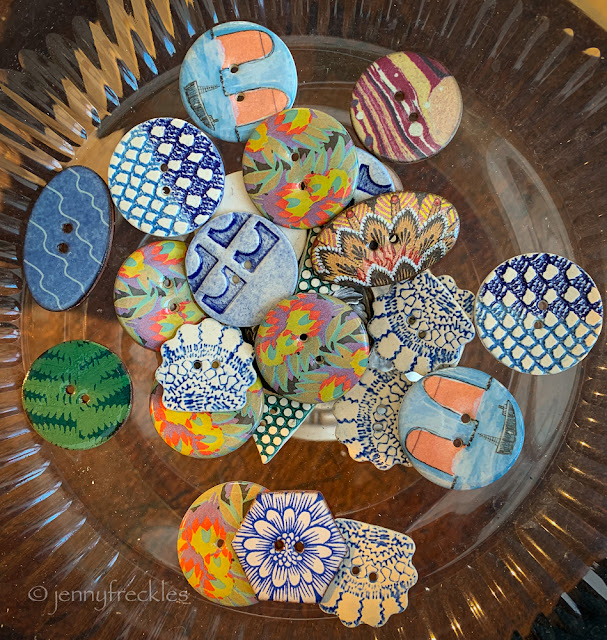
These colourful ceramic buttons in the shop caught my eye, as well as some gorgeous blue-green glassware, amongst a host of other delightful things. 


Everything was attractively displayed alongside old artefacts that presumably once graced the mill, like this cash register. 

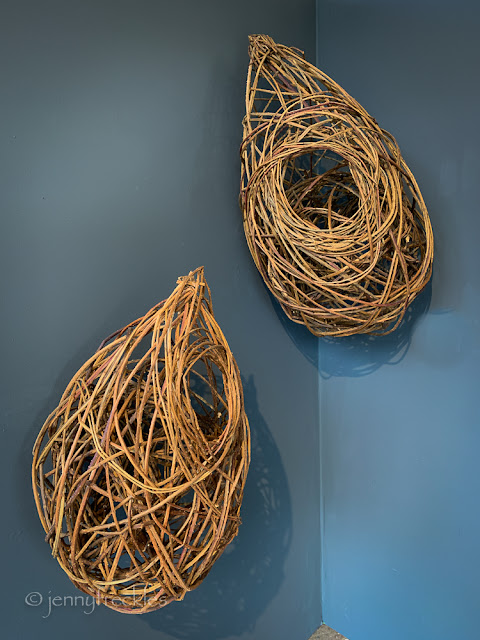
I enjoyed Oonagh Corr's pieces, woven from brambles and reminiscent of birds nests:

The colourful boards below are Bridget Tempest's work too. They are painted (or printed) but reminded me of the kind of effects some photographers manage to achieve with Intentional Camera Movement - and it prompted me that I should go out and have another play with that technique. 


I really enjoyed looking round the gallery and then I had an interesting wander round outside, through the mill complex, where there is a history and art trail. 

Tuesday, 1 March 2022

Upping the wuthering


Playing about with texture layers now... While we're spending time with the Brontës, here's a photo of the old farmhouse at Top Withins, reputed to be the inspiration for Emily Brontë's novel 'Wuthering Heights'. It's always quite atmospheric up there on the high moor anyway, but a couple of textures add a bit more of a wuthering (turbulent, stormy) feel.