Earlier posts

Earlier posts
This blog is a continuation of an older one. To explore previous posts please click the photo above.
Showing posts with label Ely. Show all posts

Sunday, 9 January 2022

Oliver Cromwell's house

Just a few hundred yards from Ely Cathedral, I found Oliver Cromwell's house, now doing good service as the tourist information centre as well as a museum. 

Oliver Cromwell, as you probably know, was an English MP, Puritan and military leader who commanded the Parliamentarian army in the Civil War (1642-1651), later becoming Lord Protector of England after Charles I was beheaded. A zealous Protestant, he was enraged by how the king, Charles I, was making changes to the church and when the king also started ignoring Parliament, civil war broke out between those who supported the king and those who thought him a tyrant who should be deposed. You can read more HERE.  

Cromwell's house was his family home for just over ten years, from 1636 when he was left the lease by an uncle. Here he lived with his wife Elizabeth and their nine children.  You can tour the house, which is quite cosy and charming inside.  Those who lived here also had responsibility for collecting tithes (taxes) and there is a tithe office in the building. 


There are pictures and a bronze bust of Cromwell himself (quite a handsome man!) and information about the Civil War. 


The kitchen, in the oldest part of the house dating back to 1215, is a small and cosy space with an open fire and bread ovens, and had a display of the relatively plain and wholesome food that Puritans ate. 

In one of the upper rooms, there was a life-size and life-like animatronic display - quite unnerving when the lady moved her head as I walked in!  It had examples of the kind of modest clothing that Puritans wore, a far cry from the lavish costumes worn by the Cavaliers, supporters of the king. They did have some comforts. The wooden box with holes in is a foot-warmer. A bowl of boiling water would be placed inside and the device tucked under the lady's dress to provide hot steam to warm her feet and legs! Damp legs were perhaps preferable to the cold? 

It was all very interesting - and as a sideline the House does 'Escape Room' experiences too, where you are locked in for 60 minutes and have to solve a mystery!  Great for families or work groups. 

Saturday, 8 January 2022

Ely Cathedral

You can't spend long in Ely without noticing the Cathedral, centrally situated in this small city and towering over everything else. I found it surprisingly hard to get a good view of it. This is the best I could find of the west frontage, with its Norman tower topped with a 14th century belfry.  The beautiful, mellow brick buildings on the right are part of King's Ely, a co-educational boarding school, said to be one of the oldest schools in the world, which uses many of the original monastic buildings belonging to the cathedral. 

Once inside the cathedral, your eye is drawn up and through the long, narrow nave, with its Norman stonework (note the rounded arches) and an ornate painted ceiling (Victorian). 


The history of the cathedral dates back to 673 AD when a Saxon Queen, Etheldreda, founded a double monastery (one for men and one for women) on the site. She sounds to have been quite a feisty woman - she was twice married, the second time to King Ecgfrith of Northumbria for political reasons, and yet she managed to remain a virgin, respecting vows she made before marriage, and eventually fulfilled her wish to become a nun.  


Construction of the cathedral was begun by William the Conqueror and it was eventually opened in 1189, after many years of work. Between the nave and the choir, there was a grand Norman crossing tower but disaster struck when it collapsed in 1322, with a great roar reminiscent of an earthquake! Alan de Walsingham, Sacrist of the monastery, distraught at the loss, had it replaced by the Octagon, a wonderful timber, glass and lead lantern, built on huge stone pillars, which really is stunning. Read more about it HEREAs the accompanying description says: 'The Octagon reminds us of how glory can come out of ruin, hope overcome despair and death lead to new life.'

Below the Octagon is an elegant octagonal altar or table. I wanted to put my camera right in the middle to take a photo of the dome from underneath, but then thought better of using an altar for that prosaic purpose and contented myself with an off centre image (above) instead! It does mean you can see the paintings of angels better. At the very centre is a medieval carving of Christ with his hand raised in blessing, carved by John of Burwell (a nearby village). 

In this area too is the pulpit, with a modern sculpture by Peter Ball: 'Christ in Majesty', carved in oak and covered in copper, brass and gold leaf. 

Of course, like all our cathedrals, Ely holds numerous tombs and memorials to past Bishops and local notables. I couldn't read the Latin inscription on the tomb below but the effigy was eerily lifelike and at the same time rather beautiful. 

Beyond the Octagon is the Choir, with heavily carved choir stalls and misericords dating from the 14th century. (A misericord is a carved hinged seat that offers support to someone standing - no doubt welcomed by the monks and choristers during long services!) 


Beyond that is the Presbytery, built in the 13th century to house the shrine of St Etheldreda. It has a magnificent, elaborately carved reredos. 


There are various side chapels, and also a large Lady Chapel, dating back to 1349 and dedicated to the Virgin Mary, mother of Jesus. Nowadays it is a large, light and airy space, but originally it would have had rich stained glass and highly coloured painted statues. These were destroyed during the Reformation in the 16th century and you can still find decapitated statues in the carved stonework and chisel marks in the walls. There is a (modern?) figure above the altar that is obviously meant to depict the Virgin Mary, though I have to be honest and say I found it rather crude in such an amazing space. 


Ely Cathedral is the kind of place you could spend hours in and still not see everything, and the kind of place that invites prayer and contemplation, not least because of its age and complex history, soaked in prayer and worship. There were other visitors but it wasn't nearly as crowded as some of our better known cathedrals and it felt all the better for it. It's stunning. I'm so glad I was able to visit. 

Friday, 7 January 2022

A few days in Ely

I was fortunate to spend a few days in Ely with a friend at the end of November. Ely (for those that don't know) is about 150 miles south east of Saltaire, in Cambridgeshire. I'd never been before and found it a charming little city, dominated by its cathedral which has a history dating back over 1300 years. The surrounding area is very flat fenland so the cathedral is visible for miles around and is sometimes referred to as 'The Ship of the Fens'. 

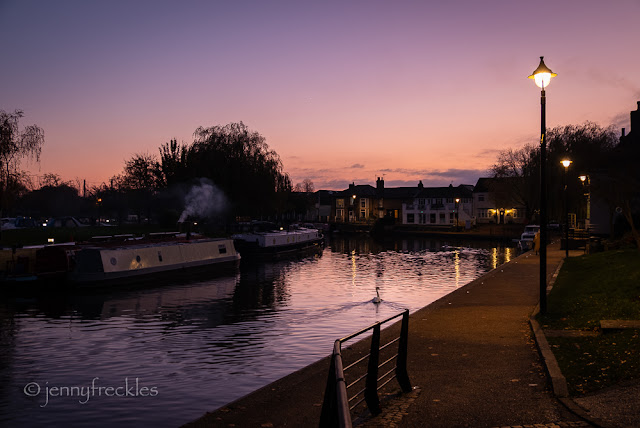
I arrived in the late afternoon and was able to enjoy a first exploration at twilight, with a prettily rosy sky as the sun set. The sun lit up the cathedral with a pinkish hue and it was also pleasantly atmospheric down by the River Great Ouse, where there is a marina. Until the 17th century, Ely was on an island in the low lying, waterlogged fenland. Eventually the Fens were drained to provide agricultural land, and the area is still dominated by farming on an industrial scale. 

The next day was dull and damp so everything looked different again, though the autumnal tones do glow in those conditions.  It's hard to find a complete view of the cathedral in any direction; one just gets enticing glimpses. 


On the riverside, a fisherman caught a small fish just as I took the photo. I was having to use a slow shutter speed because of the gloom and so his sudden movement as the line jerked meant some blurring, though I don't think it matters. It made me jump too! Authentic, anyway!