Earlier posts

Earlier posts
This blog is a continuation of an older one. To explore previous posts please click the photo above.
Showing posts with label stately home. Show all posts

Wednesday, 10 July 2024

Walled garden


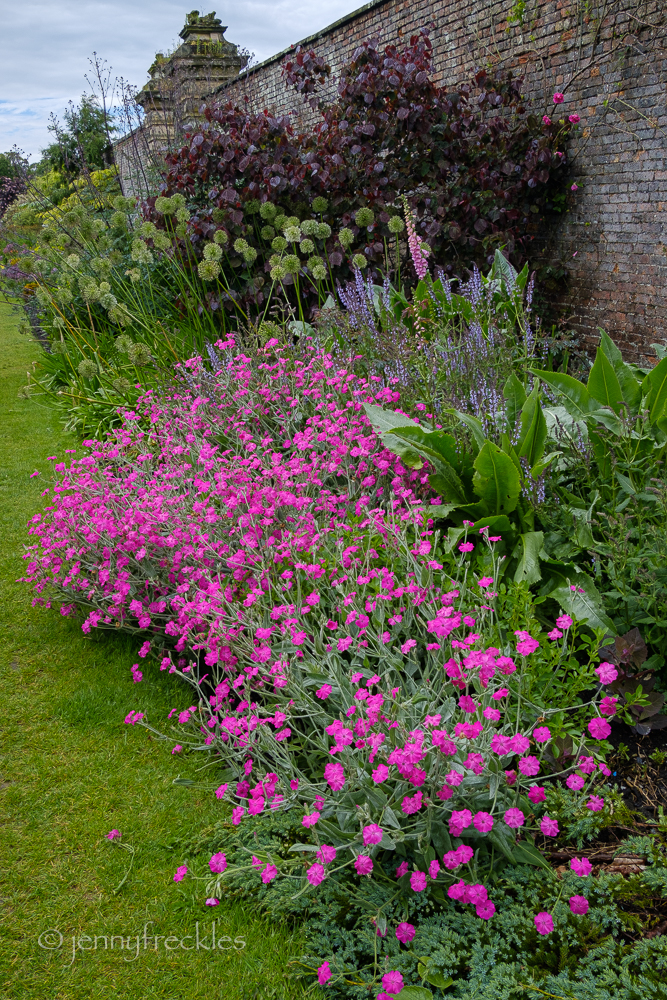
Whilst Castle Howard's grounds are mostly sweeping parkland, lakes and woodland, there is also an extensive walled garden, beautifully laid out and immaculately tended. At this time of year the stand-out stars are the roses, festooning walls and borders, lending a light fragrance to the air as you walk past. 


The gardens were presided over by an imposing 'larger than life' statue of George William Frederick Howard, 7th Earl of Carlisle (1802-1864), who had an illustrious career as an MP and, later, Member of the House of Lords. For a few years he held the role of Chief Commissioner for Woods and Forests, and was apparently an enthusiastic champion of Kew Gardens and instrumental in securing funds for a significant plant-hunting expedition to the Himalayas by Sir Jospeh Hooker. 


Tuesday, 9 July 2024

Tony Cragg sculptures


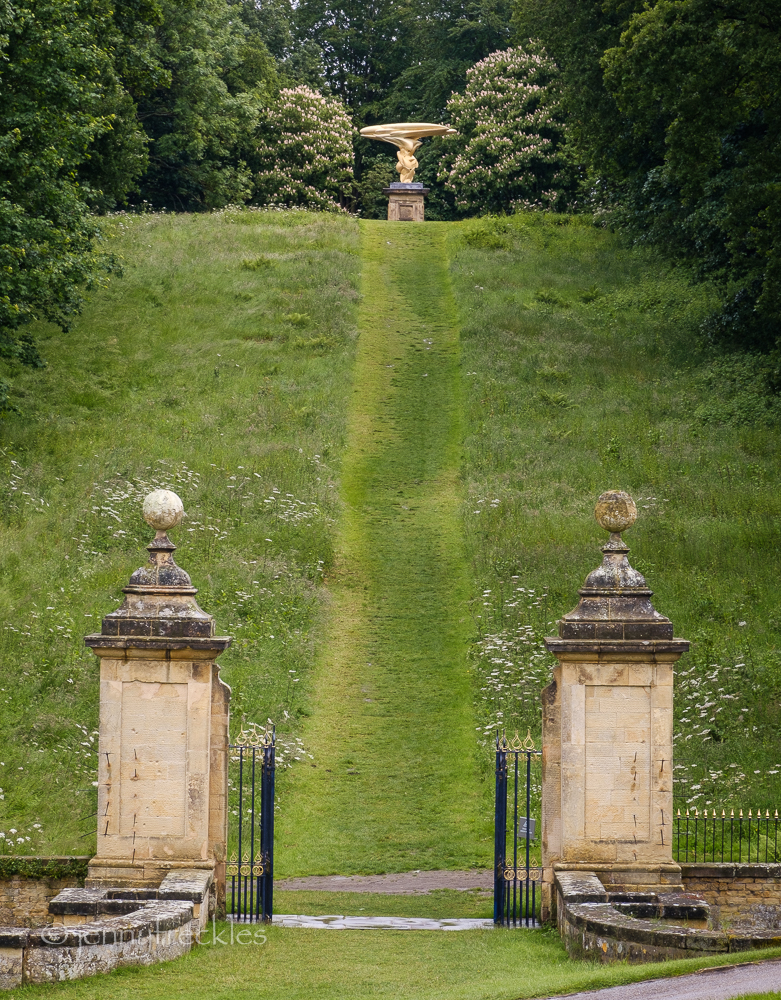
This summer at Castle Howard there is an exhibition of sculptures by internationally renowned artist Sir Tony Cragg, who is British but now lives in Germany. I think I've seen pieces by him before, perhaps at the Yorkshire Sculpture Park. They are monumental works, made of a variety of materials: steel, bronze, glass, wood, fibreglass, plastic. His work pushes the boundaries of the materials and contains echoes of his interest in geology, palaeontology and biology as well as the human form.  

I can't honestly say I warm to them... To me they are 'interesting' but not 'beautiful'. They did, however, look commanding in the landscape around Castle Howard and in parts of its interior too, and the pieces were carefully chosen for their locations (though not created as 'site specific').

In the 'Temple of the Four Winds' - an elaborate summerhouse, designed by Vanbrugh in the 18th century as a place where the Howard family could have refreshments (prepared by servants in a kitchen beneath the structure), and sit and chat or read - there was an elaborate Cragg artwork made of sand-blasted glass vessels. There were two stewards keeping an eye on it, who seemed keen to chat as there were few visitors braving the rain to walk out to the Temple. 


The amazing stucco work by Francesco Vassalli that decorates the Temple dates back to 1738. 


Of all the Tony Cragg pieces I noticed, I most liked this one (below), for its sinuous shape and the interesting way it incorporated its surroundings through the twists and bumps in the glass. 


Sunday, 7 July 2024

Music while you walk


Whilst we were exploring the interior of Castle Howard, a gentleman started to play the piano in the Long Gallery, which was rather pleasant. I gather that is a very expensive make of piano: Bösendorfer. 

Owing to the fire, many of the rooms are still quite bare with exposed timberwork and brick walls, which are gradually being renovated.  Some are furnished, like the appropriately named Turquoise Drawing Room, which had fabric-covered walls and many portraits, though some, I think, were copies rather than originals.   


This is the Crimson Dining Room (imaginative names!) with its ornate fireplaces and elaborate chandeliers. 


The dome above the Great Hall collapsed in the catastrophic fire in 1940 and has been rebuilt. Originally it had been decorated by the Venetian artist Giovanni Antonio Pellegrini in 1709-12. High up in the dome itself, 'The Fall of Phaeton' is a reproduction of his original, painted by the Canadian artist Scott Medd in 1963. 


The family Chapel dates to 1870 and is richly decorated in the pre-Raphaelite style with William Morris and Edward Burne-Jones designs and lots of gilt, very opulent.  (I prefer my chapels to be somewhere in between the austerity of Ampleforth (see last Monday's post) and this level of extravagance!) 


I absolutely adore Morris/Burne-Jones stained glass though. The faces of the figures are always gorgeous. 


Saturday, 6 July 2024

Castle Howard


The focal point of our mini-break was a visit to Castle Howard, one of the north of England's most celebrated stately homes, which I've been meaning to see for ages. Privately owned, it has been the home of the Howard family for over 300 years. You may recognise it from various films and TV programmes as it is often used as a location, most famously for 'Brideshead Revisited' in the 1980s and more recently in some episodes of 'Bridgerton'.  


Unfortunately the weather on the day we were there was atrocious. It was briefly sunny on arrival, so we opted to explore the grounds and gardens first but hadn't got far when the heavens opened and we got soaked... the first of several soakings from very heavy rainstorms, which robbed the day of some of its joy!  


It is a very grand building dating from 1699, though it took over 100 years to complete, with a lavish Baroque section by John Vanbrugh constructed in the early 1700s. The 4th Earl added a Palladian wing, so the house is rather oddly unbalanced. Sadly, in 1940, when it was being used as school for evacuees during the war, a large fire took hold and tore through more than a third of the building, causing the dome to collapse into the Great Hall. What we see now, both inside and out, is a reconstruction overseen by George and Lady Cecilia Howard and their descendants, beginning in the 1960s and still continuing. 


It is worth seeing but, to me, lacks the glory and splendour of Harewood House, our more local stately home, which I love.  

Wednesday, 18 October 2023

A return visit to Beningbrough Hall


Built in 1716 on the site of an Elizabethan house, Beningbrough Hall is one of the National Trust's finest Georgian mansions. It was the vision of a young man, John Bourchier, who inherited the hall aged just 16. Influenced by his grand tour of Europe in 1704, he commissioned William Thornton as his chief craftsman. The result is a beautiful house in the 'Yorkshire Baroque' style, with stunning mouldings and sweeping staircases. 

I last visited in 2018 and since then it has been closed for refurbishment. It was used during WWII as a base for the RAF and then the Royal Canadian Airforce. After that, its then owner, Lady Chesterfield, lived there until her death in 1957, when it was given to the National Trust in lieu of death duties. There is very little original furniture left and the hall lacks the cosy family feeling of many of our grand houses. The revamp has created exhibition space on the first floor, the Reddihough Galleries. That was what I went to see - an exhibition of black and white photos by Kate Somervell, some of Venice and some of Beningbrough itself. 


The staircases are elegant and the ceilings ornately shaped and moulded, giving wonderful plays of light and shadow, especially with the new LED lighting. It's a good house for photography in that respect. When aircrew were billeted here, all sorts of capers were dreamed up to relieve mission stress. If you could run from the bar, the full length of the house, up the stairs, along the top floor and then back down to the bar in one minute, you won a free pint. At bar opening time, there was a mad rush to get downstairs, usually on push bikes, and on at least one occasion, a motorbike to try and win the pint!


I rather liked the intimate Victorian conservatory that had been added. 


Views of the gardens through the windows were lovely too. 

Friday, 9 December 2022

One Love

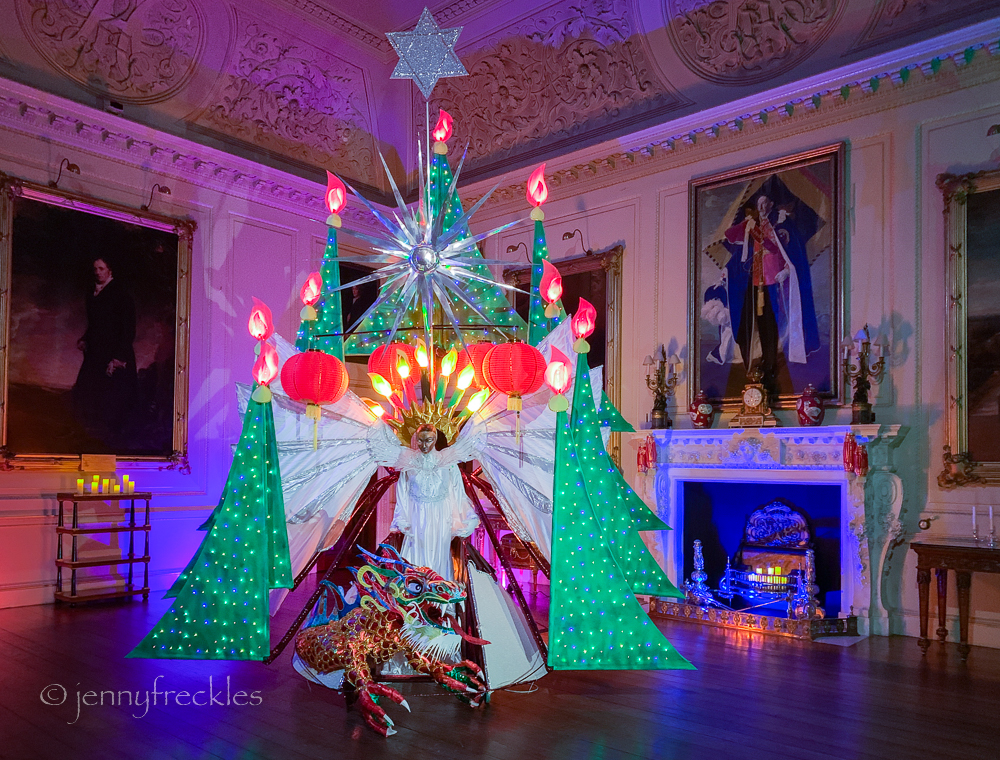
This fabulous creation, displayed in Harewood's State Dining Room, is by Hughbon Condor, an internationally respected carnival costume designer who has been associated with Leeds West Indian Carnival for many years. Called 'One Love', it depicts in a carnival costume the collective joy of Christmas and the winter season as celebrated by many different faiths and cultures. I could see a traditional Christmas tree, an angel, a Scandinavian St Lucy's Day candle crown, a Chinese dragon and lanterns, and a star. I guess perhaps I missed some other references. 

"The light dispels the darkness, the fire provides the warmth, and the belief creates the blanket to embrace the idea of 'One Love'."


Thursday, 8 December 2022

Long Live the Christmas Tree!

I reckon we are near enough to Christmas now for me to start the sparkly seasonal blog posts! 

'Long Live the Christmas Tree!' is the title of the Christmas exhibition at Harewood House. Our stately homes often dress elaborately for Christmas. (It brings in revenue). This year, Harewood has moved away from the traditional into something much more adventurous, with eleven artists being commissioned to create their own version of the classic pine or spruce tree. It was wonderfully different but also joyful and colourful. 

There were traditional trees, notably in the Gallery (above), but these were part of an installation by Leeds-based Opera North with composer Martin Green, who reworked the song 'O Tannebaum' into a surround-sound musical experience. (Thanks to my friend for the photo above. For some reason mine turned into a one second video! Not what I intended but it's too easy to nudge something on my phone!) 

In the Music Room, we found 'Aurora' (above) by Yasemen Hussein. Beautifully constructed of copper hung with shimmering crystals, it references ancient beliefs about the sun god and how winter comes when the sun god is sick and weak. The winter solstice marks the turning point where the sun god starts to revive. Evergreen boughs hung above the door were believed to protect a house against evil spirits and misfortune. 


A cone of antlers (gathered from the Harewood estate) supports a shining sun disk, in a sculpture called 'Day of the Birth of the Unconquered Sun' by Simon Costin. The idea of the Roman winter solstice and the festival of Saturnalia is linked with the North European Yuletide, quite appropriate for a grand house which holds many references to classical mythology in its decorative aspects. (And maybe even a cheeky nod to Santa's Rudolph in the antlers!)


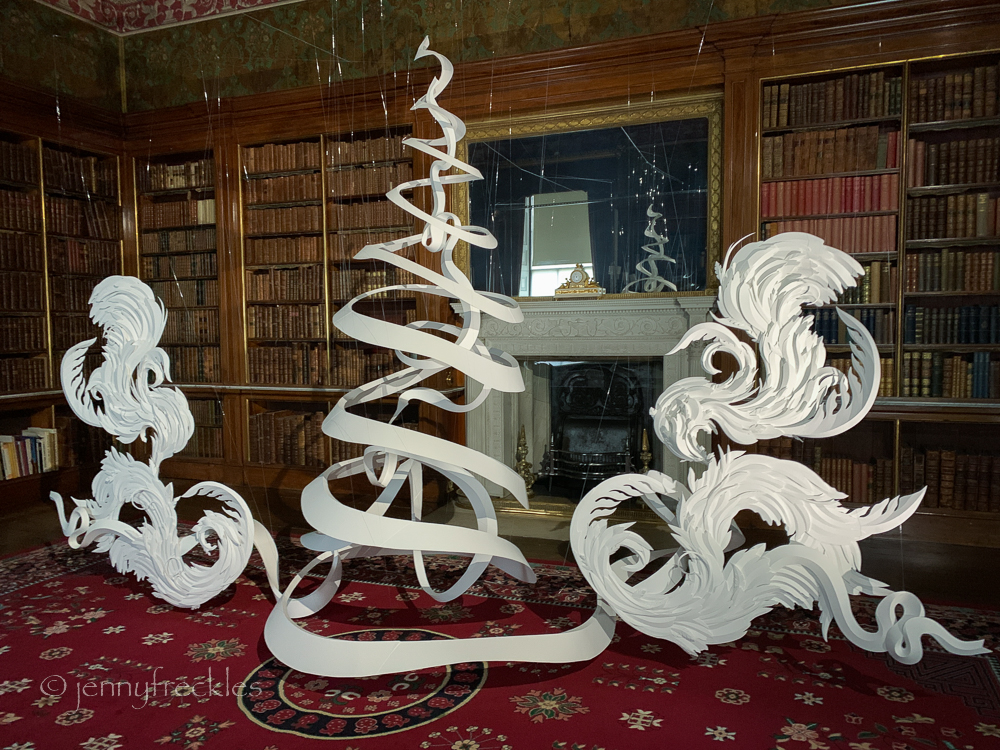
Andy Singelton's 'Ribbon Tree', an intricate, floating paper sculpture in the Spanish Library, takes inspiration from  Christmas ribbon as well as the Neoclassical decoration seen in Harewood's wallcoverings and Robert Adam plasterwork.


In the State Bedroom, 'A Christmas Bee' by Meriel Hunt brings a reminder of the hard-working bees on Harewood's estate and introduces their hive, made of wood and straw and reimagined as a Christmas tree, into a room that is fit for a queen (bee). 

My final photo shows 'Luna' by Swallows and Damsons' founder, Anna Potter. A huge wreath of wild material (Mugwort and Honesty among them) foraged from the Harewood Estate offers a nod to the feminine Mother Nature, arranged to encircle Harewood's imposing modern sculpture of 'Adam': yin and yang. Linger long enough and you become aware of a delicate scent from these plants, which all have medicinal qualities. 


It was delightful to process through Harewood's beautiful State Rooms, rendered a bit differently by the altered lighting, and enjoy these really creative artworks. 

Saturday, 3 December 2022

A visit to Harewood House

So many rainy, gloomy days in November meant fewer walks and more visits to inside attractions. I noticed Harewood House had started its Christmas exhibition very early and decided it would be good to pay a visit before the crowds got too big. Many of our large stately homes really go to town with their decorations at Christmas and Harewood is no exception, with a lovely display of artistic 'Christmas trees' in the State Rooms (more of which later) and festive trees, lights and baubles all over the gardens. It was worth seeing and I did have a short walk around the gardens too, in the drizzle. 
Despite the gloom, the view from the Terrace is always lovely, looking out over the landscape created by the famous garden designer Lancelot 'Capability' Brown in the 18th century. Many years ago a breeding programme for endangered Red Kites was started at Harewood and it has been really successful, so that you nearly always see these magnificent birds of prey soaring over the estate. 

Harewood is renowned for its art collection, including many recent commissions and acquisitions. I've always liked the huge statue of Orpheus, by Astrid Zydower, added to the formal Victorian parterre garden, the Terrace, in 1984. 

This garden also holds some delightful sculptures of rather cheeky-looking nymphs and children. 


Click the 'Harewood' label in the 'Labels' side panel on the right for some more notes on the history of Harewood  and some pictures I took, in rather better weather, last year. 

On a separate issue, is anyone else finding Blogger suddenly flagging up already published comments from weeks ago, from people who comment regularly, as Spam? It’s getting silly. 

Wednesday, 6 October 2021

Inside Harewood House

'I would not exceed the limits of expense that I have always set myself. Let us do everything properly and well, mais pas trop.' So said Edwin Lascelles to Robert Adam, when he commissioned the renowned interior architect to design his new, grand mansion in 1759.  More than 250 years of history and huge wealth (made on the backs of slaves in the Caribbean sugar plantations) mean that the interior of Harewood House is as lavish and opulent as they come. The results are certainly trop - too much - in my eyes, but I can appreciate the beauty and craftsmanship nevertheless.   

The interior tour begins in the Music Room (above), with a glorious Adam ceiling, a lush chandelier and some incredible works of art around the walls.  We progress on to the State Dining Room, full of Chippendale furniture (again, no expense spared) and  portraits of Lascelles family members, some very old and some more contemporary. This room is still used for dinners and private functions. It was extensively remodelled by Sir Charles Barry in the 1840s; the original Adam fireplace and ceiling ripped out! 

The Adam ceiling in the Gallery - the largest room in the house - is quite magnificent (and impossible to photograph as a whole without a specialist technique. My photo shows just a small section.) More photos can be seen on the Harewood House website HERE

The Main Library is rather cosily arranged, with huge mahogany bookcases designed by Sir Charles Barry but retaining the lovely Adam plasterwork. I could quite happily have settled here or in the adjoining Spanish Library to explore the rather wonderful old books - some Italian art books were dated 1598! Or how about 'The History of the Fan' or a complete set of back copies of Punch magazine, to keep you amused. 

Because of Covid, some of the narrower passageways and smaller rooms in the house have had to be closed so that social distancing can be maintained. Even so, you get a good idea of how the landed gentry lived in past centuries. For all the grandeur, I often find I notice and prefer the more modest artefacts, like this charming bust of a young girl: 


Monday, 4 October 2021

Harewood House

I had a wonderful day out recently at Harewood House, one of the foremost historic homes in the country, which just happens to be half an hour's drive away. Designed by the famous architects John Carr and Robert Adam, and later extended by Sir Charles Barry (who also rebuilt the Palace of Westminster, our Parliament building in London), it was built between 1759 and 1771 for Edward Lascelles, a wealthy West Indian plantation and slave owner. It is still owned by the Lascelles: David, the 8th Earl of Harewood, and his wife Diane. 

The south frontage has magnificent views of the gardens and estate, landscaped by Lancelot 'Capability' Brown. 


The north side, where the main entrance is, immediately declares its grandeur, with its wonderful classical and symmetrical Palladian architecture. 


Beyond the vast lawns on the north side, there are views across the Wharfe valley to the rocky outcrop of Almscliffe Crag. You may be able to spot, in my photo below, the 'ha-ha' - a hidden ditch that acts as a barrier to prevent animals getting into the gardens, without blocking the view like a wall or a fence would do. ( I don't know why these hidden ditches are called 'ha-has', unless it is just what people say when they see you unexpectedly disappearing into one!)