Earlier posts

Earlier posts
This blog is a continuation of an older one. To explore previous posts please click the photo above.
Showing posts with label Apperley Bridge. Show all posts

Tuesday, 7 October 2025

The Blacksmith's Forge


Dobson Locks on the Leeds-Liverpool Canal at Apperley Bridge recently had a Heritage Open Day. I went along as I was interested to see the blacksmith's forge in use. (I had an ancestor who was a blacksmith.)

David Wadsworth, a Trust volunteer and former blacksmith, was demonstrating how the forge worked and the skills needed to work the metal. He was assisted by a 'bellow boy', Phil Bristow, whose job was to rhythmically work the leather and wood bellows contraption, which pumps air into the coals to increase the heat and flame. Metal rods are left in the fire for a while until glowing red, at which point they can be removed and worked. A lot of the skill seemed to be in judging the optimum point to remove the metal to work it. Left too long and it goes brittle and sends dangerous sparks, too short and it's not malleable enough to work. David explained the various tools he used as he made some some demo pieces. 

When it was a working forge, they made all sorts of items for the locks, some of them quite large. You may be able to see in the photo below that there is a square hatch at the back of the fire, and that enabled very long metal pieces to be threaded through and heated. They have been able to piece together the history of the forge since the early 1800s, from documents, receipts and census records. They know who the blacksmith was at various dates and, as so often in the past, it seems to have been quite a family affair, passing from father to son. 


David was making smaller and more decorative items like hooks and pokers. It was fascinating to watch.  


He was wearing traditional wooden soled boots, studded with nails - and incidentally told us that Silsden, further up the canal, at one time had many small forges specialising in nail-making. 


In a workshop further along the row, they were making wooden parts for locks. Of course, water eventually rots the wood of the gates and paddles. Traditionally made of oak, gates have a lifespan, apparently, of about thirty years. There is a large canal workshop at Stanley Ferry near Wakefield, one of only two in the UK that now has the skills and capacity to make the huge gates themselves.  

Monday, 6 October 2025

Dobson Locks


A short walk along the canal towpath from Apperley Bridge Marina brings you to Dobson Locks, a two rise staircase lock. This part of the Leeds-Liverpool Canal was finished in 1777. In the early 1800s, warehouses, workshops and a maintenance yard were built alongside the locks. Lock gates and various other parts were made on site here, a vital part of maintaining the canal. The buildings are mostly Grade II listed and thus protected, and the Canal and River Trust still uses some of them as offices and workshops. 


Adjacent to the locks and also on the wharf by the swing bridge there are various old cottages and houses that at one time belonged to the Canal Company and were used to house their workers, inspectors and managers. It must have been a very busy place, a hive of activity. They're now private houses, retaining many original features. Together it all adds up to a rather charming and now relatively peaceful hamlet. 


Sunday, 5 October 2025

Apperley Bridge Marina


Apperley Bridge is a village on the outskirts of Bradford (now pretty much absorbed into the metropolis), straddling the Leeds-Liverpool Canal. At one time the area adjacent to the canal had several large 19th century textile mills. Of course they closed down and some of them have been demolished and others converted to apartments. In the 1990s a substantial housing development was constructed alongside the canal and I think it was then that the marina was developed, with short and long-term mooring for narrowboats, plus a chandlery and other essential boaters' facilities. I think there's also a café though I've never been to it. It's now rather an attractive area, somewhat European in feel, I always think. There's plenty of interest photographically and it's a pleasant walk around the harbour and along the towpath in either direction. 


I walked along towards Dobson Locks, beyond the Milman swing bridge on Apperley Road. 

Monday, 7 March 2022

Apperley Bridge Marina


Crossing Apperley Lane from Dobson's Lock, you arrive at the Apperley Bridge Marina. It was purpose-built, relatively recently, as part of a large waterside residential development. It provides short and long term mooring, as well as services for canal boats. Bear Boating, a boat hire company, have their base here. Compared to many places along the canal, it is very smart and orderly. It makes for some colourful photos, especially when there's hint of sunshine. I always think it has a bit of a European holiday feel to it.  

Sunday, 6 March 2022

Dobson's Lock

Different stretches of the Leeds-Liverpool Canal have different 'flavours'. Situated about four miles east from Saltaire, the area around Dobson's Lock in Apperley Bridge is open, with far-reaching views. 

Dobson's Lock, a two-rise staircase lock, was a hub of activity in the early 1800s, with warehouses to hold the merchandise being transported on the canal, a workshop that made lock gates and swing bridges, and a blacksmith to shoe the horses that pulled the barges. There's also a sweet little row of cottages, presumably built to house the blacksmith and other workers. 

In the thin winter sunshine, there were few people around to disturb the peace, though several swans seem to have this area as their base. 

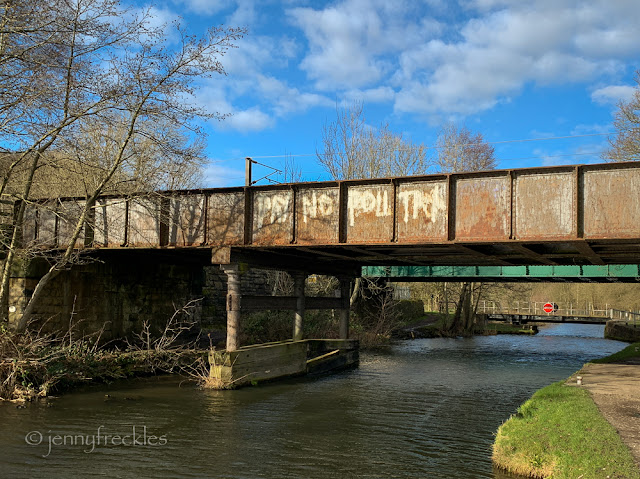
The Leeds to Skipton railway passes over the canal nearby. There's some graffiti on the bridge that begins to look quite historic from today's perspective. It was 1990 when the much hated Poll Tax was introduced by Thatcher's government. It was a per capita Community Charge to replace the previous 'rates', which were a levy on property. Quite a few folk decided to 'Pay No Poll Tax' and there were widespread riots, which led to its repeal in favour of Council Tax (again a levy on property value) in 1993.