Earlier posts

Earlier posts
This blog is a continuation of an older one. To explore previous posts please click the photo above.
Showing posts with label Hebden Bridge. Show all posts

Sunday, 1 February 2026

Yorkshire humour (repost)


I was obviously suffering from a lack of current photos to post on my blog even as far back as 2010.... This was my offering for 1st February that year, a bit of Yorkshire humour, so I thought it worth repeating:

'I guess even the most enthusiastic bloggers must sometimes have to raid the archives for inspiration and I'm no exception.  (We could call it 'blogger's block'!)  I came across this photo that I took a few months ago, of an old cemetery near Heptonstall, up on the hills above Hebden Bridge. My dad would have called it the dead centre of Yorkshire - and there isn't much more to say about it. (Although it is near the comically-named hamlet of Slack Bottom, whose name I have always enjoyed!)  And it does give me an excuse to tell you one of my favourite Yorkshire dialect jokes:

An elderly Yorkshireman was distraught when his devoted - and devout - wife died. His only comfort was knowing she had gone to be with the Lord. He gave much thought to what to put on her memorial stone and eventually decided Lord, she was Thine would be appropriate. When he went to view the stone, however, he was dismayed to find it had been inscribed Lord, she was thin. He immediately contacted the stonemason, telling him: "You've missed off the 'E' ". The mason replied that he was sorry but it was no problem and he would correct it. When the widower went again to see the stone, he found it now said: Ee Lord, she was thin.'

Friday, 26 December 2025

Christmas Eve Tractor Run


Well, this was a lot of fun even if it did turn out to be a photographic disaster as far as I was concerned. Every Christmas Eve in Calderdale, local farmers and businesses put on a charity tractor run, this year raising funds for Candlelighters, a children's cancer charity, and Forget Me Not children's hospice. The cavalcade of tractors, trucks and vans travels a circular route through the Calder valley, passing right by the end of the road where my daughter lives. I've never been to see it before and didn't really know what to expect but it was long (about 150 vehicles) and very loud, with music and horns blasting. I had not expected them to move so fast and it proved impossible for me to get clear photos, in the dark, with all the bright headlights and the vehicles travelling at that speed. So I'm sorry for the blur but I did want to show a few pics, just to remember it by. I was cold too. Note to self to dress even more warmly next time... you get colder standing still, of course, and there was a long wait. I soon warmed up back at my family's home, with a cup of tea and a thoughtfully provided hot water bottle! (They look after dear old gran very well.) 

If I go again next year, I will hopefully be better prepared.


When I eventually drove home, I was followed by a tractor making its way back to its farm. It was like being chased by a Christmas tree!  😂 😂.   

Sunday, 20 July 2025

Zine


No access, barred gate;
I would like to walk the land,
Crunch leaves, make history.


Regular readers of my blog may remember that earlier this year I booked myself on a photo walk in Hebden Bridge, where I restricted myself to taking square, mono photos (as a challenge and because it was a really dull, damp day that suited the black and white treatment). [See HERE and several posts after that one in late February 2025.] The walk was led by Bryony Good, who is an artist/creator working from a studio in Hebden Bridge. She offers a variety of creative workshops, and has now produced her first 'zine' with contributions from many of her workshop participants. I am delighted to say one of my photos and the accompanying haiku I wrote have been featured in it. It's always a pleasure to see one's work in print. 

As for 'zines', they are a way of presenting work that has almost passed me by. My daughter used to write music zines when she was in her teens but as a medium they were never 'current' for me. I keep thinking maybe it's a format I should use more. Working out a bit cheaper than a hardback book and perhaps allowing a more creative, looser structure, they are an attractive and accessible format for sharing work. 
 

Wednesday, 28 May 2025

Heptonstall's Methodist Chapel


The old and new Anglican churches in Heptonstall aren't the only places of worship in the village. There is also a Wesleyan Methodist Chapel, though it is not now in regular use. Built in 1764, to house a rapidly growing non-Conformist congregation, it clings to the hillside on the north east side of the village, with wonderful views over the valley.  The formation of the congregation was overseen by John and Charles Wesley, the Anglican evangelists and preachers, who founded the breakaway Methodist revival movement. Octagonal chapels are unusual though not unique, believed to have no corners for the devil to hide in, and focused around the central pulpit. 


We didn't find the chapel open, though I gather some of our members eventually managed to find a keyholder and were allowed inside. 


We were graced by a visit from a rather fluffy cat, who stretched out in the sunshine on the warm stone steps, quite oblivious to the photographic equipment sharing its space. 

Sunday, 25 May 2025

St Thomas à Becket, Heptonstall


Here are a few more photos of the old church, St Thomas à Becket, in Heptonstall. With parts dating back to the 1200s, though extended since then, it was damaged in a fierce storm in 1847, after which the new church was built just across the graveyard. The ruins of the roofless church are preserved and it has a peaceful atmosphere, with plenty of arches and angles to challenge a photographer. 


This niche in the wall near where the church's altar would have been is, I believe, called a piscina. It would have been used for washing communion vessels and for 'the reverent disposal of sacred substances', through the drain or sacrarium, which would have drained direct into the ground and not into a sewer. 

The floor of the old church has some inscribed gravestones, though it's not clear if these remain in situ or have been lifted from the graveyard itself to provide a firm floor.  On very old graves, people were often listed by initials rather than full names.  


Saturday, 24 May 2025

Old and new church


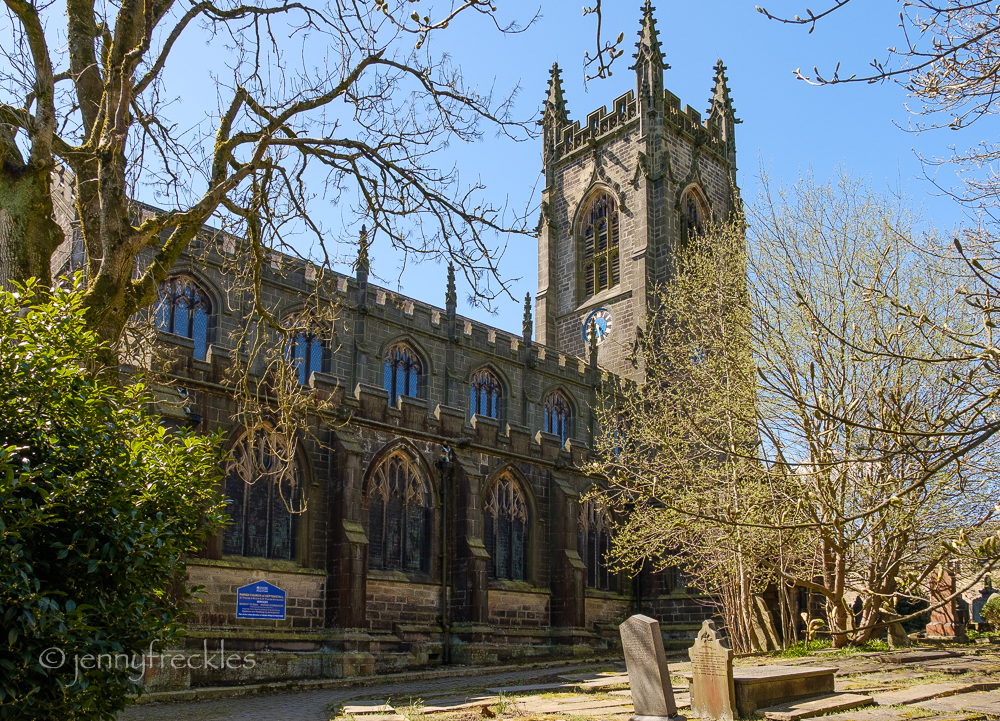
Heptonstall is unusual in having two churches within one graveyard. The old church, St Thomas à Becket, was built around 1260, with later adaptations. A huge storm in 1847 caused part of the tower to fall away, so in 1854 the current church, St Thomas the Apostle was constructed a few yards away. The old church and ancient graveyard are carefully maintained and services are sometimes still held within the ruined nave. 


There are approximately 2100 graves in the old churchyard, and I read somewhere that there may be up to 100,000 people buried there. Many of the graves list whole families; where possible they have all been transcribed, which is important as, over the years, the lettering weathers or the stone crumbles away.  


I could honestly spend all day wandering around graveyards. there are many stories to uncover, especially where there are old graves. Some of these date back to the 1600s. 


Behind the new church, another more modern graveyard is still in use. It's here that the resting place of the poet and writer Sylvia Plath can be found. Her life and tragic death are well-documented and the cause of much speculation. Her husband, the poet Ted Hughes, from whom she was separated at the time she took her own life, comes from this area of Yorkshire and had her buried here. Her grave is a place of pilgrimage for some.  It has been damaged several times by people trying to obliterate her married name and the inscription chosen by Ted Hughes for the memorial.  


"Death must be so beautiful.  To lie in the soft brown earth, with the grasses waving above one's head, and listen to silence.  To have no yesterday, and no to-morrow.   To forget time, to forgive life, to be at peace."         
Sylvia Plath (The Bell Jar


Friday, 23 May 2025

Heptonstall's oldest buildings


One of Heptonstall's oldest buildings is Stag Cottage in Stag Fold, which dates back to the 1500s. I tried to get a photo of it (above), as it is charming, but the light was very tricky. You can get a better appreciation of it, inside and out, from the website listing it as a holiday let, HERE. There are several 'folds' in the village. The term originally meant an enclosure where animals were kept, but in Yorkshire it seems to have become a term for cottages clustered around a yard, perhaps originally all belonging to the same family.


One of the old buildings on the main street was the Cloth Hall, where the 'pieces' woven by the handloom weavers were brought, from their homes, to be sold to merchants. It's now a private residence and you can discern areas on the stonework where alterations have been made during its history. Above the door is a datestone: 1545-1558. 


There's an archway preserved, just off Northgate, inscribed with the initials IB and the date 1578. 


I'm sure there are more charming corners I've yet to discover. 

Thursday, 22 May 2025

Heptonstall


I mentioned Heptonstall yesterday - and that gives me chance to share some photos I took a few weeks ago when I met members of my camera club there for an outing. Heptonstall is a small village perched on a hill above the larger town of Hebden Bridge in Calderdale. The village has a long history, back as far as the 1200s. Pre-industrialisation, people tended to live on the hills rather than in the valley, and the settlements in the valley grew when industries developed that needed water power. 

Heptonstall was historically an important centre of handloom weaving and has many very old properties along narrow, winding streets still surfaced with the stone setts common in this part of the country. (In fact they had been covered over with tarmac but were uncovered when some work took place. Local pressure led to them being restored and retained.)  


The many weavers' cottages have large windows on the upper floor, which gave light for the family's handloom weaving.


Yes, in the modern world with everyone's big cars, the narrow streets and lack of parking space here are a nightmare... especially when you meet the local bus, albeit quite a small version. 


The archway of the Great North Gate leads to what is now Heptonstall Museum, formerly the Old Grammar School.


Heptonstall is a really fascinating place to explore and there is a published trail to follow that takes in the main sights. I've visited several times before but never before have I known it to be sunny! It's very often bleak, windy and drizzly up there. In fact it was so sunny that it was quite hard to deal with, photographically - far too much contrast and shadow!! 

Wednesday, 21 May 2025

A summery jaunt


I'm delighted to have made new friends among the other residents in my apartment block and I went with a couple of them to Hebden Bridge, on a glorious summer day (even thought it's still spring!). It was very warm and very sunny - pleasant conditions for feeling like you're on holiday somewhere in the Med but useless for taking photos! Anyway, I was too busy chatting to attempt many photos. We had lunch and a wander round the streets, explored a few shops and then sat in the sunshine and had ice cream, before coming home. Altogether a very pleasant day.  

These pictures were taken right in the centre of town. The old mill (above) has been repurposed into retail space. The old bridge (below) that gives Hebden Bridge its name was built in 1510. The original settlement was up on the hill at Heptonstall, avoiding the marshland around the rivers in the valleys. The Halifax to Burnley packhorse trading route went across the hills but had to drop down into the valley to cross the River Hebden, so there had to be a bridge here. Eventually the marshland was drained and that allowed roads to be built, and then the canal and railway. The valleys became populated as water-powered mills sprang up during the Industrial Revolution in the 18/19th centuries. 


Saturday, 3 May 2025

Jumble bells!


This scene is at the heart of Jumble Hole Clough. Apparently there used to be a house called Beverley End somewhere here, and the hillside is elaborately terraced. It's all connected with the textile trade and the mills that used to fill even this little valley. My daughter thinks the terracing may once have been a 'tenterfield', where they had the 'tenters': wooden frames that they used to stretch and dry woollen cloth in the open air during its manufacture. The cloth was held in place by rows of 'tenterhooks', which is where we get the phrase 'to be on tenterhooks', meaning to be in a state of unease or suspense. 

Now, the whole hillside is alive with bluebells and wild garlic, so very pretty. 


Tucked into the banking we found a patch of wood sorrel. Its trefoil leaves fold up into little tents at night, and the flowers close, opening again in the light of day. 


I also found this red, white and blue variety of comfrey. Comfrey roots and leaves contain allantoin and have traditionally been used in ointments to heal bruises and sprains.