Earlier posts

Earlier posts
This blog is a continuation of an older one. To explore previous posts please click the photo above.
Showing posts with label Settle. Show all posts

Monday, 9 December 2024

Settle


Settle is an attractive small market town in Ribblesdale, in the south of the Yorkshire Dales. It was originally a local rural centre, served by packhorse trails and drovers' roads but started to grow in the 17th century when a turnpike road was constructed to benefit the local textile trade and connect the area with the more industrialised towns in Lancashire and Yorkshire. The coming of the railway opened up the possibilities still further and the town became a centre for cotton spinning. Nowadays, tourism is the main focus, as the town is quite near the famous Yorkshire Three Peaks and attracts walkers. 

It's an interesting place to rootle around, with old buildings and narrow streets, some still cobbled. It fascinates me how the rooflines go up and down, buildings obviously shoe-horned in at various points of its history. 


My friend wanted to get a few things in Booths supermarket (a rather superior store), so I waited in the car, enjoying the scenery around. The newish flats opposite the car park looked very attractive (I now have a vested interest in apartment buildings!). They are part of the McCarthy and Stone chain... rather expensive. There's a two bed apartment for sale there at the moment for over £300,000, with an eye-watering service charge of over £5000 a year plus ground rent plus a car parking charge! (You can, however, watch cricket from the roof terrace, as it's next to the local cricket ground.)

Sunday, 8 December 2024

Lines, light, landscape, body


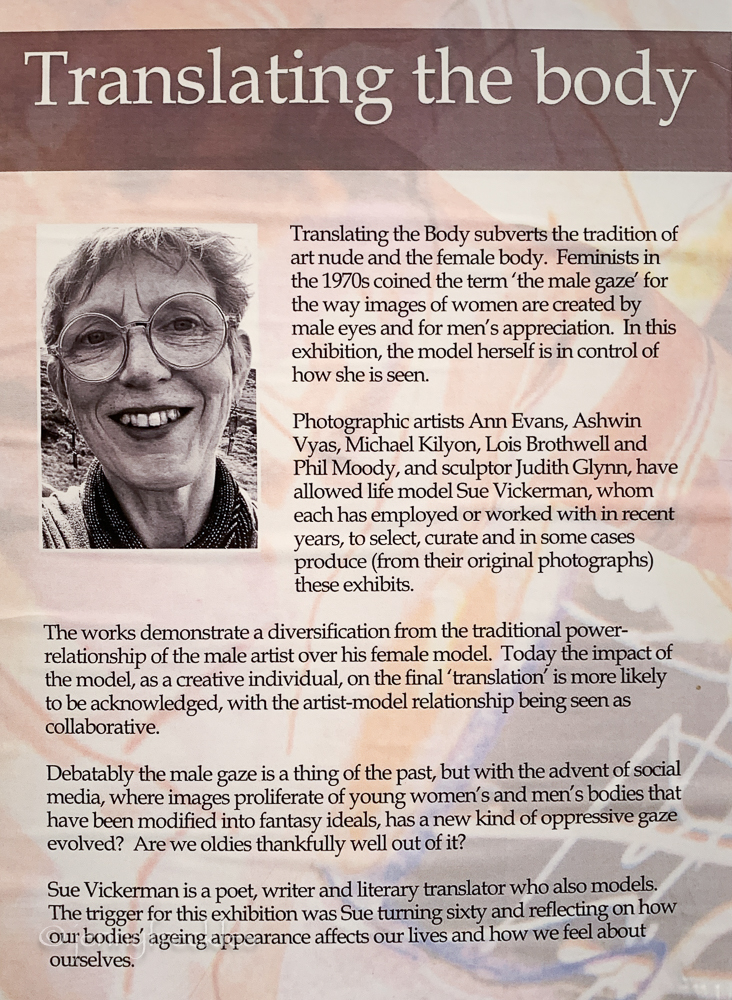
The exhibition I went to see in Settle was 'Translating the Body', curated by an artist's life model, Sue Vickerman ('Suki'). Here she has turned convention on its head, showing works created in modelling sessions she has had with various artists. In some cases she has taken photos or amended the artworks, taking control of and questioning the power dynamic between artist and model. 


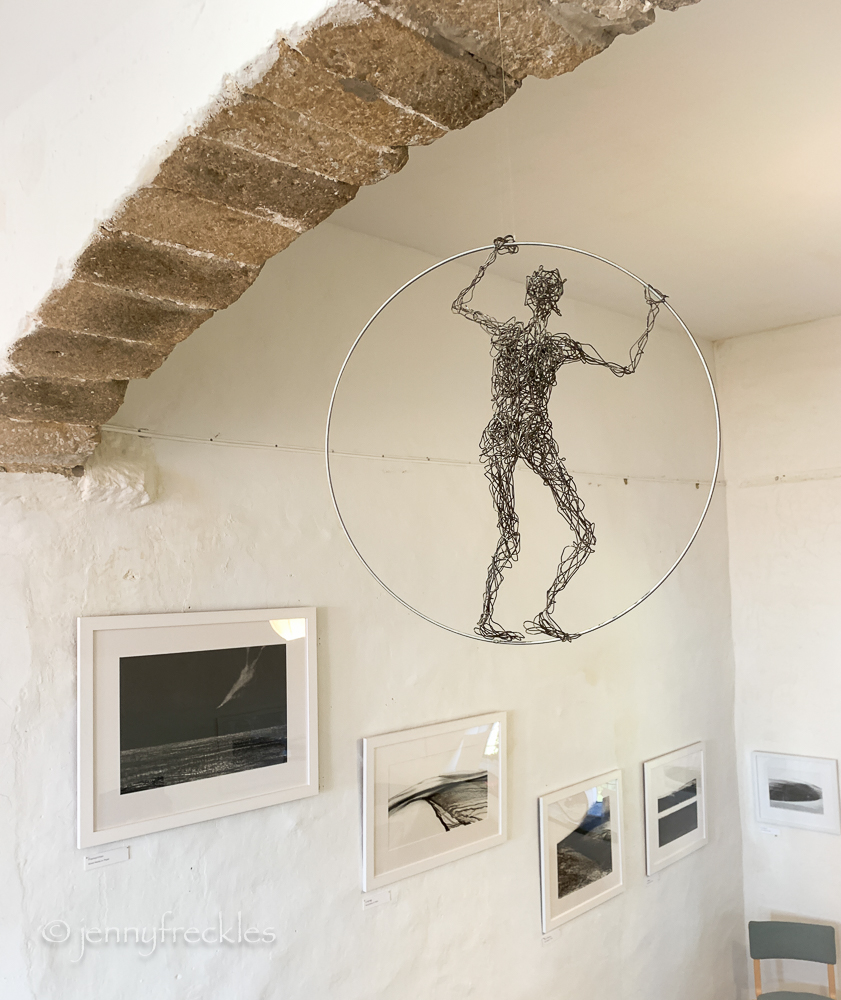
I can't say I liked most of the work but I did find it interesting - and I did like the wire sculptures by Judith Glynn. 


The exhibition was paired, in a rather inspired way, with one called 'Land and Light', monochrome Yorkshire landscapes by Elizabeth Smith. Chalk and charcoal lines and smudges, powerful though minimal, evoked the hills and moors and the movement of light across the landscape. I did like these, very much. You could not help but see parallels with the lines, shapes and shadows of the nude human body, exemplified in the other displays. 


Saturday, 7 December 2024

The Folly, Settle


I went to Settle recently, to see an exhibition in The Folly. It's a wonderful old building, dating back to the 1670s. Originally built as a home and offices for wealthy Settle lawyer and landowner Richard Preston, it has a chequered history. When it was sold to the Dawsons in around 1702, after Richard's death, they leased The Folly to a succession of tenants and its uses included a farmhouse, bakery, warehouse, furniture shop, refreshment rooms, fish & chip shop, bank, salvage business and antique shop. Nineteenth-century census records show that The Folly was occupied by two or three different families and their lodgers. In 1871, there were 21 people living in the house. Recently, it has been restored and the whole building brought back into use as a museum (with a nice café).  


You initially enter the hall, a grand room that would have been the main reception room for Richard Preston's visitors and clients. It has beams, panelling and a massive fireplace, with unusual stones forming the arch - called, apparently 'joggled voussoirs'. 

A magnificent oak staircase connects this room to the rest of the house. It has clearly been bashed about a bit over the years. There's evidence of woodworm and its timbers are twisted. The rounded finials on the newel posts looked to me like two people hugging! 


Upstairs the light through the mullioned windows was casting bright bands across the polished wood floor. 


The exhibitions change from time to time, but there are displays describing some of Settle's history, with some interesting local artefacts and furniture. There is an oak seat made in the workshop of Robert 'Mouseman' Thompson, so named because of his trademark mice carved into every piece. 

Monday, 6 December 2021

Settle station

The railway station in Settle, like most of the stations on the Settle-Carlisle line, retains a lot of its heritage charm. Opened in 1876, as part of the Midland Railway Company, it is still painted in their colours of red (properly called Crimson Lake) and cream. Almost closed in the 1980s, pressure groups ensured its survival and the line has gone from strength to strength, helped by the superb scenery that it passes through, although I believe there are only 8 or 9 services a day through Settle. 

The station occupies an elevated position, giving lovely views across to Giggleswick school's unusual copper-domed chapel  (above) and with a view of Pen-Y-Ghent along the platform (below). 

I was amused to read the signs on the platforms - 'Settle down' on the Carlisle side and 'Settle up' on the Leeds side, though I was puzzled... I always think of anywhere south (Leeds, London) as 'down' and anywhere north (Carlisle, Glasgow) as 'up' so to me these signs were illogical. My knowledgeable friend pointed out that in railway terms, London is the centre, so you always go 'up' to London.


A few vintage suitcases reinforced the heritage feel of the station:

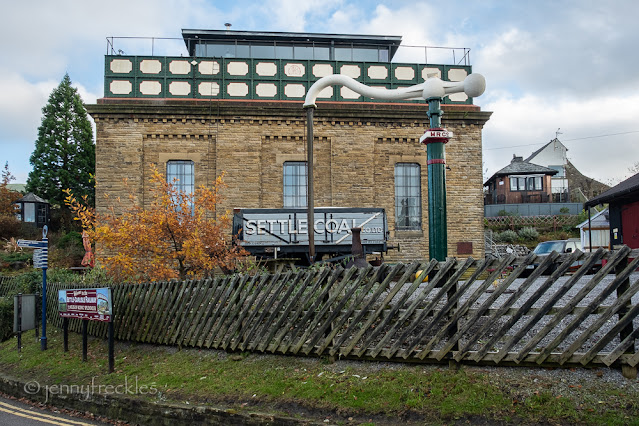
and, in the station yard, what was once a huge water tower with a cast iron tank for replenishing the supplies of steam trains, has been converted into a residential property. I'd love to see inside! The owners are, apparently, fellow Bloggers so there is an entire blog dedicated to it - see HERE - with some photos. 


Sunday, 5 December 2021

Settle

It just happens that I've ventured up to Ribblesdale quite a few times in the recent past. One day I decided to explore the market town of Settle in a little more detail, instead of just passing through. In the photo (below) of its market square, you can just see in the background a rock outcrop with a flagpole atop. That's Castleberg Rock, and I decided to walk up there, just for fun. It's a bit of a steep scramble but worth it for the views, and interesting to watch the rock climbers negotiating the steep crag. 

The panorama from the top is stunning, looking over the town and the neighbouring village of Giggleswick and with far reaching views. The photo (above) taken from that viewpoint, shows the Town Hall, with its numerous chimneys and huge gables, on the left and the famous 'Ye Olde Naked Man Café' just across the main street. According to some accounts, that building dates back to 1663 and was once a house - and the name maybe comes from an undertaker's business or the trade sign of a local carpenter. Other accounts date the building to the 19th century and suggest it may have been an inn. It doesn't really matter. These days it's a family run café and bakery and provided a tasty sandwich and good coffee. I shared an outside table with a couple on holiday and within minutes we'd shared a myriad of details, so that I felt like I'd found a new BFF (as my grandchildren would put it!). She was from Lancashire, he from Yorkshire and I still find it heartwarming how genuine and friendly people can be round here. 

Another notable building in Settle is The Folly, built as a house in the 1670s by a local lawyer, Richard Preston. In its time it has been a farmhouse, bakery, warehouse, furniture shop, bank and even a fish and chop shop. It has been divided up into dwellings and then reunited into one building. A Heritage Lottery Fund grant allowed it to be rescued and preserved. Now it holds the Museum of North Craven Life. 


Just as a foot note, I was intrigued by the carefully chiselled graffiti at the base of the flag pole up on Castleberg Rock - 1841! Proof that 'vandalism' has existed for a long while. 

Saturday, 4 December 2021

Scaleber Foss

Scaleber Foss or Force is a scenic waterfall, just off the road between Settle and Malham. Scrambling down to it through the steep, wooded gorge, on the slippery rocks and fallen leaves, was a little tricky, so I only ventured as far as the first flat viewpoint. Had I been braver (or more foolhardy?) I could no doubt have found a vantage point clear of the trees. Nevertheless you can see it's quite attractive and worth the visit. 

From the road above, the limestone scenery is stunning, with Stockdale Beck carving a route down from the hills on its way to the falls. 

Saturday, 27 November 2021

Autumn riches

Autumn came slowly this year, with a whispering softness that at first made me impatient and then eventually beguiled me. The woodland below the old limestone quarry between Langcliffe and Stainforth was full of subtle colour. 

By contrast, trees in the nearby market town of Settle were bolder: copper, gold, russet and orange glowing beautifully in the sunshine.


Friday, 22 October 2021

River Ribble


It took us a few minutes to locate the right path after lunch in Feizor. Being relaxed and full of good food clearly dulled our wits a little! Eventually we found the route, which follows the Dales High Way long distance path over to the River Ribble at Stainforth. Lovely views again from the top and then a gentle stroll downhill into the valley, punctuated by some rather high ladder stiles and precarious stone step stiles. Those have cantilevered stones right through the wall, and are often slippery and uneven with use. As it says in an article I read: 'All is typically well until you reach the top, when realisation dawns that you will have to pirouette to face the other way before descending the other side, as the stones are the same on both sides.'  Pirouetting feels harder when you're full of Sunday lunch, I have to confess, not to mention the complications of heavy boots, bulky backpacks, a walking pole and my camera!  

Anyway, we successfully arrived at the river in Stainforth, beside the rather elegant old bridge, built around 1675 to span the river instead of the original ford. (Stainforth means 'stony ford'.) People call it a packhorse bridge but it is in fact wide enough for carts, and many true packhorse bridges don't have such high parapets, in order to allow the heavily laden horses to pass across unimpeded.
Below the bridge, the river tumbles over falls known as Stainforth Force. There was quite a crowd of people here and when we neared the falls we realised why. In the autumn, salmon migrate up river to spawn and they leap up the falls in spectacular fashion. We were lucky enough to see several fish attempting the jump, though I found it impossible to photograph them, what with all the spectators and the fact that the fish are very fast and you can't predict where they will appear.  I was frankly astonished to see them, having spent some time here in past autumns and never seeing one. Quite a thrill! 


Downstream of the falls the river becomes calmer, meandering along through meadows. There isn't much autumn colour in the leaves yet, but there are a lot of red hawthorn and rowan berries. 


And so back into Settle, past a couple of old mills that were originally fulling mills and then cotton mills, and nowadays are converted into apartments and small business units. 

Wednesday, 20 October 2021

Settle Circular


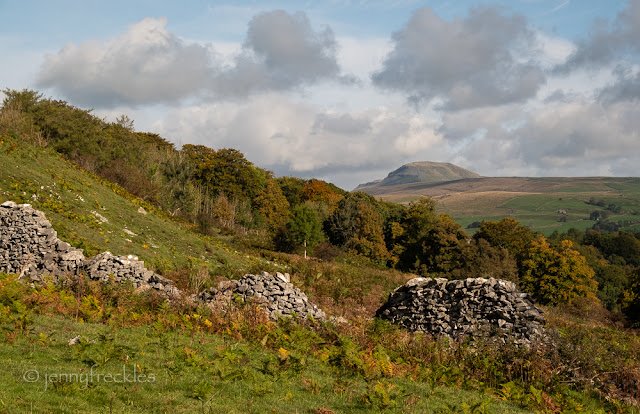
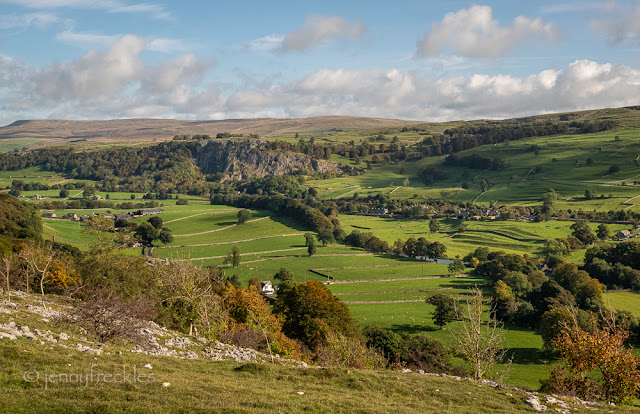
My friend and I were fortunate to have a glorious early autumn day for an eight mile circular walk from Settle, a market town in Craven on the western edge of the Yorkshire Dales. The route took us from the River Ribble, up along Giggleswick Scar and over to the hamlet of Feizor. This is limestone country, with remnants of limestone pavement and the characteristic drystone walls everywhere. There are wonderful views up Ribblesdale. You could see Pen-y-ghent, the lowest of Yorkshire's Three Peaks, in the distance. I rather liked the way the tumbledown wall in the foreground echoed the shape of the mountain.  

Looking down along the valley, the village of Langcliffe sits downstream of Stainforth Scar. During the late 19th and early 20th centuries, limestone was quarried in this area by Craven Lime Works and burned in a massive Hoffman kiln to produce lime that was used in agriculture and building (mortar and limewash) as well as in a host of small-scale industries: tanning, textiles, soap and paper making. I once visited the remains of the Hoffman kiln, which was very interesting. (See HERE) 
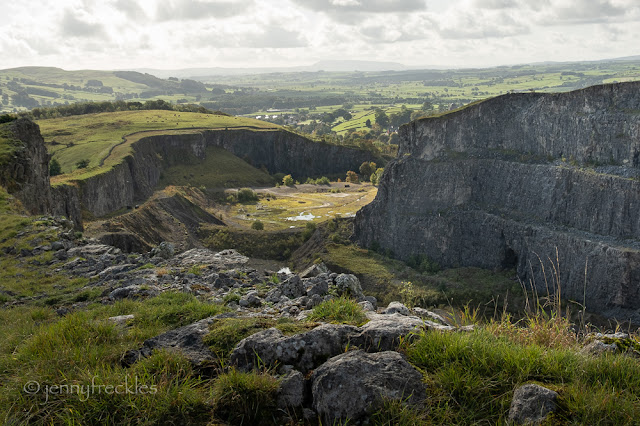

On the other side of Giggleswick Scar, part of the Scar has been extensively quarried for building materials. The huge quarry was closed ten years ago and the land is now earmarked for some kind of industrial development. On the far horizon you may just be able to see the distinctive whaleback shape of another peak, which is Pendle Hill in Lancashire. 


Further on, the path meandered through upland meadows, which in summer are rich with wildflowers.


We then dropped down to the hamlet of Feizor, where there is a very popular café: Elaine's Tea Rooms, a real hidden gem, with plenty of outdoor seating. (I think it's still advisable to sit outside in these Covid times, even though it's getting colder.)  It's not often I have a full Sunday lunch halfway through a long walk. It was delicious - though it maybe made for a slower walk onwards, since I was rather full and thus quite sleepy!