Earlier posts

Earlier posts
This blog is a continuation of an older one. To explore previous posts please click the photo above.
Showing posts with label mill. Show all posts

Wednesday, 26 November 2025

Knitters' Paradise


I made the most of a bright but freezing cold late autumn day with a trip to Cullingworth, to visit Coldspring Mill. A friend had recommended it to me as it has a huge yarn store. The mill - quite hidden away down a lane - was built in the 1880s as a soap mill. It used lanolin from a local tannery to produce soap that was used in the wool scouring trade. During WWII farm machinery was stored there and then it became derelict. It was rescued and refurbished in the late 1980s and now sells yarn from local Yorkshire producers, at lower prices than traditional shops (as it doesn't have high street overheads). It now also has a large store selling outdoor clothing, and a coffee shop. 


I intended to take a few photos inside but quickly became so fixated on all the gorgeous yarn on the shelves that I forgot! (I'm sure I'll make a another visit so there'll be another chance.) 

Outside there were a few interesting things - this vintage Jowett van was one of them. Jowett was a local vehicle manufacturer between 1906 and 1954, producing lightweight cars and vans that could cope with our area's hilly terrain. 


Round the back there was a (knitted) lady who looked as if she'd rather tired of her knitting. But who wouldn't sit outside to knit in these attractive surroundings? (Though she'd probably died of hypothermia, it was that cold!) 

Saturday, 16 August 2025

A linear walk #3


Saltaire to Bingley Five-Rise Locks

The new road bridge over the canal here is quite a dominant feature, a little tunnel that separates the semi-rural outskirts of Bingley from the denser urban centre. Immediately beyond is the fairly recent mill conversion of the former Britannia Mills, a large scale wool worsted factory, built in the late 1800s, one of several mills and industrial premises that existed alongside the canal in Bingley in the 19th and 20th centuries. I don't know when it ceased production but it lay empty and some of the buildings were demolished, until it was revived as apartments in the old three storey shed with a couple of new apartment blocks added on the site too. 

The pattern of old industrial buildings interspersed with newer residential builds continues along the canal. 


Leading up from the canal, some of the rows of Victorian terraced housing still stand, gradually giving way to newer and less dense residential areas as you progress up the steep valley side. 

There's a family of swans living in this area (not the same ones that hang around in Saltaire). 


Some of the old mill chimneys have been left standing, proud monuments to a different era. 


Around the Park Road bridge, the vegetation in the canal is particularly dense, with a large patch of reeds encroaching on the navigation. They look quite pretty but will soon make the canal impassable if they're left to proliferate. This is the section of canal that was lifted and moved several yards. Just over that wall on the left, the bypass speeds through and right beside that is the railway, those steps leading down from Park Road to the station platform. There really wasn't a lot of room to slot a dual carriageway through, so hats off to the planners and engineers that squeezed it all in! 


The vibrant mural that now decorates a gable end just beside the Park Road bridge has only recently been painted. It depicts moorhens, many of which frequent the canal. It is by Misc.Etc, sponsored by Bradford City of Culture 2025. 

Saturday, 19 July 2025

Dowley Gap Mill


A recent walk took me along the little lane from the canal bridge at Dowley Gap towards Hirst Woods. I was rather cheered by all the shasta daisies in flower along the wall beside the building. It seems people have been cutting them; there was a sign asking people not to pick them (as it is actually someone's garden). 

This residential complex was once a small worsted mill and associated cottages, built in 1818. By 1890 the mill was disused - and, I gather, became a brewery for a while. At some point in the 1990s the mill was converted to a dwelling (perhaps apartments?), with a large window inserted into the gable end and a stairwell added. The conversion appears to have been done with care and imagination. The whole site, however, is a bit of a hodge-podge of buildings, some better cared for than others. 


It is accessed by a narrow lane along the canal side from Primrose Lane, past Dowley Gap Locks, which then peters out by the aqueduct. What was until recently a rough scramble up to the aqueduct has recently been made into steps, which makes it much easier walking!  


The 'Seven Arches' aqueduct was, in its day, a substantial engineering feat, built to carry the Leeds-Liverpool Canal over the River Aire. At some point the towpaths have been crudely resurfaced with concrete so that, walking over it, you never appreciate the beauty of the original structure. 


Unfortunately the beauty of this whole small area is somewhat marred by the adjacent sewage works, with paddles slowly rotating in the circular settlement tanks. Depending on the direction of the wind, there is often a nasty odour... so much so that I should not like to live in the mill complex! Perhaps you get used to it. 


I was sure I had, somewhere, several recent photos of the mill complex from the canal side. Can I find them? No. So this picture below is years old and taken in a different season altogether! 

Wednesday, 21 May 2025

A summery jaunt


I'm delighted to have made new friends among the other residents in my apartment block and I went with a couple of them to Hebden Bridge, on a glorious summer day (even thought it's still spring!). It was very warm and very sunny - pleasant conditions for feeling like you're on holiday somewhere in the Med but useless for taking photos! Anyway, I was too busy chatting to attempt many photos. We had lunch and a wander round the streets, explored a few shops and then sat in the sunshine and had ice cream, before coming home. Altogether a very pleasant day.  

These pictures were taken right in the centre of town. The old mill (above) has been repurposed into retail space. The old bridge (below) that gives Hebden Bridge its name was built in 1510. The original settlement was up on the hill at Heptonstall, avoiding the marshland around the rivers in the valleys. The Halifax to Burnley packhorse trading route went across the hills but had to drop down into the valley to cross the River Hebden, so there had to be a bridge here. Eventually the marshland was drained and that allowed roads to be built, and then the canal and railway. The valleys became populated as water-powered mills sprang up during the Industrial Revolution in the 18/19th centuries. 


Sunday, 23 March 2025

Sunny Bank Mill's archive


Salts Mill has a small archive on display but the museum and archive at Sunny Bank Mills is much more extensive, no doubt due to the fact that it is still in the possession of John and William Gaunt, owners of the textile mill, which ceased production in 2008.

In the entrance there is a Hattersley Power Loom, made locally in Keighley and one of about 200 similar machines used at Sunny Bank from about 1950 to 2008.  


In the archive there are thousands of pieces of cloth made at the mill, mostly a very fine wool worsted, used in men's suiting. 


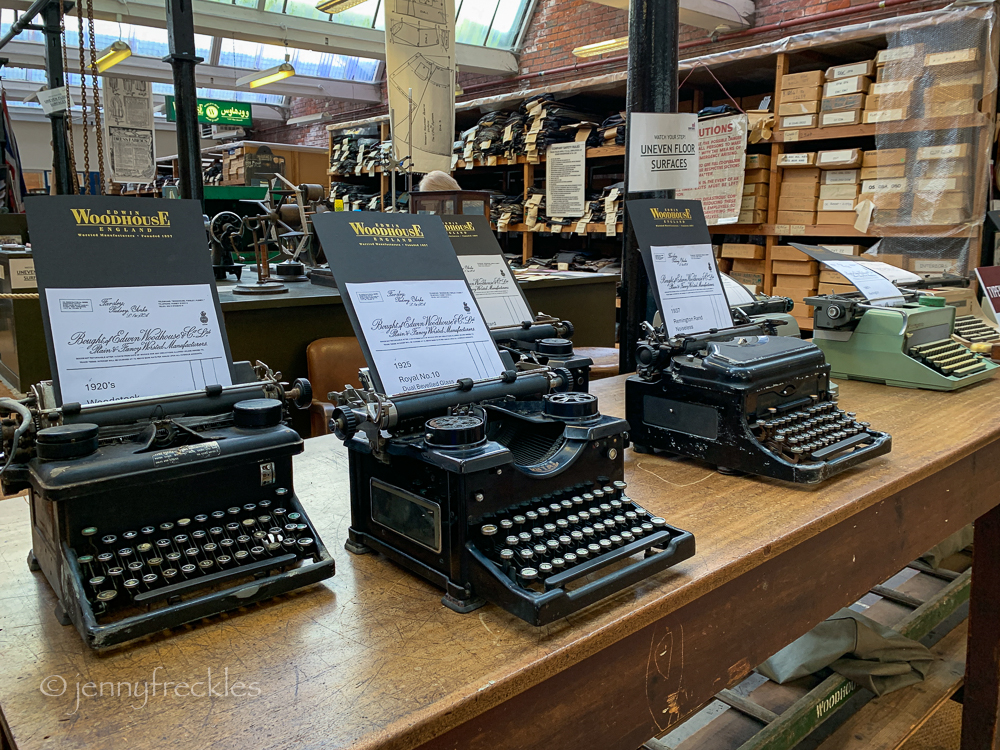
I was also quite amused to see a parade of typewriters, from some of the earliest models right through to the electric ones we used to use before computers took over. (I had one myself.) Seeing them reminded me of my first job at the local Electricity Board HQ, where all our letters and reports had to be handwritten first and then sent up to the typing pool to be typed, before they were delivered back to the originator. Hard to believe these days, when missives can be transmitted electronically in a matter of minutes! 


Saturday, 22 March 2025

Ones to Watch 2025


The main gallery space at Sunny Bank Mills was hosting a new exhibition: 'Ones to Watch 2025'. 'Showcasing some of the most exciting emerging talent Yorkshire has to offer, the exhibition brings together work by artists from across disciplines, from painting to sculpture, film, photography, ceramics, design and more.'  Inevitably there were some I liked, some I didn't like, some I couldn't 'get' and one or two pieces that I found intriguing. I did enjoy the large charcoal portrait by Ellie Andrews, entitled '(M)OTHER', one of a series of sketches she made of five women, who are all mothers. 


As I sipped my coffee (and relished my cake... a treat I allowed myself!) I watched a slow and mesmerising video by Angelika Kacourris. It was of 'nothing in particular' that the creator found on a local walk but, watching a horse cropping grass and a loop of tiny flies dancing in the sunlight, it was both strangely beautiful and very relaxing. 

Another piece I enjoyed was this simple yet visually arresting grid of coloured squares, a collaboration between Twinkle, an Indian artist and Ehsan Mojaver, who is Iranian. 'Against the grey tones of England, this installation offers a vibrant reminder of the warmth and diversity of their homelands.' 


In the same gallery, a shop offers carefully curated homewares and other beautiful objects, displayed on and around pieces of old furniture that are original to the mill. Sunny Bank Mills has echoes of Salts Mill and yet offers something different too. It's a highly successful and laudable endeavour, I feel. 


Friday, 21 March 2025

Artists' studios


There are a number of the large mill floors at Sunny Bank that have been partitioned off into sections that artists can rent as studio space. As well as the Print Fair, it was 'Open Studios' day so there was a vast array of artwork on display and for sale. There are painters, printers, ceramicists, jewellers, weavers, photographers ... So much wonderful colour and creativity on show.  


Odd corners held random but interesting paraphernalia. 


Perhaps the most exciting area was the 'Scrap Centre of Creative Reuse', a large store crammed full of 'scrap' - old bicycle wheels, textiles, paper and card, cardboard tubes, rope, plastics, metals, rubber, odd bits of wood. It was rather wonderful; stuff that would have gone to landfill, now rescued and sold at minimal cost for use in play, education and artistic creation. They also have an area of eco-friendly domestic supplies, where you can refill your washing up liquid or shampoo, or stock up on biodegradable and recyclable brushes, cloths and suchlike.  


Various rooms are used for workshops and training programmes, mostly related to textiles. There's a School of Sewing, a room full of weaving looms (below) and children's daycare and a forest school on site. Such a good use of a sprawling mill complex that otherwise might have been left to go derelict - and laudable because (unlike most of our old mills) it has remained in the same ownership after the original woollen mill was closed down. 

Thursday, 20 March 2025

Outside and inside


I got chatting to another photographer. She was semi-professional and a lot more 'serious' than I, with a good camera and large lens. We agreed we were both captivated by the old mill buildings. They are gradually being reclaimed and refurbished; there are a lot more areas in use now than when I first visited a few years ago. Then you come across an area like this:


Along with its harmonious colour palette, the glorious jumble of stone, brick, wood, metal and glass, getting overrun with weeds and creepers, really makes my heart sing. Maybe I'm odd in that regard as, no doubt, some would simply see decay here but I love places like this. 


Round the back of the 1912 mill is the old mill pond. I'm not sure whether this was a source of water for the steam power or simply a reservoir, maybe for fire-fighting purposes. It's now well fenced off for safety reasons but to my eyes, again, it brings interest and nature into this rugged industrial site. 


Yarn winding and twisting machinery once filled the floor of the Colonnade (below). Now its beams have been left exposed and it provides a sculptural walkway in what's called Weavers' Yard. 


When you get tired of exploring the outside, there are now all sorts of studios and shops in the different buildings. Record Plant specialises in vinyl and has hundreds of discs to browse and buy. 


In a corner of the former Mending Rooms (where I imagine the burlers and menders used to inspect the finished cloth for snags and imperfections) is a rather lovely shop called Cahm, selling aromatic oils, scented candles and all manner of luxury spa and bath products. It smelled heavenly in there. I don't use candles now though (might set off the smoke alarm in the flat!) and I no longer have a bath, just a shower, so I didn't treat myself. 

Wednesday, 19 March 2025

People Powered Press


The People Powered Press had an exhibition on the top floor of Sunny Bank's 1912 mill. You'll perhaps remember them as I've featured them before. They have a base in Saltaire, with the world's largest letterpress printing press. They work with individuals and community groups, making large scale letterpress works. 

One of their banners said: 'Nothing for us without us', originally created by young people involved in the 'Born in Bradford' study, expressing their conviction that services for young people should be created and delivered in collaboration with them, rather than just presented to them. This was, however, the weekend after that now infamous and disgusting spectacle of the US President and members of his administration belittling and humiliating Volodymyr Zelenskyy, the President of Ukraine, in the Oval Office. The banner seemed to me very poignant, as this is also Ukraine's desperate cry, to be centrally involved in any discussions towards a ceasefire and lasting peace. How anyone could think they should not be, is beyond me!  


People Powered Press use a system of shapes called Brico (below) that can be assembled in different ways to design letters, which can then be used to print from. 


The 1912 Mill has echoes of Salts Mill, though much smaller and built of brick not stone. I love to think of the hundreds of people who've climbed up and down these stairs over many years. 

Saturday, 11 January 2025

Elsecar village


This surprisingly tranquil scene was just a few hundred yards from Elsecar Heritage Centre. It is the beginning of the Elsecar Canal, a branch of the Dearne and Dove Canal. The canal network was created to carry coal and other cargo (including pig iron) from the mines and ironworks. The coming of the railways and subsidence from the mining meant that their viability was short-lived. It is only in recent years that they have been restored. 

Across the canal, the spire of Holy Trinity Church stands tall over the village. Built in the early 1840s, it was part of Earl Fitzwilliam's investment in the area. Like Sir Titus Salt in Saltaire, his Christian paternalism meant that he wanted his workforce to have good housing and facilities like schools and a church. 


I wondered if it might be the church that my ancestors attended but I've since researched some of their children's baptisms and it seems they were non-Conformist chapel-goers. The church itself was locked up but there was a pretty angel on a grave in the churchyard. (I love to see Victorian angel statues.) 


From the churchyard you could see an old corn mill, now a craft centre, at the side of the canal. Through a gap in some houses, there was a good view over the lower part of Elsecar village. 

Old Row (below) appears to be one the few remaining terraces of houses that Earl Fitzwilliam had built for his coal miners in the late 1700s. Plain but substantial, stone-built with slate roofs, they must have been rather superior dwellings in those days, each with a private walled yard at the front and back, and an allotment. They are now Grade II listed, reflecting their importance to the history of this area.  I bet they're still quite nice houses to live in.