Earlier posts

Earlier posts
This blog is a continuation of an older one. To explore previous posts please click the photo above.
Showing posts with label repost. Show all posts

Saturday, 20 June 2026

Martin Parr


Another repost, a flashback to ten years ago when I visited The Hepworth in Wakefield :

'Everything in The Hepworth is worth seeing but I especially went along to view the current exhibition of the photographer Martin Parr's work. It is entitled 'The Rhubarb Triangle and other stories'. At its heart is a new commission of photographs of the famous 'rhubarb triangle', an area near Wakefield that specialises in growing the sweet and delicate Yorkshire forced rhubarb, grown in dark sheds and harvested by candlelight. Alongside were many of Martin's other photographs, among them his documentary series focussing on the seaside and the middle classes in the 80s. If you don't know his work, do look him up. He manages to be both funny and poignant, and some of his images are a scathing commentary on life in Thatcher's Britain towards the end of the twentieth century.

The wonderful collage shown above is called 'Common Sense' - highly saturated images of 'bits and bobs' of life in the 90s, wonderfully kitsch and quite bizarre but somehow a fascinating archive.

The four people were watching a video about Martin Parr, listening through headphones. Every now and again they'd all guffaw with laughing, which added to the slightly odd feeling, since I didn't know what they were laughing at.'

It's poignant now, as Martin Parr died in December 2025. He was the same age as me... That's quite sobering. 

Wednesday, 10 June 2026

Garden gnomes

The hot weather stopped me from venturing out and then I've been preparing to go away on holiday so I'm running out of photos, at least until I've uploaded and processed my holiday snaps. I was looking back to some of my blog posts ten years ago and this one popped up. I remember it well and it still amuses me. 

'My local Asda are selling these cheery garden gnomes and have them lined up on the windowsill - I think they're hilarious! (Someone must be buying them, as the line is getting shorter week on week). On Friday night there was a small boy, aged about six, sitting on the windowsill at the end of the row. He was sitting very still and had one hand raised, palm out, just like the gnomes. So cute, made me smile - made my night, in fact. (Though I didn't dare take a picture of him.)'

To be honest, I'm not fond of gnomes and garden ornaments in general - though there is a very old and faded gnome in the garden outside my flat (see below) that someone obviously once liked. Even so, there was something very heart-warming about the scene in the supermarket. 

Sunday, 1 February 2026

Yorkshire humour (repost)


I was obviously suffering from a lack of current photos to post on my blog even as far back as 2010.... This was my offering for 1st February that year, a bit of Yorkshire humour, so I thought it worth repeating:

'I guess even the most enthusiastic bloggers must sometimes have to raid the archives for inspiration and I'm no exception.  (We could call it 'blogger's block'!)  I came across this photo that I took a few months ago, of an old cemetery near Heptonstall, up on the hills above Hebden Bridge. My dad would have called it the dead centre of Yorkshire - and there isn't much more to say about it. (Although it is near the comically-named hamlet of Slack Bottom, whose name I have always enjoyed!)  And it does give me an excuse to tell you one of my favourite Yorkshire dialect jokes:

An elderly Yorkshireman was distraught when his devoted - and devout - wife died. His only comfort was knowing she had gone to be with the Lord. He gave much thought to what to put on her memorial stone and eventually decided Lord, she was Thine would be appropriate. When he went to view the stone, however, he was dismayed to find it had been inscribed Lord, she was thin. He immediately contacted the stonemason, telling him: "You've missed off the 'E' ". The mason replied that he was sorry but it was no problem and he would correct it. When the widower went again to see the stone, he found it now said: Ee Lord, she was thin.'

Wednesday, 28 January 2026

Fountains Abbey


Since I've run out of current photos until I can go somewhere interesting, and since we've recently had a look at Bolton Priory, I thought I'd repost a collection of my images of Fountains Abbey. Up near Ripon, it's probably one of the UK's most stunning ruined abbeys, now a World Heritage Site. It was a Cistercian monastery, founded in 1132, and became one of the wealthiest in England due to its extensive landholdings. That didn't stop Henry VIII dismantling it in the 1500s, and then it was sold and became part of a landowner's estate, eventually becoming a 'romantic ruin' in a vast garden site. It's now in the care of the National Trust. 

I'll let the photos speak for themselves. It's apparent that I often visit in winter! That avoids some of the crowds that converge in summer, though it's always busy. I just might drive over there again soon, though not until the weather has improved a bit.  For more about it's history, see HERE. 


Saturday, 25 January 2025

Repost: A history of the wool textile trade in Yorkshire #9


Burling & mending:

The final stage of the worsted manufacturing process was burling and mending. This involved highly skilled workers inspecting the finished cloth by sight and feel, for imperfections and knots. These were then teased out and invisibly mended, to leave a perfect length of cloth. This photograph, hung on the wall of Bradford's Industrial Museum, captures the process - and the concentration required - very well.

It reminds me of when I was first a student at Bradford University in the early 1970s. I rented a room high in the attic of a house in Bradford. From my window I could look down into a room in the building across the road where workers sat with huge rolls of cloth. Not being from this area, I was rather puzzled - until a fellow student, Bradford born and bred, explained that the workers were highly skilled burlers and menders in the textile industry, which in those days still survived as a major business in the area.

HERE  is a photo of the Burling and Mending Shed at Salts Mill. 

Friday, 24 January 2025

Repost: A history of the wool textile trade in Yorkshire #8


Weaving:

Once the yarn was spun it was woven into a fine, wool worsted cloth, used for suiting and other clothing. The quality of worsted produced by Saltaire's Salts Mill, especially that made with mohair and alpaca as part of the mix, was highly regarded. It had a cotton weft and was fine and lustrous, which made it very suitable for the crinoline dresses that were popular with Victorian ladies. It is said that Queen Victoria, who kept two alpacas in Windsor Great Park, sent their wool to Salts to be made into cloth for her dresses.

Some of the cloth made was kept in the natural shades of the wool, and the various different wools twisted together gave pleasing variations. But there was also a dye-house in Salts Mill where cloth (and probably yarn, I don't know) was dyed to order, before being dried, pressed and packaged ready for despatch to the customer. It seems the dye-house had a particularly unhealthy atmosphere and was a dangerous place to work.


Wednesday, 22 January 2025

Repost: A history of the wool textile trade in Yorkshire #7


Cogs and wheels:

These are the huge cogs and wheels on one end of a spinning machine. You can see from this how big an issue health and safety would have been in a Victorian mill. There don't appear to be any guards on the machinery. Workers, especially women and children, were frequently injured or killed by the machinery - hair, clothes and scarves got caught, fingers trapped and limbs crushed, and there were reports that some children - who worked long hours until factory reforms were eventually brought in - were scalped when they crawled under the machines or killed when they went to sleep and fell into the machinery.

Thankfully, Titus Salt was not at all uncaring about his workers. In 1868, he built Salts Hospital (see HERE) - originally as a two-storey building with a casualty ward for accidents at the mill. In time, this grew into a cottage hospital for the whole community. 

It's interesting to see that the manufacturer of the spinning machine in the photo was a company in Keighley (pronounced Keethley!), a few miles up the Aire Valley from Saltaire. When textile production in this area died out, it affected many more than those who actually worked in the textile mills themselves.

Tuesday, 21 January 2025

Repost: A history of the wool textile trade in Yorkshire #6


Spinning:

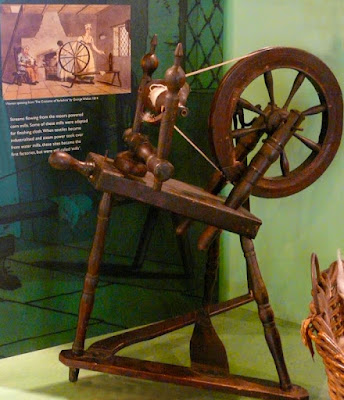
Spinning was the final stage in converting wool to worsted yarns which could be woven. The machines drew out the roving to its final thickness (count) and added twist for strength (just like a hand spinning wheel does). There are three main types of spinning machine (flyer, cap and ring) but they all work on similar principles and mainly differ in the way the twist is made and the yarn wound onto bobbins

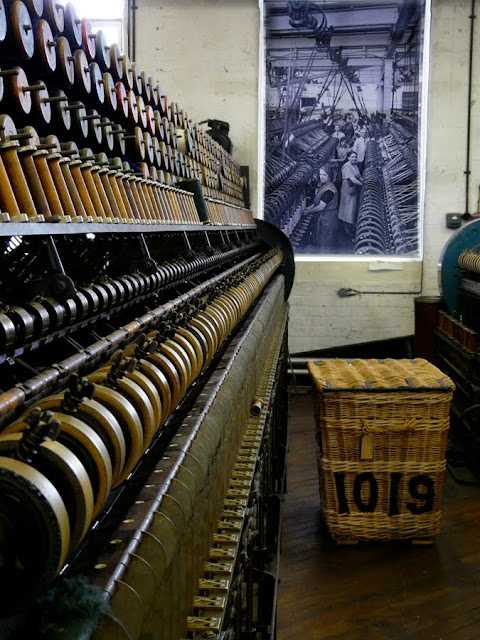
When I think of a textile mill, I suppose it's the spinning machines that I imagine. They would have been tightly packed together and the noise from them would have been incredible. From the picture of the mill on the wall above, you can see how narrow the aisles between the machines were. I imagine that the children, for so long employed in these mills, would have been very useful - their smaller bodies would have more easily been able to move under and around the machines.

The industry gave rise to some wonderful names for the different trades. One of my favourites is a 'bobbin ligger' - the person who put the bobbins on the spinning frame that filled them with thread. The 'bobbin doffers' would take the full bobbins off the spinning machines.  

There are some of Ian Beesley's wonderful photos of people doing these jobs HERE


Monday, 20 January 2025

Repost: A history of the wool textile trade in Yorkshire #5


Bobbins:

Drawing was the process by which the combed 'tops' were gradually reduced from thick slivers of wool to a 'roving' from which yarn could be spun. The wool passed through a series of machines with rollers, each designed to play its part in the gradual drawing-out process. You can see the difference in the thickness of the wool between yesterday's top balls and the bobbins in this picture. To give some idea of scale, each of these bobbins is about a foot (30cm) high. (Isn't 'bobbins' a lovely word..?) But the wool is still way too thick for weaving and has no twist to make it strong.

Saturday, 18 January 2025

Repost: A history of the wool textile trade in Yorkshire #4


Top balls (!):

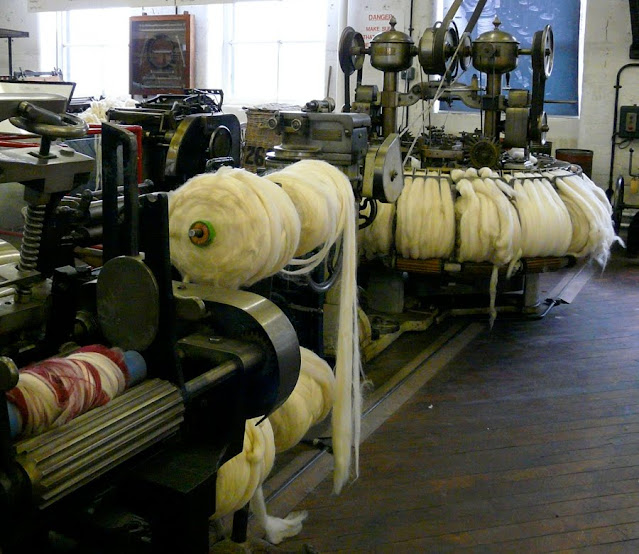
The next stage of the worsted manufacturing process was Top making or Finishing. The wool slivers were further treated to make them a uniform thickness and moisture was added to enhance the suppleness of the wool. The Top ball produced was the woolcomber's finished product and the Tops could be packed and transported like this. 

Many of the textile mills in Bradford specialised in just part of the overall manufacturing process - woolcombers or spinners; whereas Salts Mill was such a huge enterprise that it saw the complete process through from end to end - from raw wool to the finished worsted cloth. 

That had been Sir Titus Salt's vision for Salt's Mill and village, to concentrate all the processes from his various mills in Bradford into one enormous factory. He bought the land, on a greenfield site well away from the filth of disease-ridden central Bradford, and, in the 1850s, set about creating a much healthier place for his employees to live and work. 

Friday, 17 January 2025

Repost: A history of the wool textile trade in Yorkshire #3


The Noble Comb:

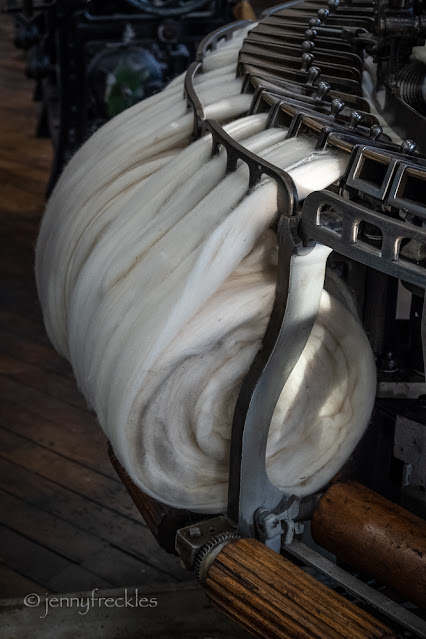
The sorted wool was scoured and washed to get rid of dirt and impurities. It was then prepared (the equivalent of carding, which couldn't be used because it would break the long fibres needed for fine worsted). By this means the fibres were disentangled and aligned more or less parallel, in long 'slivers' of wool. These were then ready for combing, a process which further straightened the fibres and sorted out the long ones (tops) used for worsted, from the short ones (noils) which couldn't be used. There were various types of combing machine. The one in my photo is called a Noble comb and Salts Mill would have had many of these.


Funnily enough, the Shipley pub where we sometimes used to have get-togethers from work is called The Noble Comb. Until I went to the museum, I hadn't realised where the name originated. I think there must be a lot of pubs in this area whose names relate to the wool industry. There is, of course, the famed Woolpack in the TV soap Emmerdale. (Maybe I'll go on a pub name hunt one day!)

When Salts Mill was opened in 1853, a grand banquet took place in the Combing Shed - there were over 3,500 guests, so you can imagine how big the room is. 

Wednesday, 15 January 2025

Repost: A history of the wool textile trade in Yorkshire #2

Wool sorting:

The processes of producing worsted cloth in a factory are essentially the same as those carried out by the local cottage producers - preparing and cleaning the wool, carding, spinning, weaving and finishing the cloth. The difference lies in the industrial scale of the operation and the huge size of the machinery used. Bradford's Industrial Museum has examples of many different types of machine with displays explaining the processes. Since the museum building, Moorside Mill, was once a small worsted spinning mill, it's easy to imagine how Salts Mill might have looked inside - though Salts was massive in comparison.

But even in the big mills, until as recently as the second half of the 20th century, the initial processing was done by hand. When the raw wool fleeces were brought in, the wool was first hand-sorted by quality and condition. The sorted fleece was tossed into huge wicker skips beneath the workbench. Wool sorting was a highly skilled trade using sight and touch. Woolsorters were proud to pass their unique knowledge down from father to son, often through several generations.


The wool textile trade locally has diminished significantly since the latter part of the 20th century, but there are a handful of mills still producing specialist cloths. A few years ago I worked near a mill and noticed these large sacks of raw wool still being delivered. 


Tuesday, 14 January 2025

Repost: A history of the wool textile trade in Yorkshire #1


Given the weather recently, I haven't been getting out to take photos. It seems a good opportunity to revise and repost a series I compiled in my early days of blogging, about the history of the wool textile trade, which underpins the creation of Saltaire.

A history lesson:  

When I was wandering round Salts Mill recently, I got thinking that - much as I love the mill and Saltaire in its present incarnation, and enjoy uncovering its history - I really know very little about the processes that went on in the mill during its time as a worsted manufacturer. There are the paintings by Henry Carr (see HERE) which give some idea, but hardly the full picture. In the interests of research therefore, I took myself off one day to visit Bradford's Industrial Museum, to find out more about the woollen and worsted industry, upon which the fortunes of this area rose and fell. Their displays are fascinating and I learned a lot.

Bradford was originally a small town, granted a charter in 1251 by King Henry III that enabled it to have a weekly market. This was an important development as it became a meeting place where people could buy and sell cloth. Poor conditions in the area for growing crops meant that local farmers subsidised their income by weaving cloth. People could now buy local wool to card, spin and weave it into cloth to be sold for a profit at the market. Initially this was a cottage industry carried out in people's homes. Many of the old weavers' cottages hereabouts have large windows in the upper storey, as good light was important for handloom weaving. The area is criss-crossed with packhorse routes along which people from the moorland villages would carry their cloth down to the markets. Eventually some of the local corn mills, powered by streams coming down from the moors, were adapted into small mills for making cloth.