Earlier posts

Earlier posts
This blog is a continuation of an older one. To explore previous posts please click the photo above.
Showing posts with label coal mining museum. Show all posts

Saturday, 24 September 2022

Machines (mostly)


There is lots to see above ground at the National Coal Mining Museum, with some of the original machinery still working and sheds full of vehicles and machines, archived for posterity. You begin to realise that, when our mines were gradually closed, it signalled the end of an era not just for the miners themselves and their communities but for whole swathes of British manufacturing capacity that supported the industry.

I found it interesting to try to pick out small photographic compositions from the machinery. 


Not a machine of course, but included just because he was cute, a little Welsh pit pony called Ernie, one of four retired pit ponies still kept at the Museum. They spend much of their time grazing in fields around the museum but are brought in to stables so that visitors can see them and learn about their lives. 


Friday, 23 September 2022

Life underground


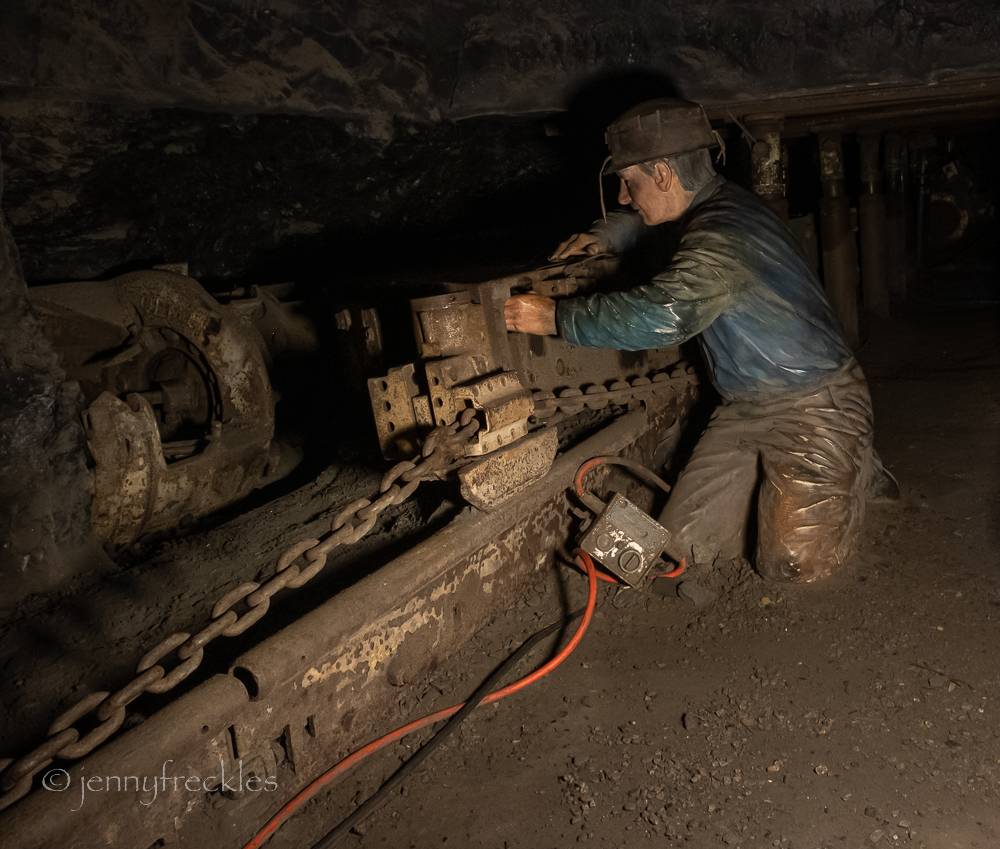
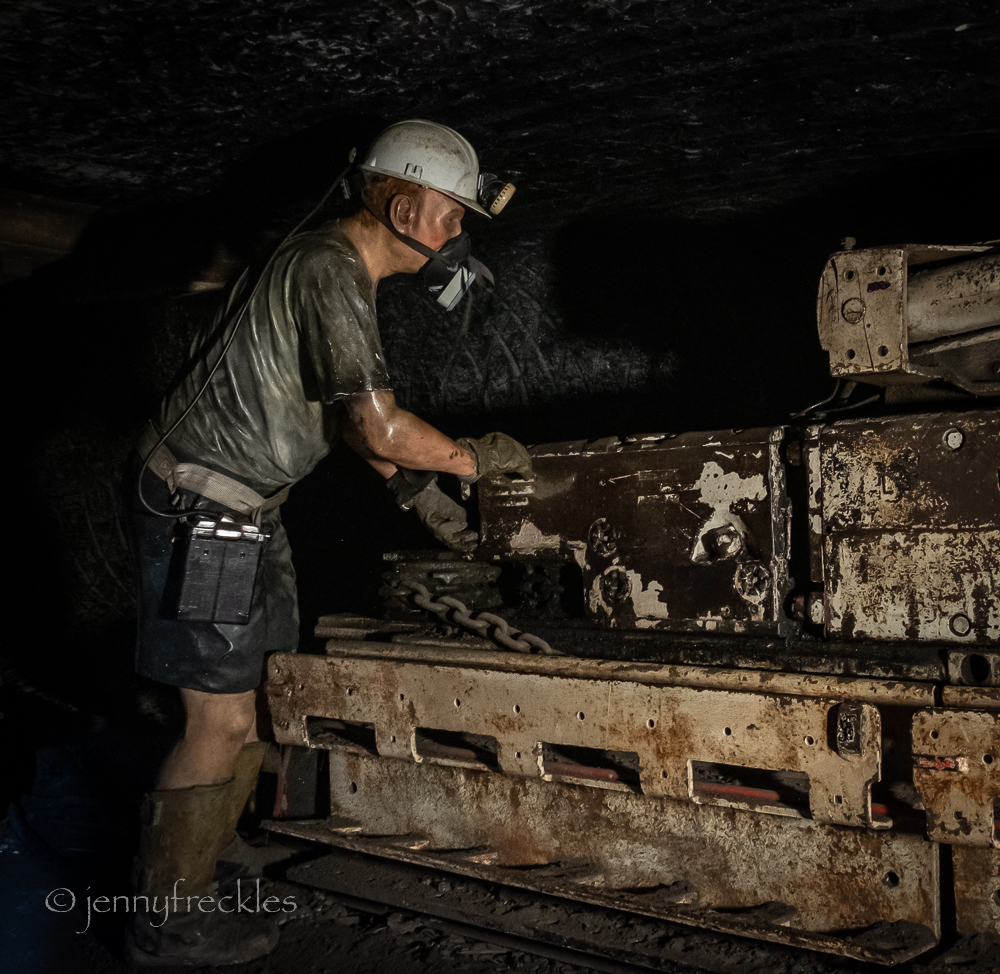
Because of the risk of sparks, visitors to the National Coal Mining Museum are usually banned from taking anything containing batteries on the tour below ground: cameras, phones, watches, car key fobs and suchlike are all surrendered at the pit head. Our camera club had negotiated a special private tour, and we were allowed to take with us down the mine our cameras, with batteries installed and switched on above ground, plus a tripod. We were all given safety helmets and small lamps and had to wear face masks too. Crammed together in the clanking lift cage with its mesh sides, I got a real taste of what my forebears must have endured every working day. The guides are themselves ex-miners and have very interesting tales to tell (though of course my deafness does not help when someone has a mask on. I couldn't lip read him, so I couldn't decipher much.) It was really dark so lighting for our photos was tricky - the supplied lamps didn't throw much of a beam. I was pleasantly surprised how well some of my images came out, after some careful processing, considering the gloom and the difficulties of positioning when there were a dozen of us in the same space. 

The tour passes round a circular route through tunnels, some wide and quite high and others very narrow where you had to duck under beams and doors. I was glad of the hard hat! It is broadly arranged so that you walk through a timeline from the earliest days of deep mining through to the later, mechanised operations. There are various vignettes set up to illustrate life below ground. 

In the early days it was common for women and children as well as men to work full shifts (12 hours) underground. Children could squirm into tinier spaces and were also employed to load and haul baskets of coal. Little ones as young as five were tasked with opening and closing the doors that allowed air to flow through the mine (see photo above). They sat for hours alone, with only a small lamp for light, which often burnt out. Read some of their stories HERE. It was not until 1842 that an Act of Parliament forbade the employment of women and children under 10 underground, though many women evaded this and continued to work illegally,  and they were still able to work at the colliery above ground. My own great grandfather was working as a miner aged 16 in 1881 and on the same census sheet one of the miners is shown as aged 14. 

When children were banned, mines started to use sturdy pit ponies to haul the loads of coal. The last of them was retired in the 1990s. Many of them lived for months on end in stables underground, only seeing daylight for a short break every now and again, though I think they were generally well looked after.


Miners worked in the dim light, using picks, shovels and brute force in the early days to hack coal from the seams. The tunnels were often so narrow they had to crawl and work lying down. In the 1920s/30s, mechanisation crept in. Pneumatic drills (using compressed air) had the advantage of not being likely to spark, and became the tool of choice. Read about a miner's day in the 1930s HERE.  (I found this article and photos really interesting, illuminating the life my ancestors led.) 


Coal was placed in tubs on tracks to be transported and, later, conveyor belts made the the moving around of coal and waste rather easier. 


Eventually larger drilling machines and 'ploughs' that scraped the seams made the extraction of coal quicker and easier, but of course needed men not only to work them but to install and maintain them. As a child, I remember being taken to the annual miners' galas in the 1950s/60s. There would be tents with displays and mock-ups of mines, and arrays of huge machines that looked (to a child) like menacing creatures, maybe dinosaurs or deep sea creatures, with rows of enormous teeth! Impressive.  


Thursday, 22 September 2022

Our mining heritage


Pit headstocks like those above used to be a common sight across Nottinghamshire and Yorkshire when I was young. We could see half a dozen of them from our back garden at my family home. They are the winding gear for the lift cages that took miners up and down to the deep coal seams. The last deep coal mine in the UK, Kellingley Colliery, closed in 2015 and there are now just a handful of open cast and small privately owned mines operating (although approval has been given recently for a new deep mine under the Irish Sea). Thankfully, some of the heritage has been preserved, notably at Caphouse Colliery, the National Coal Mining Museum, which is about 40 minutes drive from here. My camera club arranged a photography trip there, so I went along, although I've visited a couple of times before. There is lots to see above ground but the highlight, of course, is a tour below ground through part of the mine itself. 

Honouring the heritage is important for me. I grew up in a mining town in Nottinghamshire and my maternal grandfather and both my great-grandfathers on my mother's side of the family were miners, as were legions of their male relatives. Their careers spanned the period from the 1870s right through to the end of the Second World War. Mining was a 'reserved occupation' so they were at least spared conscription, though it was a tough and dangerous option and they all suffered respiratory problems in later life. My granddad had to leave the mines due to ill health and became a bus driver for a while but was crippled with chronic bronchitis and emphysema and died relatively young, at 66, as a result. 

Mines were originally privately owned by wealthy landowners, until the government nationalised the industry in 1947 after WWII. Safety was patchy and often poor and there were notable pit disasters. Safety lamps were invented in 1816 to try to prevent explosions caused by naked flames igniting 'fire damp' (methane gas). Even after electric lighting was introduced, flame safety lamps were still used to test for gas down the mines. I rather like them and the museum has quite a collection. I'd quite like one as a reminder of my family history; I might buy one one day. They come up for sale online.  

The museum illustrates some of its history with a few models of workers at strategic points. This one, sitting in the office at the weigh-bridge where loaded coal lorries were weighed, looked so realistic, with his pen and his sandwich, that at first I took him for an actual person!  

Clearly not an actual person but nevertheless a realistic and poignant depiction, this sculpture of a miner is displayed in the Museum's entrance: