Earlier posts

Earlier posts
This blog is a continuation of an older one. To explore previous posts please click the photo above.
Showing posts with label Nidderdale. Show all posts

Friday, 21 June 2024

More from the Himalayan Garden...


... just because it's so beautiful, with its engaging mixture of lush garden views, trees, planting and sculptures.

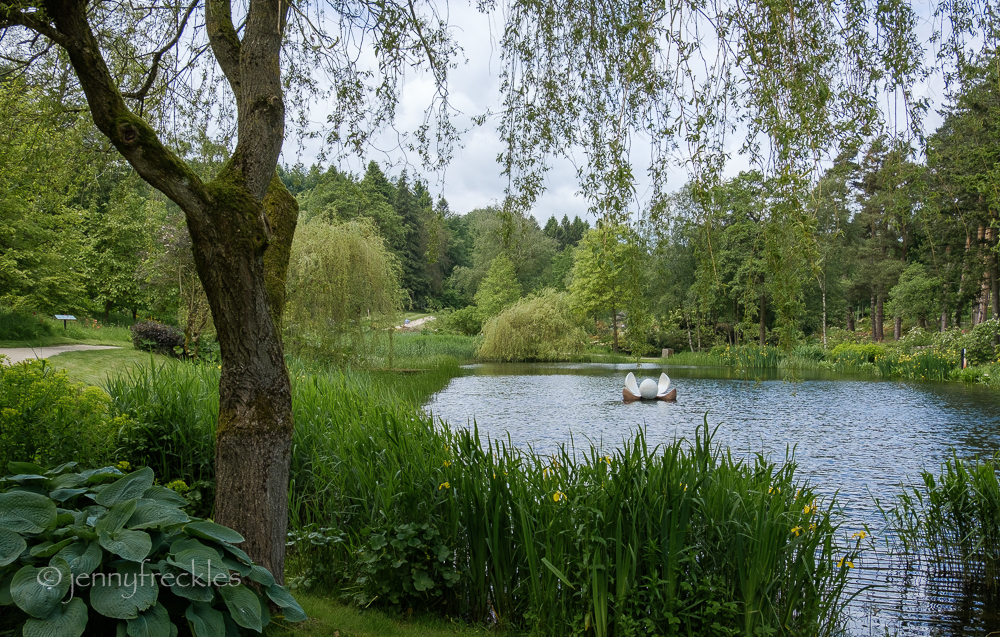
The Ting Pagoda is in fact classed as a sculpture, by David t'Hoen, and sits at the end of the Magnolia Lake, called after the magnolia blossom sculpture (Rebecca Newnham) floating on its surface. 

One of my favourite artworks is the exuberant Red Scarf (Carol Peace) whose coppery surface wonderfully catches the light. 

Oceanus, one of three pieces by Magda of Magdooska Creates, was a creative use of recycled glass and a bicycle wheel, which I rather liked.  


Love-in-a-Mist (Michael Kusz), the common name of a Nigella flower, was an attractive rendition of a flower that has a very complex structure. 


The few remaining azaleas in flower offered bright punctuations in the landscape. Blue iris were one of my mother's favourite blooms, glorious in colour and themselves quite sculptural in form. 


The metal stork and herons beside the lake were by an unnamed Zimbabwean artist. 

Thursday, 20 June 2024

'Bursting from the Slumber'


Ilkley-based sculptor Anna Whitehouse has overseen this installation of Himalayan Blue Poppies tumbling down a hillside, at the Himalayan Garden. Its creation was impacted by the Covid pandemic but, when people were allowed once again to gather together, over 1300 ceramic poppies were handmade in workshops in schools, colleges and community groups, then glazed, fired and assembled into this riverlike cascade. The artist comments that 'it is a symbol of re-emergence and the power of community'. The makers were able to relax and socialise whilst engaged in a soothing and tactile creative activity. Each poppy has been personalised by its maker, with messages of freedom and the names of family, friends and, in some cases, those they lost to the Covid virus. 


Tucked away in the garden were some real Himalayan Blue Poppies (Meconopsis) too. Rare in the UK and apparently difficult to grow, they need moist conditions to flourish and have a short flowering season. They are unusual and rather pretty, with a slight pink flush to their blue petals. 

Wednesday, 19 June 2024

Ways of relaxing?


Different ways of relaxing, perhaps? 

Thai Buddha (artist unknown)


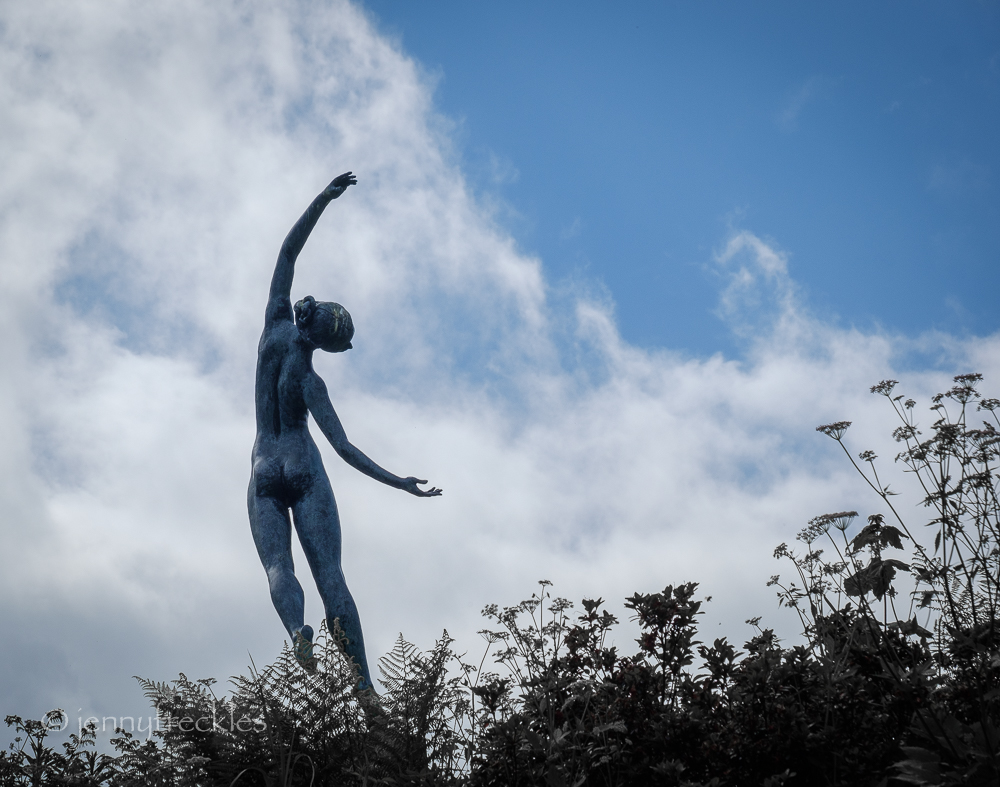
Juliet - Study of a Dancer (Tom Merrifield)


A Brisk Walk (Simon Conolly)

All photographed at the Himlayan Garden and Sculpture Park near Ripon, North Yorkshire.

Tuesday, 18 June 2024

'The Ocean comes to Yorkshire'


I enjoyed this installation at the Himalayan Garden: 'The Ocean comes to Yorkshire' by Subodh Kerkar from Goa in India. Kerkar, an artist, activist and former medical professional, uses shells, pebbles, sand and leaves, often in situ on the seashore, to create ephemeral land art installations. Here, he's used cowri shells which were once employed as currency. The carved poles and suspended disc celebrate the ocean 'as a medium of cultural diffusions' (whatever that means!) Whatever meaning you take from it, I found it visually and photographically interesting.


Monday, 17 June 2024

Himalayan Garden and Sculpture Park


My first visit to the Himalayan Garden and Sculpture Park was in 2018 and I've been meaning to return ever since. I finally made it! Tucked away up in Nidderdale, between Masham and Ripon, the woodland gardens, now covering over 45 acres, were created by Peter and Caroline Roberts after they bought the land in 1996. The gardens are now in the care of a charitable trust. Since my last visit a lot more has been developed and there are many more sculptures, in both permanent and temporary displays. 

'Contemplation Circle' (Liam O'Neill) consists of five huge chairs, each carved from a single piece of timber. 


'Bullrushes/Reedmace' (Michael Kusz) was part of the Landscape Exhibition of pieces exploring the intersection of art and nature. 


'Roebuck Deer' is one of several realistic pieces by Hamish Mackie, who also created 'The Swift', which you can see below. 


The steep site originally had a few rhododendrons along the drive and they inspired a vision to develop the site as a Himalayan garden. It now has one of the largest collections of rhododendrons, azaleas and magnolias in the North of England. My visit was a little late in the season for the best showing of these cultivars. Most of the blooms were withered, though I still found a few bright spots of colour. 


'Fisherman Head' ( Christopher Marvell) is a quirky, humorous work, aptly sited by one of the lakes. 

'This is Not a Knot' ( Karin van der Molen) was another wry creation, suspended in the trees. 


'Magnolia' (Rebecca Newnham) floats serenely in another lake, to which it gives its name. 

Tuesday, 22 August 2023

The Coldstones Cut artwork


The Coldstones Cut is a public artwork that provides a safe viewing platform for the adjacent Coldstones Quarry (see yesterday). Created by Andrew Sabin and opened in 2010, it is a massive stone structure that feels like a medieval castle. As well as the viewing area it has sinuous paths through thick stone walls that culminate in two tower-like 'forts'. You can't determine its 'secret' on the ground. Only from an aerial perspective would you see that the whole forms a curious spiral structure, likened to snail shells or a woman's reproductive system. I like to think of it as the Earth Mother, watching over the men ransacking the quarry below for its treasure.   See HERE and scroll right down for this hidden view.


There are stunning views from up here. It's said that on a clear day you can see York Minster - but it wasn't a clear day! 


There is a sculpture of a bike up here too, commemorating the Tour de Yorkshire and the unforgiving climb up Greenhow Hill. By the time we were coming away, huge storm clouds were building. Thankfully we were safely ensconced in a café by the time the rain came but that did sadly put paid to any further plans for exploring the area. 

Monday, 21 August 2023

Tonka trucks


You may recall me mentioning earlier this year that I was planning a camera club outing to The Coldstones Cut artwork and the adjacent Toft Gate lime kiln remains. Well, it happened... but sadly for some reason the old lime kiln was securely padlocked and the area inaccessible. I had taken photos there before (see HERE) but it was disappointing that my fellow photographers couldn't access it, as it is interesting. 

The artwork at the brow of the hill was open to explore though (see tomorrow). It overlooks the Coldstones Quarry, owned by Hanson, part of the Heidelburg Cement Group. Here they produce 600,000 tonnes of aggregate a year, for major construction projects in the UK. It is one of the highest quarries in England and its workings are almost completely hidden from view from the surrounding area, as they are burrowing down deep inside a hill. From the viewing platform at the artwork, there was a good view of the big machines and the crushing facilities. Those big yellow trucks look like Tonka Toys from this height. You can see the levels where they are working to blast and extract the rock, which then gets trucked up to the top to be crushed into aggregate in the sheds. 


Wednesday, 29 March 2023

Brimham Rocks #3


Just a few more images from Brimham Rocks... The outcrop above is right beside the visitors' centre and refreshment area. The balanced stack in the middle is called the Eagle, though from this angle it doesn't look much like an eagle to me. 

The tree below has been photographed a million times!  It's a favourite haunt of the birds too. 


Personally, I liked the one below the best. It was much further out, on the perimeter walk, and so it is less well known. I loved the way the tree rises from the sinuous cleft in the rock, searching for the light and its freedom. Seen in winter, before it is obscured in leaves, the serpentine shape is pronounced. 

Tuesday, 28 March 2023

Brimham Rocks #2

The amazing rock formations at Brimham are thought to have been formed 325 million years ago. That's 100 million years before the first dinosaurs walked the earth! (There was a time when they were assumed to have been carved by druids.) They are made of millstone grit, a coarse grainy sandstone that was deposited by immense rivers, before being exposed and weathered by glaciers, water and wind.  

Over the years many of them have acquired names, though it's often hard to see exactly which rock is referred to. Those above, I think, include the Anvil and the Porpoise Head. I know the one below, miraculously balanced on a tiny point, is the Idol Stone. A similar balanced stone was pushed over and smashed by vandals a few years ago... so these will not last forever, whether eroded by weather or by mindless idiots! 

This one is called The Dancing Bear - maybe you can see its head and snout. 

Not sure of the name of these but, from one angle, they looked to be having a smooch. You can imagine all sorts into the shapes - I see a dog's head there on the right. 

Maybe a dinosaur's head? 

Somewhere in this region is one known as the Druid's Writing Desk. I thought it may be this one below, which certainly had a flat surface. Looking at photos online since I've come home, however, I don't think I'm correct. It's interesting how the rocks appear from different angles. Looking one way you can immediately see the 'character' and from another direction it looks like... well... just a rock!  


It is a fascinating place to wander. Children love it, plenty of scope for climbing. I have a photo of my granddaughters sitting in a hole in a rock where I have a similar photo of their mother, my daughter, sitting when she was little. Happily for families ( and my camera club outing!) there is a small refreshment kiosk and toilets in the centre of the site, so chance for a rest and an ice cream when needed. 

Monday, 27 March 2023

Brimham Rocks

The Coldstones Cut camera club outing will be combined with a visit to Brimham Rocks, a locally famous outcrop of fantastically shaped rocks, weathered by wind and water for millions of years. The site is an SSSI and is now managed by the National Trust. It gets overrun with visitors in the school holidays and at weekends but on a cold, damp afternoon in February there were only a handful of people there. It is criss-crossed by marked trails and I chose to explore the Woodland Walk, which takes you past a lovely pond, then around the perimeter of the site, giving good views over Nidderdale, and then through the rocky area back to the car park. 


Many of the rock formations have been given names over the years and I'll show a few tomorrow.