There are several trails you can follow through Hackfall Woods, meandering up and down the hillside and offering surprise views of the river and of various follies, built in the 1700s by the Aislabies when they created this woodland garden. The ruin in the photo below is called Fisher's Hall, probably after William Fisher, one of the Aislabies' gardeners. These 'romantic' follies were designed to attract and delight 18th century visitors, offering places to rest and enjoy the views. One of them, The Ruin, a tiny banqueting hall, has been restored by the Landmark Trust as one of their unusual and historic holiday lets. See HERE.
Sunday, 14 May 2023
Saturday, 13 May 2023
Hackfall's plantlife
Hackfall Woods were full of bluebells, not quite in full bloom but still very pretty.
Down by the river, kingcups (sometimes called marsh marigolds) made vibrant yellow splashes.
Ferns were unfolding their little fiddle heads. I vividly recall learning the very complicated life cycle of ferns in school biology. Quite astonishing.
Young beeches seem reluctant to part with their leaves, now faded to a dark, metallic bronze, until the new shoots unfurl.
Numerous little brooks tumble down the hillside into the river, through a miniature world of lichens and mosses, ferns and serpentine fronds of tiny leaves.
Friday, 12 May 2023
Hackfall Woods
Hackfall Woods was a new area for me to explore. About 30 miles from Saltaire, just south of Masham in lower Wensleydale, the River Ure winds its way through a gorge. It appears to be a natural landscape but was in fact largely designed in the 1700s by the Aislabies, who were also responsible for creating the landscape and water gardens at nearby Fountains Abbey and Studley Royal. They turned an existing semi-ancient woodland into a pleasure garden, with surprise views, follies, a lake and fountains. It was popular with tourists in Victorian times and then fell into decline. Logging operations in the 1930s destroyed some of the trees. It was rescued in the 1980s by the Woodland Trust and the newly formed Hackfall Trust, who have spent much time and money, including a large Heritage Lottery grant, to rescue and restore it into what is now a Grade 1 listed wild garden. It still doesn't seem all that well-known. I've lived in Yorkshire for years and only recently discovered it.
From just beyond the car park, there are wonderful views, with Mowbray Castle (one of several follies) peeking through the trees. At this time of year, it's noticeable how some trees are well cloaked in leaves whilst others are just beginning to green up.
Down by the river, there are a few areas of sandy beach with evidence of 'landscaping' not only by the Aislabies but by the forces of water and nature, and the attentions of today's visitors.
Wednesday, 6 April 2022
Jervaulx Abbey
Jervaulx Abbey, in Wensleydale, is one of our smaller ruined abbeys. Originally a Cistercian monastery (like Fountains Abbey, though much more modest) it became renowned for breeding horses (a tradition that still continues in the area around Middleham) and Wensleydale cheese was first made here by the monks, initially from sheep's milk and later from cows' milk. (It is now made mainly at a creamery in Hawes.) The abbey was abandoned at the Dissolution of the Monasteries by Henry VIII in the 1500s. It became part of the grounds of Jervaulx Hall and remains in private ownership, kept as a romantic ruin.
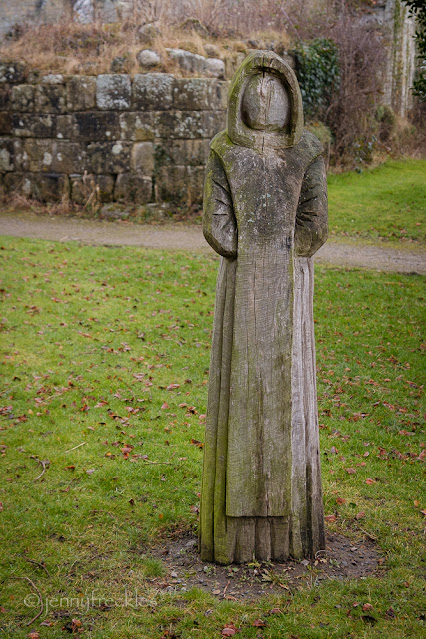
It used to have a rather nice tearoom, but that seems to be closed now. Perhaps Covid undermined that operation. It must be very hard to maintain such a significant monument without the support of the National Trust or English Heritage. There was no-one around (apart from a small wooden monk!) and entrance fees are simply paid into an honesty box. Quite pleasant to wander around for half an hour or so, even on a dull, damp day.
Tuesday, 5 April 2022
Castle Bolton
Sadly, the weather on the third day of my break didn't improve... still drizzly, misty and dull. I ventured up to Castle Bolton, just to see the area, though it was all closed for the winter. The village is called after the medieval Bolton Castle, built in the late 1300s and still owned, remarkably, by descendants of the Scrope family, the original owners. Mary, Queen of Scots, whom Queen Elizabeth I saw as a threat to her rule, was imprisoned here for six months in 1568, before being removed to Tutbury where she spent most of the last 18 years of her life until her execution in 1587. It doesn't sound like too harsh an imprisonment, as the castle was made more comfortable for her and she had a retinue of at least 50 knights, ladies and staff, most of whom lodged in the surrounding village. She was also allowed out to go walking, riding and hunting. The castle was later damaged in the English Civil War, after a siege lasting a year.
Nowadays it is run as a heritage centre, with family days, falconry displays, a café and a shop and it is available for weddings and private events. Maybe I'll go back sometime when it's open.
The surrounding village is quite attractive, as is the small church of St Oswald (very damp and musty inside!)
Monday, 4 April 2022
Dales Countryside Museum
I was deeply impressed with the bronze spearhead (above), about 9 inches long, possibly a votive offering made in the Bronze Age (between 4000 and 2000 BC) and found in Semerwater, a nearby lake. Wow, wow, wow! It is absolutely beautiful, with such lovely detailing.
I learned of the importance of knitting in the local communities, done by men and children as well as women and quite a sociable, community activity. I also learned that there is such a thing as a 'knitting stick'. A knitting stick (seen in use above) is a tool used by knitters to secure one needle and take the weight of their knitting. These handy little gadgets help serious knitters to knit quickly (some can knit as fast as three stitches per second - that is 180 stitches per minute!) and also makes it easier for them to knit on the move, while they are walking around. There were many examples on display, mostly wooden, turned and carved with personalised symbols.
There was a display about lead mining (above), which I found interesting in the light of my recent exploration of the lead mines above Grassington and another exhibit about peat cutting, peat being used extensively as fuel for homes and industry.
All very fascinating - I could have spent longer exploring and there was a lot to take in.
Sunday, 3 April 2022
Gayle
As the day wore on the weather got even worse! I headed for the market town of Hawes, where at least there are places to go inside. Just up the road behind Hawes is the village of Gayle, sitting on either side of Gayle Beck which flows steeply down to Hawes in a series of falls. (I told you there were a lot of waterfalls in this area of the Dales.) Originally a farming settlement, it grew in the late 18th century as quarries and coal mines opened in the area. The beck also provided the water power to drive Gayle Mill, built around 1780 as a cotton-spinning mill and converted to a sawmill in 1878. After featuring on the TV programme Restoration in 2004, it was indeed restored and functioned as a working sawmill, where they ran workshops and sought to preserve the old, heritage skills. It was closed in 2018, though I have been on a tour of it in the past. (See HERE). The Gayle Mill Trust still operates out of other premises, so I'm not sure if the Mill will reopen or not.
The village centre is a Conservation area, and has several old buildings like Old Hall below, with a date stone of 1695.
Saturday, 2 April 2022
A Dales church
Hardraw, near Hawes, is a tiny hamlet with just a few stone houses, a church, the pub and the visitor centre for the waterfall of Hardraw Force. Its church of St Mary and St John is charming. Consecrated in 1880, it is a memorial to the brother of the 1st Earl of Wharncliffe, and replaced an earlier Chapel of Ease. It's Grade II listed and, perhaps because of its relative youth as churches go, it was refreshingly free of the damp mustiness you associate with old churches. It was raining hard when I visited, which may explain why I unaccountably failed to take a photo of the exterior. I rather liked the snowdrop-framed view along Hardraw Beck though. (Could swear I heard the water sighing with relief that it had survived its 100 foot drop down the Falls. Ha!)
Our tiny churches often hold treasures and this one had a rather stylish stained glass East Window, dedicated to the memory of one of the former vicars, Rev'd Robert Pinck, who was incumbent here for nearly 60 years, from 1854 (aged just 30) until he died in 1913.
There was also a modern wood carving of Joseph, Mary and the baby Jesus (though not the wee donkey!) that I rather liked.
Friday, 1 April 2022
Behind the Green Dragon
Tucked away behind the Green Dragon pub at Hardraw there is an exquisite little valley, narrow and meandering, with a secret at its core. The stream is Hardraw Beck, crisscrossed by bridges and with paths penetrating up the gorge.
At the head of the gorge is the secret: Hardaw Force, the longest single drop waterfall in England (above ground) at 100 feet high. It was certainly impressive after recent rains, and the drizzle and mist only added to the drama. The waterfall stars in 'Robin Hood: Prince of Thieves', in a scene where Maid Marian catches Robin Hood bathing under it. (I really needed Kevin Costner there in my photo - to give scale, you understand.)
The valley is privately owned and has a quirky café at its entrance, with a helpful weather station that only confirmed what I already knew - that it was raining! The gorge has such remarkable acoustics that a brass band festival takes place here each year (pre-Covid anyway) and other musical events are also staged.
Thursday, 31 March 2022
One misty, moisty morning
(Back to the mini-break in early March)
'One misty, moisty morning' is the title of a 1973 Steeleye Span song that still plays in my head from my student days. It was apt for the second day of my mini-break in Wensleydale, when the blue sky disappeared and left drizzle and a cold, damp mist hanging in the valley. It was atmospheric though, and not much can spoil the beauty of those stone barns and rambling drystone walls.
On the road between Askrigg and Hawes there is a stand of trees on top of a hill that caught my eye, with random walls meandering across the slopes. I think I prefer the mono version, though the way I've processed it makes it look less misty.
Saturday, 26 March 2022
Aysgarth Falls
I hope you're not tired of seeing waterfalls! There seem to be as many in this area of the Yorkshire Dales as there are in Iceland, though perhaps not quite so spectacular. The light was fading by the time I arrived at perhaps the most famous of them - Aysgarth Falls. In fact along this stretch of the River Ure there are three sets of falls - Upper, Middle and Lower, all within a half a mile or so of each other and all quite easy to access. My photos show the Upper Falls.
By the way, the dale is called Wensleydale, after a village, rather than Uredale after the river, which is a departure from the style of most of the other Yorkshire Dales. There are, however, several places that have Yoredale in their name, harking back to the older name.
The amount of blur a waterfall photo needs is a matter of personal preference, I guess. I quite like the milky effect of a long exposure, as it suggests the motion of the water tumbling down.