Wednesday, 28 January 2026
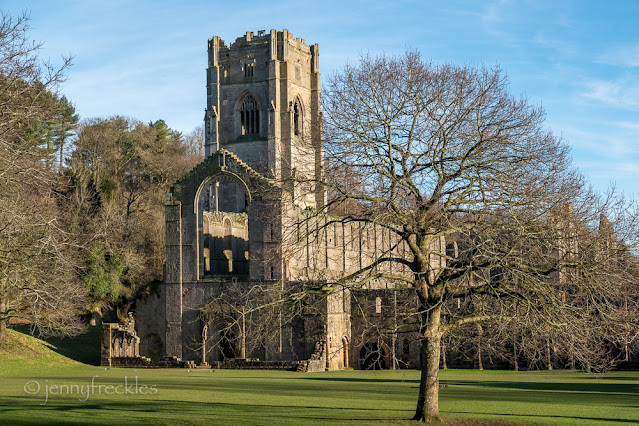
Fountains Abbey
Saturday, 29 June 2024
Foam patterns
Friday, 28 June 2024
Seven Bridges Valley Walk
Thursday, 27 June 2024
Studley Royal
Thursday, 5 May 2022
St Mary's and the boggarts
Beyond Studley Royal Water Gardens and the ruins of Fountains Abbey there is a deer park with a large area of grassland and some huge, ancient trees, some of which now lie fallen and decaying. In the middle is St Mary's Church, a High Victorian Gothic Revival masterpiece built in the 1870s by the architect William Burges. It was commissioned by the Marquess of Ripon as a memorial after a family tragedy.
I was interested by the echo of the church's shape in the semi-derelict tree in front of it. Closer inspection of the tree provided some wonderful boggarts (or perhaps gargoyles) lurking in the wood. See what you can spot. Pareidolia is alive and well here!
Wednesday, 4 May 2022
Studley Royal water gardens
Even though I visited Fountains Abbey fairly recently, on a sudden whim a friend and I set off for another visit there, to see photographs of the World Heritage Site taken during lockdown by the landscape photographer Joe Cornish, which are currently on display there. This time we spent more time exploring the Studley Royal end of the estate, rather than the abbey itself. The water gardens were laid out in the early 18th century by the landowner John Aislabie and his son, William. (See HERE). John's political career had foundered (he was Chancellor of the Exchequer and was implicated in the South Sea Bubble crisis) and he retired in 1720 to his Yorkshire estate, with a vision to impress visitors with a breath-taking formal garden, studded with classical statues, follies and garden buildings. William later bought the ruins of Fountains Abbey, conveniently next door, as a romantic ruin to complete the gardens.
Friday, 15 April 2022
On Good Friday
'God of love, we are disconcerted by the violence in our world, and especially now by the acts of war in Ukraine. Enable us to stand in solidarity with those who suffer, and who live today in fear and anxiety. Sustain the hope of all those who seek justice and peace. Send the Holy Spirit, the Spirit of peace, to inspire the leaders of nations and all human beings.' Brother Alois, Taizé
Saturday, 29 January 2022
Swanley Grange
Friday, 28 January 2022
Fountains Hall and Mill
After the Dissolution of the Monasteries by Henry VIII, Fountains Abbey was sold. Between 1598 and 1604 the new owner, Stephen Proctor, built a mansion in the grounds, partly constructed of stone from the ruined Abbey itself. It's a fine example of a late Elizabethan 'prodigy house': grand, showy houses built to impress.
It passed through the hands of several families and was later used to house evacuees from a school during WWII. It fell into dilapidation after the war and was restored by the National Trust in the 1980s. It is now one of the many fascinating, historic buildings that the National Trust rents out as holiday lets.
Close to Fountains Hall, there is Fountains Mill, a water mill built by the Cistercian monks in the 12th century to grind the grain to supply the monastery with bread and ale. It was continually in use until 1927, and was also used as a sawmill and a stone masons' yard. One of the waterwheels is still in working order. The building is apparently the oldest standing (non-ruined) building in England in the care of the National Trust.
You can still ring the bell that presumably reminded the lay brothers of their start and finish times, and perhaps the times of prayer during the day.
Thursday, 27 January 2022
Fountains Abbey
I'm sure many people knew that my 'tiny planet' yesterday was made from a panoramic shot of the famous Fountains Abbey, near Ripon, North Yorkshire, now in the care of the National Trust. A former Cistercian monastery, founded in 1132, it became one of the wealthiest monasteries in England by the mid-1200s, thanks to its extensive land holdings farmed by lay brothers, and sales of wool. It later suffered problems with disease in its sheep, raids by the Scots into the north of England, and finally the Black Death (1348-49) which decimated the population. The Dissolution of the Monasteries in 1539 was the end of that story, but the estate was sold to gentry and a mansion (Fountains Hall) was built, partially from stone from the Abbey itself. In the 1700s, John and William Aislabie linked the Abbey site with neighbouring Studley Royal to form extensive, landscaped water gardens and a deer park, with the abbey ruins as a romantic centrepiece. The whole estate is now a designated World Heritage Site.
There are lovely views of the ruins from the banks of the River Skell, which runs alongside.
Enough of the buildings survive to give a good idea of the size of the monastery and the use of its various parts.
The floor plan of the abbey church is clear, with the 49m high tower, added in the early 1500s, still largely intact.
To my mind, the most atmospheric part is the vaulted Cellarium, originally divided up into storerooms, whose pillars supported the lay brothers' dormitory above. I love its soaring arches and the play of light and shade.