Earlier posts

Earlier posts
This blog is a continuation of an older one. To explore previous posts please click the photo above.
Showing posts with label Yorkshire. Show all posts

Friday, 4 September 2026

Tea


That most English of things... tea. I must admit to drinking a lot of it. My preferred brand is, of course, Yorkshire Tea, processed and packed in Yorkshire, though - contrary to some of the jokey adverts - it isn't grown here! They source it (apparently) from farms in India and Africa. 

I was amused to see this poster (below) in a local café, playing on the endless debate about what 'colour' your cup of tea should be. I've a friend who prefers it somewhere between the second and the third cup on the chart. That's much too weak for me and I let her add her own milk and pour from the newly filled teapot. (I always use a teapot!) Then I let the pot stand and brew for a few minutes more as I like mine nearer to the fifth cup.  The ones on the bottom row are commonly called 'builders' tea'. Perhaps strong men like a strong brew. I had to look up 'Hendo's' - it apparently refers to 'Hendersons Relish', a spicy and fruity relish produced in Sheffield that's similar in appearance to Worcestershire Sauce. I'm not actually sure you could get a mug of tea to look as dark as the last two, certainly not with milk in it. Some people do drink it black, without milk, of course. 

It's been interesting to watch my granddaughters' progression towards tea. They were not offered it as little children and always preferred warm milk, even when they graduated from bottles and sippy cups. Maybe two or three years ago, the older one moved on to enjoying tea, and now makes quite a decent brew herself. The younger one still seems to prefer milk or juice but will sometimes try a cup of weak, milky tea. It must be an age thing! 

Friday, 10 July 2026

Another day, another canal


I went to visit a friend who lives near the Calder and Hebble Navigation. It's a unique waterway, quite different from the Leeds-Liverpool Canal (LLC) that I'm more familiar with. The Navigation is based around the Rivers Calder and Hebble. By the year 1700, they had created 'canal cuts' in places where the rivers are winding or have weirs. These canal cuts allow boats to bypass those tricky sections. It means sometimes you find yourself walking along the river and other times on a stretch of canal. This makes the waterway quite complex, with floodgates to protect the canal sections and locks to adjust the heights between the rivers and canals.


It's more urban than many parts of the LLC too, though still quite attractive in some areas. It has a few marinas, with the usual mix of hire boats, well-kept narrowboats that are used by their owners for leisure and adventures, and quite a lot of smaller, scruffier craft. Those often belong to people who've fallen on hard times and find a boat a more affordable living solution than bricks and mortar. 


Unfortunately, our planned walk was interrupted by the closure of the waterside path, due to the Transpennine Route Upgrade (TRU). This is a major project to upgrade the railway across the north of England between Manchester and York. The TRU aims to increase capacity by adding extra track, electrifying the entire route, introducing digital signalling, and upgrading stations. It's a huge and costly project. We came up against a large working area, where they are moving and rebuilding Ravensthorpe Station. 


It meant we had to abandon the waterway and strike off along the busy main road, though thankfully after a while we did manage to find a route that led us through quieter woodland and eventually back to the canal towpath. 


It was a good walk, adding another 6 miles on my 'steps app'. My phone must wonder what's going on, since this month I've done many miles more walking than I usually average! 

Thursday, 7 September 2023

Baildon


Baildon sprawls its way up the hillside towards Baildon Moor, just to the north-east of Saltaire. Originally a small village with ancient origins as far back as the Bronze Age, it started to grow during the Industrial Revolution and is now designated a small town (since 2013), as the area has been infilled with a vast amount of housing. Having a railway station with links to Bradford and Leeds, it is very much commuter-territory and the house-building continues. 

The town centre, towards the top of the hillside, still has some older buildings. The centre is now more or less a huge roundabout but it is here that the 'potted meat stick' is sited. (Its name comes from its mottled pink stone, which resembles that foodstuff - see below.) Given to Baildon in 1862, it was a drinking fountain and memorial to Frances Ferrand, one of the Holdens, a leading Baildon family. Community spirit is still strong here, with several busy cafés, various churches, independent shops, a farmers' market once a month and all sorts of sports and activities. 


Friday, 23 September 2022

Life underground


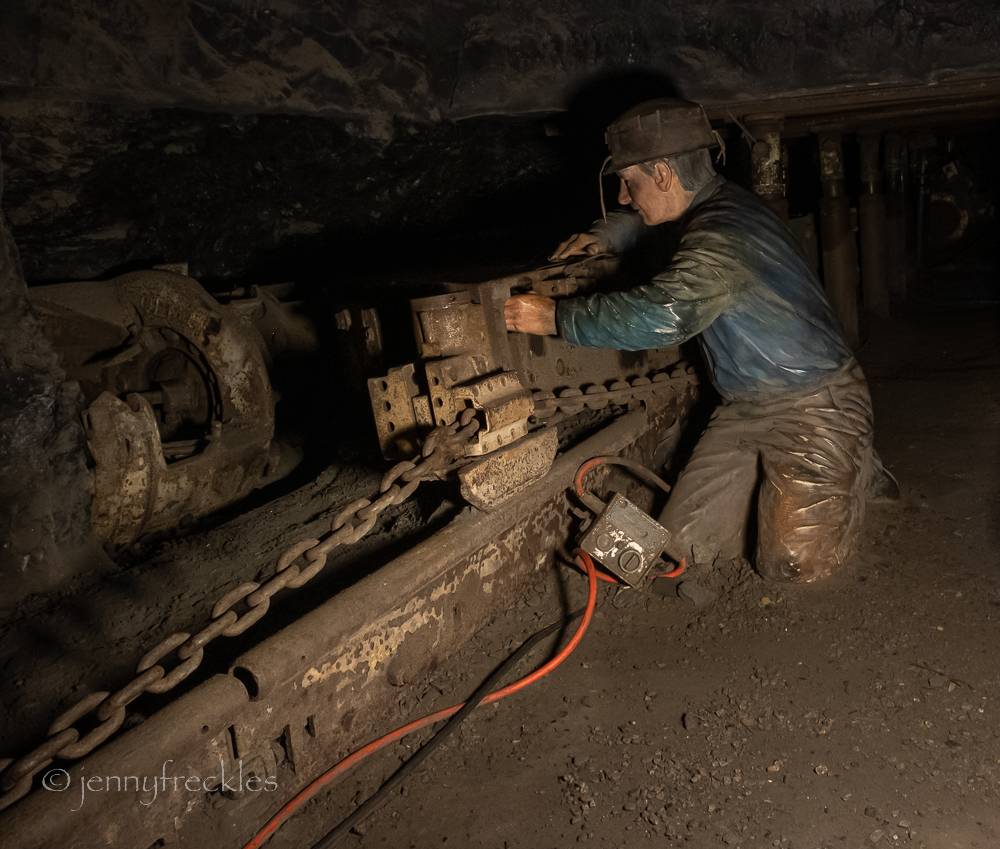
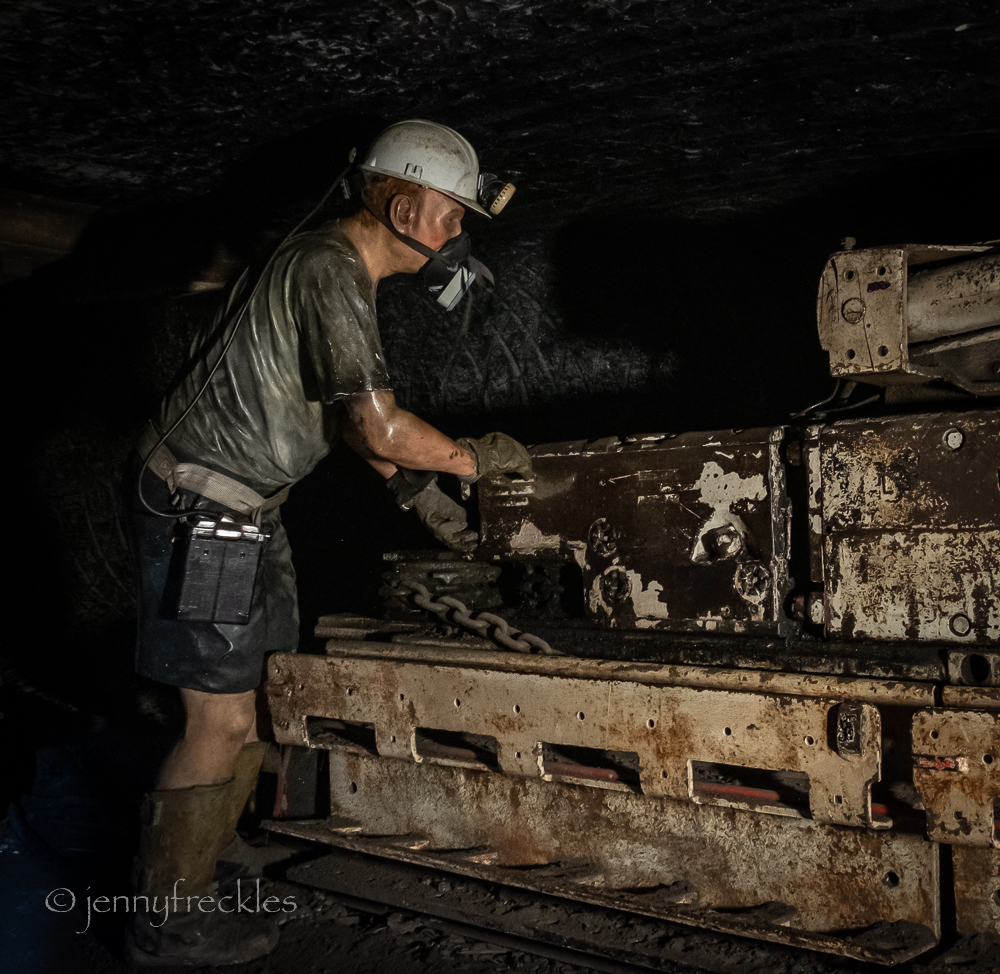
Because of the risk of sparks, visitors to the National Coal Mining Museum are usually banned from taking anything containing batteries on the tour below ground: cameras, phones, watches, car key fobs and suchlike are all surrendered at the pit head. Our camera club had negotiated a special private tour, and we were allowed to take with us down the mine our cameras, with batteries installed and switched on above ground, plus a tripod. We were all given safety helmets and small lamps and had to wear face masks too. Crammed together in the clanking lift cage with its mesh sides, I got a real taste of what my forebears must have endured every working day. The guides are themselves ex-miners and have very interesting tales to tell (though of course my deafness does not help when someone has a mask on. I couldn't lip read him, so I couldn't decipher much.) It was really dark so lighting for our photos was tricky - the supplied lamps didn't throw much of a beam. I was pleasantly surprised how well some of my images came out, after some careful processing, considering the gloom and the difficulties of positioning when there were a dozen of us in the same space. 

The tour passes round a circular route through tunnels, some wide and quite high and others very narrow where you had to duck under beams and doors. I was glad of the hard hat! It is broadly arranged so that you walk through a timeline from the earliest days of deep mining through to the later, mechanised operations. There are various vignettes set up to illustrate life below ground. 

In the early days it was common for women and children as well as men to work full shifts (12 hours) underground. Children could squirm into tinier spaces and were also employed to load and haul baskets of coal. Little ones as young as five were tasked with opening and closing the doors that allowed air to flow through the mine (see photo above). They sat for hours alone, with only a small lamp for light, which often burnt out. Read some of their stories HERE. It was not until 1842 that an Act of Parliament forbade the employment of women and children under 10 underground, though many women evaded this and continued to work illegally,  and they were still able to work at the colliery above ground. My own great grandfather was working as a miner aged 16 in 1881 and on the same census sheet one of the miners is shown as aged 14. 

When children were banned, mines started to use sturdy pit ponies to haul the loads of coal. The last of them was retired in the 1990s. Many of them lived for months on end in stables underground, only seeing daylight for a short break every now and again, though I think they were generally well looked after.


Miners worked in the dim light, using picks, shovels and brute force in the early days to hack coal from the seams. The tunnels were often so narrow they had to crawl and work lying down. In the 1920s/30s, mechanisation crept in. Pneumatic drills (using compressed air) had the advantage of not being likely to spark, and became the tool of choice. Read about a miner's day in the 1930s HERE.  (I found this article and photos really interesting, illuminating the life my ancestors led.) 


Coal was placed in tubs on tracks to be transported and, later, conveyor belts made the the moving around of coal and waste rather easier. 


Eventually larger drilling machines and 'ploughs' that scraped the seams made the extraction of coal quicker and easier, but of course needed men not only to work them but to install and maintain them. As a child, I remember being taken to the annual miners' galas in the 1950s/60s. There would be tents with displays and mock-ups of mines, and arrays of huge machines that looked (to a child) like menacing creatures, maybe dinosaurs or deep sea creatures, with rows of enormous teeth! Impressive.  


Thursday, 22 September 2022

Our mining heritage


Pit headstocks like those above used to be a common sight across Nottinghamshire and Yorkshire when I was young. We could see half a dozen of them from our back garden at my family home. They are the winding gear for the lift cages that took miners up and down to the deep coal seams. The last deep coal mine in the UK, Kellingley Colliery, closed in 2015 and there are now just a handful of open cast and small privately owned mines operating (although approval has been given recently for a new deep mine under the Irish Sea). Thankfully, some of the heritage has been preserved, notably at Caphouse Colliery, the National Coal Mining Museum, which is about 40 minutes drive from here. My camera club arranged a photography trip there, so I went along, although I've visited a couple of times before. There is lots to see above ground but the highlight, of course, is a tour below ground through part of the mine itself. 

Honouring the heritage is important for me. I grew up in a mining town in Nottinghamshire and my maternal grandfather and both my great-grandfathers on my mother's side of the family were miners, as were legions of their male relatives. Their careers spanned the period from the 1870s right through to the end of the Second World War. Mining was a 'reserved occupation' so they were at least spared conscription, though it was a tough and dangerous option and they all suffered respiratory problems in later life. My granddad had to leave the mines due to ill health and became a bus driver for a while but was crippled with chronic bronchitis and emphysema and died relatively young, at 66, as a result. 

Mines were originally privately owned by wealthy landowners, until the government nationalised the industry in 1947 after WWII. Safety was patchy and often poor and there were notable pit disasters. Safety lamps were invented in 1816 to try to prevent explosions caused by naked flames igniting 'fire damp' (methane gas). Even after electric lighting was introduced, flame safety lamps were still used to test for gas down the mines. I rather like them and the museum has quite a collection. I'd quite like one as a reminder of my family history; I might buy one one day. They come up for sale online.  

The museum illustrates some of its history with a few models of workers at strategic points. This one, sitting in the office at the weigh-bridge where loaded coal lorries were weighed, looked so realistic, with his pen and his sandwich, that at first I took him for an actual person!  

Clearly not an actual person but nevertheless a realistic and poignant depiction, this sculpture of a miner is displayed in the Museum's entrance: 


Monday, 4 October 2021

Harewood House

I had a wonderful day out recently at Harewood House, one of the foremost historic homes in the country, which just happens to be half an hour's drive away. Designed by the famous architects John Carr and Robert Adam, and later extended by Sir Charles Barry (who also rebuilt the Palace of Westminster, our Parliament building in London), it was built between 1759 and 1771 for Edward Lascelles, a wealthy West Indian plantation and slave owner. It is still owned by the Lascelles: David, the 8th Earl of Harewood, and his wife Diane. 

The south frontage has magnificent views of the gardens and estate, landscaped by Lancelot 'Capability' Brown. 


The north side, where the main entrance is, immediately declares its grandeur, with its wonderful classical and symmetrical Palladian architecture. 


Beyond the vast lawns on the north side, there are views across the Wharfe valley to the rocky outcrop of Almscliffe Crag. You may be able to spot, in my photo below, the 'ha-ha' - a hidden ditch that acts as a barrier to prevent animals getting into the gardens, without blocking the view like a wall or a fence would do. ( I don't know why these hidden ditches are called 'ha-has', unless it is just what people say when they see you unexpectedly disappearing into one!) 


Thursday, 31 December 2020

A look back

 
One of the bonuses of having to stay close to home this year has been that I amassed enough local photos of good enough quality to make a calendar. I've shown all of these images on my blog during the year but I think it's nice to look back at the year as a whole - and forward to the next one, which we hope will be rather better! (I've been inspired by John at 'By Stargoose and Hanglands' who does this exercise every year.)

JANUARY

FEBRUARY

MARCH


APRIL

MAY


JUNE

JULY


AUGUST


 SEPTEMBER

OCTOBER


NOVEMBER 


DECEMBER


As we say 'good riddance' to this tough old year, I wish everyone 
A very happy New Year 
and look forward to a 2021 that is healthier, more enjoyable, kinder and less stressful in every way! 
(Even if progress to that goal seems frustratingly slow.)