Earlier posts

Earlier posts
This blog is a continuation of an older one. To explore previous posts please click the photo above.

Tuesday, 15 February 2022

The Corn Exchange, Leeds


I had a much needed trip to Leeds city centre to stock up on a few things that can only be found in the city stores. I've only been there once in the past two years. It felt surprisingly intrepid to be on a train again, pacing the malls and sitting in coffee shops with a lot of other people, after months of mostly avoiding crowds. Many folk had clearly had the same idea to fill a very rainy day with a trip to the shops. I still wear a mask in busy places, despite them no longer being mandatory. Lots of people don't! Hopefully I will survive unscathed... 

Halifax has its Piece Hall, Bradford its Wool Exchange and Leeds has a Corn Exchange. Opened in 1863, it was designed by Cuthbert Brodrick, who was also responsible for Leeds Town Hall. It was, of course, originally used by merchants trading in grain, with a large circular trading floor and numerous small offices around it. Refurbished in 2008 and again more recently, it now holds a variety of small independent shops and food outlets. It is wonderfully colourful, though even with a wide angle iPhone lens it's hard to capture the sense of space and the soaring domed roof. 


Many of the shop are are a bit arty and quirky. There was actually a queue of clients at the piercing studio - and no, I don't mean this chap! I don't think people were having to wait quite that long! 

It's a splendid and impressive building on the outside too, though long-running redevelopment work to the areas around means it's currently impossible to get a photo without including barriers and signage. 

Monday, 14 February 2022

Three, two, one and four

Just meandering home the scenic way from Shipley town centre, along the towpath of the Leeds-Liverpool canal, I was struck again by how many chimneys you can see in a short stretch, relics of course of the textile mills that used to dominate the valley. The 'three chimneys view' alongside Shipley Wharf is quite well known. Getting a little closer, it becomes apparent that one of the chimneys is - unusually for this area - made of red brick, whilst the other (Salts Mill's huge chimney, looking relatively small from here) is the local honey coloured stone. 


Just to complete the number sequence, four young swans came a-swimming, with a retinue of ducks and geese. 

In the other direction, Victoria Mills chimney retains its decorative top - and a hoarding shields the construction site where they are building a new complex of apartments and a home for older people. It didn't take long for the graffiti 'artists' to leave their mark. Chaos indeed! 


Sunday, 13 February 2022

Around Fewston

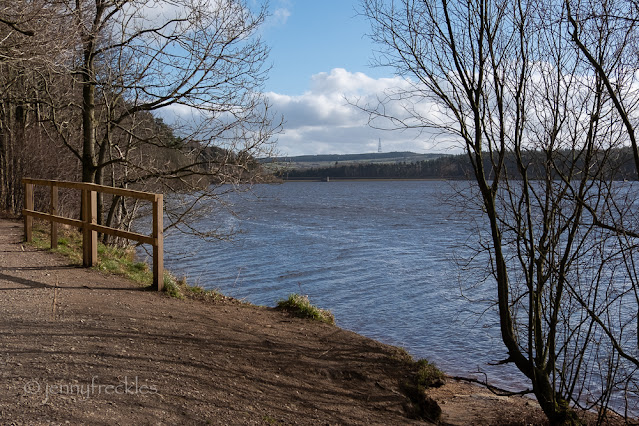
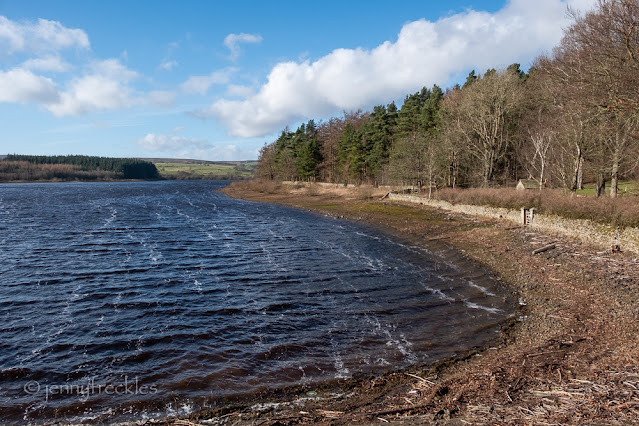
After spending ages in the woods photographing snowdrops, I enjoyed a brisk, breezy walk down to Fewston Reservoir, which has a footpath right round it. It's a pleasant circuit of about four miles, with terrain varied enough to make an interesting ramble.  


In places the wind was really strong, causing fascinating waves and patterns on the surface of the water. We've had a fairly dry winter so far. Though it's often been dull and drizzly, we've not had a lot of heavy rain or snow so the water level is not as high as it often is. 

Fewston is one of a series of reservoirs built in the 1870s in the Washburn valley. The picture below is the view from the dam wall, showing the spillway that connects Fewston to neighbouring Swinsty Reservoir. 

Saturday, 12 February 2022

Snowdrops in the woods

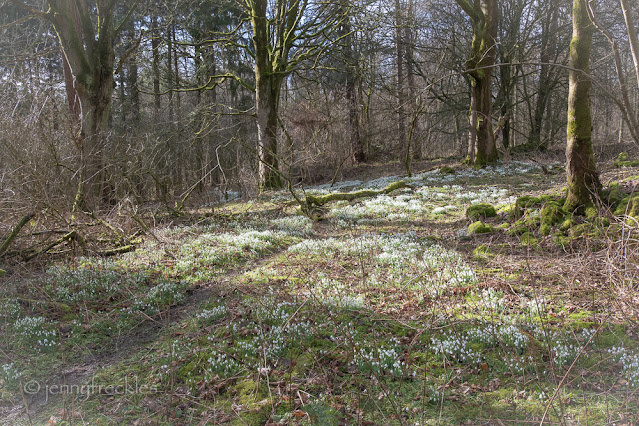
I made a return visit to the woods above Fewston Reservoir. There are lots of naturalised snowdrops there, perhaps a legacy from the garden of the ruined cottage nearby. They have spread over quite a large area and really do look like light drifts of snow. I first discovered them three years ago but lockdowns prevented me from going back the past two years. Anyway, they were as magical a sight as I remembered.

Like bluebells, they are hard to do justice to in photographs but that never stops me trying! 

They are our simple 'native' snowdrop, Galanthus nivalis (not actually native at all but introduced and cultivated, albeit hundreds of years ago). They're such a welcome sign of new life as Spring starts to wake up our woodlands and gardens. 


Friday, 11 February 2022

A lazy day

Granddaughter number two had a couple of days off school recently with a bug (not Covid!) so I was drafted in to care for her one day. She was actually pretty much recovered, thankfully, and we had a really lovely day together. There was a time, pre-school, when I looked after her more often so it was lovely to reconnect, especially after the last couple of years when our family times together have been so limited by the lockdown. In my head she's still about 5. In reality she is now 7 so I had to catch up - she can read really well, and she is more than competent doing many things - like spreading her own toast! She happily worked through a puzzle book I'd taken along and also did some neat and vibrant colouring. She's a loving and very active little soul. She wore her roller skates much of the day and times of quiet industry were interspersed with hectic bouts of roller skating up and down the hall, and leaping around on cushions. We even did a dance-off in the kitchen. 

The picture below came about because we were looking at old photos on my phone and there was one of her, aged about 3, sitting in her pushchair wearing the same hat. She insisted on digging it out from a cupboard and wearing it again! 

She's full of useful info too. "Did you know... that it's the daddy seahorses that have the babies?" - - accompanied by graphic gestures indicating the birthing of quantities of little creatures, as seen on so many nature documentaries on TV. 

All in all, I had a most entertaining day. I'm conscious that both girls are getting a little too old to feature on my blog really. I'd hate to embarrass either of them. On the other hand, my time with them is always so precious and it's lovely to have the memories documented.  


Thursday, 10 February 2022

Blue light

Somewhat running out of photos and ideas... February is always a tricky month for getting out taking shots. I've been looking through my last year's work and I came across this one that I've not posted before. It's a simple image of one of Saltaire's street lights and I decided it was quite pleasing, with its limited colour palette and the contrast of the straight, strong metal and the random wood tracery. 


Wednesday, 9 February 2022

Tree down


Heavy rain over the past few days means that the River Aire is running full and fast. The surge of water has brought down with it an enormous tree, now marooned above the weir in Roberts Park. There's all kinds of debris in the fish pass too. There was a man from the Environment Agency there as I walked past and he was on his phone, presumably giving someone somewhere a report on the hazard. I can't imagine how they will resolve the issue, but I suppose they'll have to. A huge tree like that could cause quite a lot of damage to a bridge, I imagine, as well as potentially blocking the river flow and causing a flood. 

Tuesday, 8 February 2022

Tupped


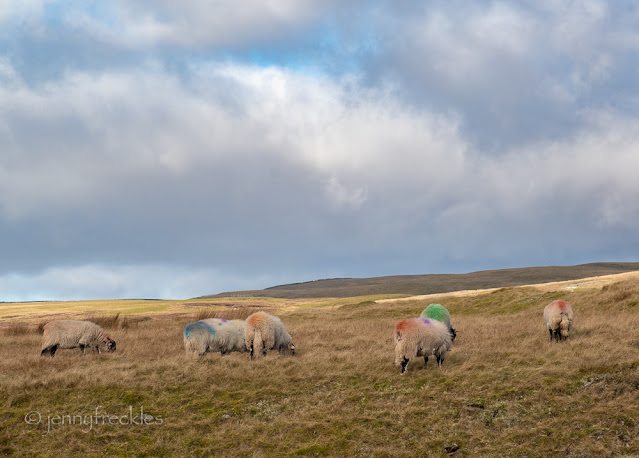
There were lots of the typical, hardy Yorkshire Dales sheep grazing on the moors around the Grassington lead mines. I was intrigued to notice the multi-coloured marks - and then mildly amused when I realised the significance... The male rams/tups are marked on their undersides with colours which transfer to the ewe during mating in the autumn, so that the farmer can see whether they have mated and with whom. Basic but effective. The gestation period for a lamb is about 4.5 months so, before long, our meadows will be filled with frisky lambs again. That's a season that I always look forward to. 

Monday, 7 February 2022

Grassington Lead Mines - part two


The ruined site here is the coal-fired Cupola smelt mill, built in 1792 to replace an earlier peat-burning mill. The ore was piled into furnaces to extract the lead, which has a low melting point and can be drained as liquid, leaving the impurities behind as waste. In the 20th century, some industry returned when the spoil heaps were further processed to extract baryte from the waste. 


The most obvious feature of the mining trail is the flue chimney, which has been restored and made safe and stands proudly above the site. 


From the Cupola mill, you can clearly see the line of the main flue that extracted the poisonous gasses from the smelting works. In parts it has either been excavated or has collapsed so that you can see the rather beautiful arched stonework of its construction. At intervals there are condensers that enabled further tiny particles of iron, known as fume, to be extracted from the gas - little was wasted! 


I found it fascinating to explore the Grassington site and it made for a good (if breezy!) walk. Lead mining was an important industry all over the Yorkshire Dales in the 18th and 19th centuries. There are even bigger sites to be explored above Swaledale, further north.  Whole families were engaged in the work, with children and women expected to work long hours. There's a whole lost language  too: 'buckering the ore', 'minding the hotching tubs', 'bouse', 'buddles' and 'slime pits'. 

Most of the mining families lived within walking distance of the mines, in the villages of Grassington and neighbouring Hebden, where the population peaked in the late 1800s. 

There's an interesting and readable website HERE with lots of information about Dales lead mining, as well as detailed info about the Grassington mines HERE.

Sunday, 6 February 2022

Grassington Lead Mines - part one

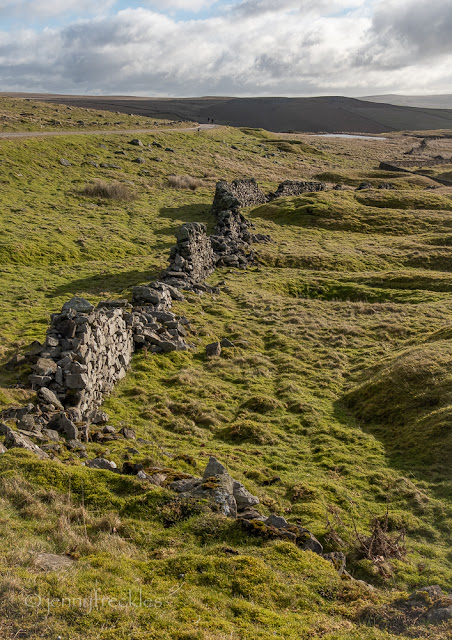
At first glance, the moorland above Grassington looks relatively untouched and wild. It's only when you start to notice the numerous trackways criss-crossing the landscape that you realise that, actually, at one time it was a massive industrial site. Just across the lane from the Yarnbury house that I showed yesterday, there is a tunnel entrance with a date-stone of 1828. This is a gently sloping shaft that was apparently used to bring horses up from a mining level, pulling wagons of lead ore. 

It appears that some lead was mined from the area as early as the 1400s but evidently it was a significant industry from the 1600s, initially from short, shallow shafts. By the mid 1700s larger and deeper mines were being worked, though difficulties in managing the water table and consequent engineering works to build drainage tunnels meant that production was limited. In 1818, the 6th Duke of Devonshire (who owned the land) appointed a professional mining engineer, John Taylor, as Mineral Agent and from that point improvements in technology and efficiency meant the extraction and processing of lead ore grew. The peak came around the 1850s and by 1882 the last lead mine was abandoned. 


Even now, there are numerous slag heaps and ruined buildings, with evidence of collapsed shafts, making it possibly quite hazardous to stray far off the path. There has been an attempt to document the ruins with a trail and a series of information boards, though they could now do with renewing. 

This building was the site of the Brake House Wheel built in 1821: a large water wheel powered by a channel known as the Duke's High Water Course, fed by small reservoirs. The wheel drove a system of rods, levers and ropes that provided pumping and winding for several separate mines. They also used horse-whims, capstans with a central axle around which a horse would walk to power a pump or pulley. 


Saturday, 5 February 2022

Yarnbury

It's been on my list for some time to visit the lead mines on the moors above Grassington, and I finally did, a couple of weeks ago. Following a steep lane up from Grassington village, you eventually arrive at the hamlet of Yarnbury, which is nothing more than a large (Grade II listed) house with a few cottages and outbuildings. The house was built in the late 1700s. The Duke of Devonshire's Mineral Agents, Cornelius Flint and later John Taylor, apparently employed local agents who lived and had their offices here, overlooking the mining area. I've searched the censuses. In 1871 and 1881 the occupier was Thomas Trevethan. Born in Cornwall, he was a 'mining agent and assayer of minerals' - who lived there with his wife Harriet and their six children. 

It's a rather attractive house with fantastic views, and it's still a private residence, though it's right out 'in the middle of nowhere' nowadays. Of course, in the late 18th and early 19th centuries this area was a hive of industry, though by 1882 the lead mines had largely been abandoned. I'll show some more photos tomorrow, taken as I explored the Lead Mining Trail. 


Friday, 4 February 2022

Textures

Sometimes I think I'm slightly weird in that I can really get attracted to take images like these, of rough textures or rust or patterns and colours. I may go on to use them as overlays on some of the more 'creative' work that I occasionally play around with. I do, however, like these just as they are, particularly that top one. It has some kind of story to tell... 


Thursday, 3 February 2022

East Riddlesden Hall

The Covid pandemic meant I didn't visit my local National Trust property last year, so I'm going to make up for that this year as it is only about 6 miles away. What's more, you can walk to it along the canal, mostly avoiding roads, so that makes an excursion there even more attractive. 

The property in question is East Riddlesden Hall, a 17th century Grade I listed manor house, built on the site of an older farmhouse in 1642 by a wealthy yeoman clothier, James Murgatroyd. He was a Royalist (supporter of King Charles 1, during the English Civil War) and there are various Royalist symbols within the building. Saved from demolition in the 1930s, it was gifted to the National Trust and we can still enjoy it today. It's not huge but has a pleasant intimacy inside, and the gardens around it are well cared for and interesting (although inevitably a bit bare at this time of year).

I noticed this date stone which appears to have been re-used in a wall. The date is 1692 and I can make out the letters E (or B?), S and M. I'm not sure what that signifies, although it appears that in 1692 the hall was owned jointly by Edmund Starkie and the Murgatroyd family. 

I've always liked this old door, which is getting increasingly overgrown as the years pass.  Just above it is a sundial, though I don't think that is particularly old. 

In front of the hall is a large duckpond, and a couple of old barns, though they weren't open to visitors.


Wednesday, 2 February 2022

Heaton Mount

Following on from yesterday's post, our friendly guide also took us into the Heaton Mount mansion. Built in 1866, in Italianate-Baroque style by local architect J T Fairbank, it originally belonged to the Kell family and then in 1889 it was sold to textile manufacturer John Ambler, the owner of Midland Mills (for £9750, about £1.5 million today). It was later owned by Arthur Crossland, remaining in private hands until the 1950s, when it became a convent school and was eventually subsumed into the University's Management Centre site as the post-graduate centre. 


I'm assuming that this wonderful photo (above) that I spotted on the wall in the mansion is John Ambler and his family. I've found the 1891 census, when John was 62, living with his wife Edith Alice (34, née Gates) and, at that time, a son John Norman aged 2 and an infant daughter Mabel in Heaton Mount. I've found a death notice for his wife Edith Alice, who died on 21 February 1900 aged just 43. How sad. On the next census, 1901, John (72) is shown as a widower, still living at Heaton Mount with his daughters Mabel (10) and Grace Eveline (5); sons Ernest (9), George (7), and Charles (4) - and a multitude of housekeepers, servants and a nurse domestic to look after the children. The oldest boy, John, was 12 in 1901 and I found him at boarding school in Harrogate. It looks like the photo dates from around that time or perhaps a little later. (I wondered whether it was taken to commemorate John's 75th birthday?)  John Ambler Snr died, aged 82, on 25 June 1910. He had been chairman of Jeremiah Ambler & Sons Ltd, mohair and worsted spinners. He was a senior magistrate and a member and alderman of Bradford Council. Clearly one of those illustrious, industrious Victorian gentlemen who left us such a fine legacy in this area. 

The mansion still has a magnificent staircase and wonderful stained glass, fine oak panelling and ornate plasterwork. 


Regrettably, with only my phone and with having to take quick snaps as I walked, I haven't really been able to do it justice in these photos. I did want to record it all though, as it was such a treat to be able to see the interiors again, holding so many amazing memories of my time as a student there.