Earlier posts

Earlier posts
This blog is a continuation of an older one. To explore previous posts please click the photo above.

Friday, 15 October 2021

Bradford street art 2


Fairly recently, some murals have been stencilled around Bradford by the Bristol-based street artist, Stewy. They depict local characters, whose stories are interwoven with the city. Polish Anna (Aniela Torba) was a familiar face around Bradford's markets between the 1960s and 80s. I remember her well; always colourfully dressed with a woolly hat and a huge thick jacket covered in badges, she would chat to stall holders, cadge endless mugs of tea and sometimes sing in a very loud, deep voice. She always had a stick, which she'd wave about and bonk people with if she didn't like what they were doing! Quite an eccentric and no-one seems to know her personal story. There were rumours she'd been in a concentration camp during WWII. There's an article about her HERE


Not far away from Anna, at the other corner of the market, is Barry Roots, a DJ and reggae musician who ran the Roots Record Shop on Lumb Lane in Bradford. 

On North Parade, there is a stencil of Ces Podd, a Bradford City footballing legend who made a record 565 appearances for the side between 1970 and 1984. 


Elsewhere, I came across this cute dog (?) on a skateboard - with an important message to get across. 


Looking up, there's this colourful and emotional face. (Pity about the advertising banner now partially obscuring it.) I'm sure there is much more street art to be found... I'll have to keep my eyes open when I'm down in the city. 

Thursday, 14 October 2021

Bradford street art 1

Confusingly, there are two railway stations in Bradford. The one I use from Saltaire is Forster Square - and it's quicker and easier to take the train (about a 15 minute journey) than to take the car and find somewhere to park. It was a beautiful, blue sky day when I made the trip recently to do a bit of shopping. 

The area around the station, St Blaise Court, is pedestrianised and the arches that support the road alongside are floodlit with coloured lights at night. (St Blaise was apparently the patron saint of wool-combing.) It has sculptures: Fibres, by the artist Ian Randall, which use old rail lines and coloured fibre optic capsules. I quite like them. 

Across the road, there is another sculpture: Connecting the City, by Rick Faulkner. It is like a giant steel needle, which of course references the textile history of Bradford. The fibre optic thread through it lights up at night and symbolises the road and railway connecting people to the city. 

Elsewhere in the town centre, an empty bank building has been used to display large photographs by Carolyn Mendelsohn, a Saltaire-based photographer. These are part of an ongoing and long-standing project to photograph girls aged between ten and twelve, exploring the complex transition between childhood and young adulthood. I've seen several exhibitions of some of these portraits and they are immensely touching (especially for me, being the gran of a similarly aged girl). I'm not entirely sure they translate well to being printed up so big and placed outside but they are nice to see. 


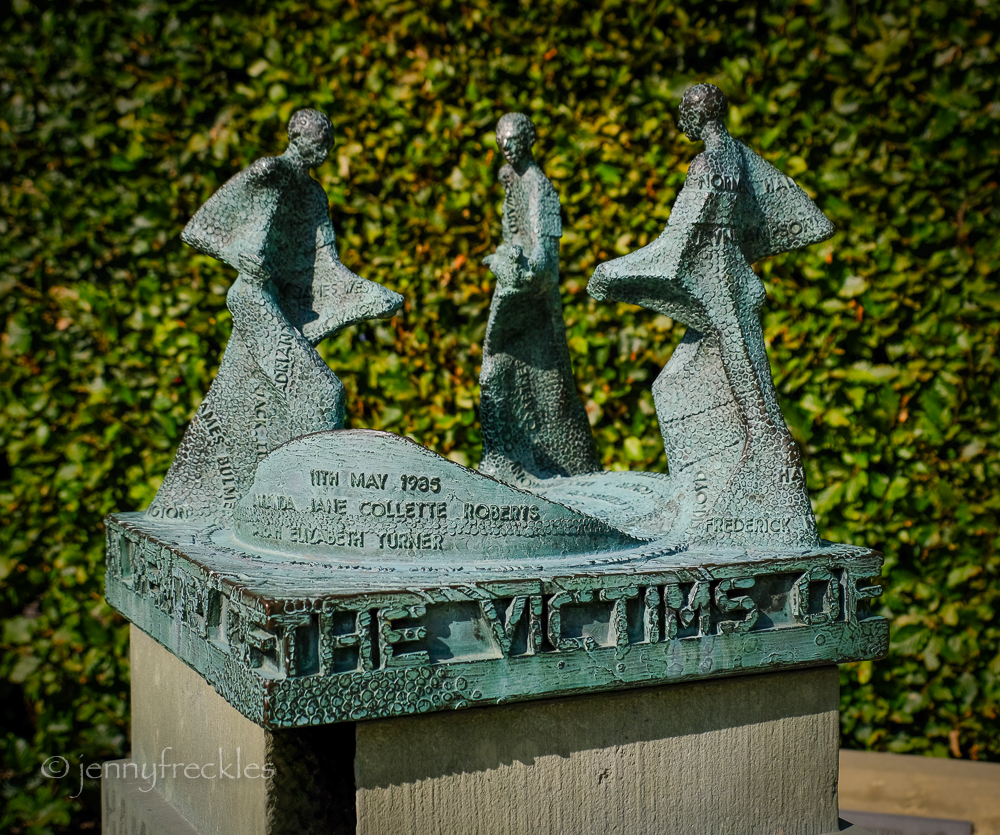
In front of Bradford's City Hall, there's a sculpture that commemorates the Bradford City Fire Disaster, on 11 May 1985. 56 people lost their lives and more than 300 were injured, some horrifically, when fire broke out in the football stadium during a home game. The people of Bradford, me included, will never forget that day. The sculpture is by a German artist, Joachim Reisner, and was presented by our twin town of Hamm to the people of Bradford. By a twist of fate, the sculptor's wife, originally born in Bradford, was actually at the football stadium on the day of the disaster, on a civic visit.  The memorial has on it the name of every person who died. The three bronze figures, in a broken circle that represents the stadium, suggest the divide between life and death and the many rescuers running to offer help - from fire crews to the local residents whose homes surround the football ground; from medics at the hospital to social workers who later were tasked with supporting the traumatised. I find it quite emotional to see. 


Wednesday, 13 October 2021

Caroline's


By far the ugliest building in Saltaire, a mess of prefabricated panels, pebbledash, upvc and flat roofs - and yet, despite appearances, Caroline's Social Club is one of the beating hearts of the community. It started life as a Working Men's Club and has evolved into a pub and entertainment hub, hosting many events: bingo, Slimming World, salsa nights, private parties, regular comedy nights and live music sessions, including the well regarded 'The Live Room' series ('the best all round roots music club in Bradford').  It looks at its best at dusk, when the lighted rooms beckon a cosy invitation, or on a sunny day when the yard and beer garden at the back are packed with people having a good time. (It was busier than it looks when I took this photo.) 

It has won CAMRA awards, for Club of the Year and gets five star reviews: "friendly; helpful staff; good prices; great beer." And its website features one of my photos! (I can't honestly remember if that is with permission or not. I can't say I mind.)

It'd be lovely if a millionaire came along and offered to demolish the pre-fabs and build a replacement, with a similar purpose, that would fit in better with the village's general attractiveness but I don't suppose that's likely to happen.  As it is, I'm sure it's fortunate that they have managed to keep going through this pandemic, with all the challenges it has posed for hospitality venues. It probably all runs on a shoestring and they have to be continually innovative to survive. So - well done, I say. 

Tuesday, 12 October 2021

Wuthering Heights

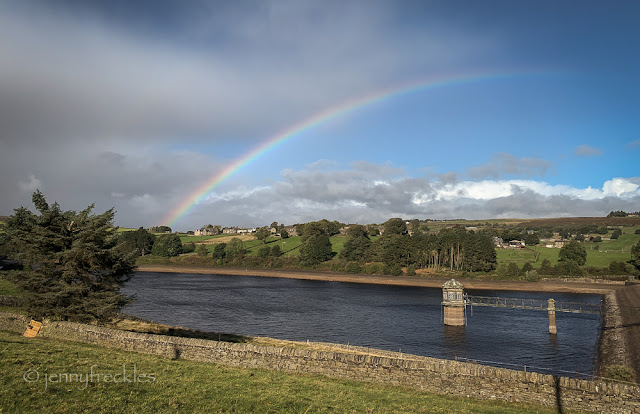
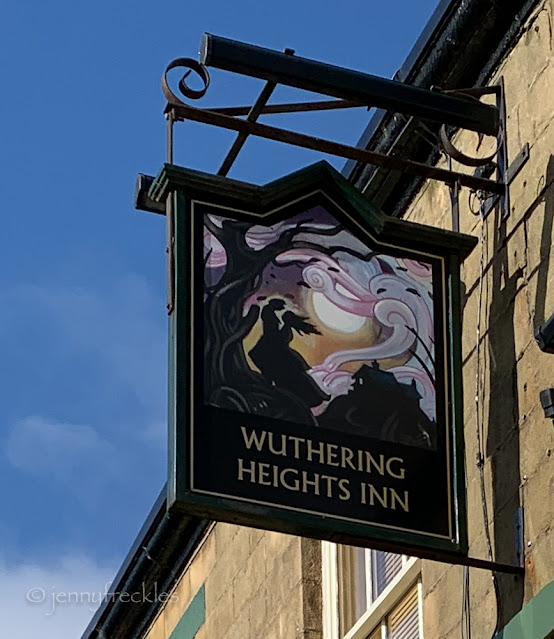
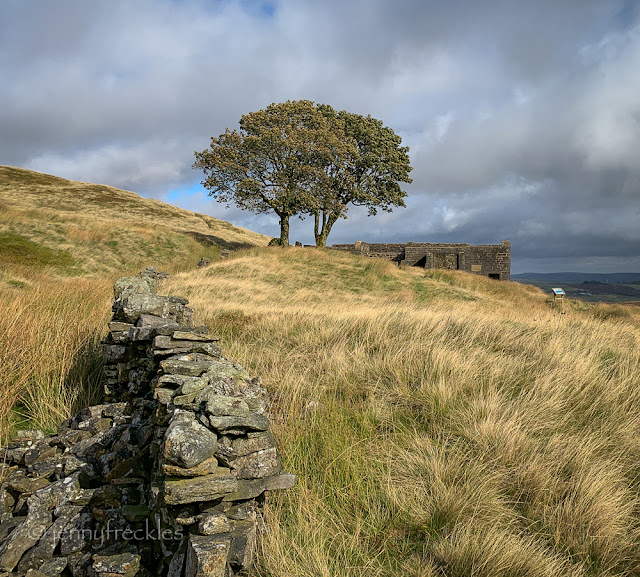
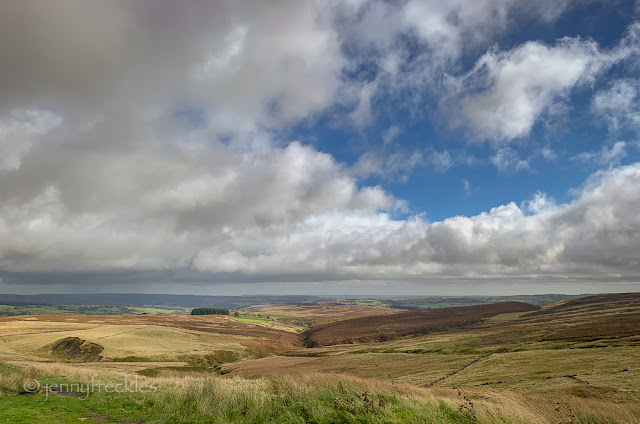
It was a blustery day. The scudding clouds, driven by strong winds, kept releasing intermittent but insistent bursts of rain - but there were rainbows, as if to compensate for the wildness. It was, however, an appropriate sort of wildness since I was intent on walking up to Top Withens again. The pub sign in the hamlet of Stanbury, overlooking Haworth Moor, rather gives the game away. Top Withens is reputed to be the farmhouse that inspired the location of the Earnshaw family house in Emily Brontë's 1847 novel 'Wuthering Heights' - and this, of course, is prime Brontë territory. 

Helpfully, the pub frontage also gives a definition of 'wuthering' - 'a Yorkshire word referring to turbulent weather'.  As I've said, it was certainly that kind of a day, though to be honest I have rarely been up there in anything but wuthering conditions! You kind of expect it, as you almost expect to catch a glimpse of three sisters hurrying along in long skirts and Victorian bonnets!


It's a fair old trek, along part of the Pennine Way, to the ruined farmhouse, with its lonely trees. The information boards point out that the farmhouse itself bears no resemblance to the Earnshaw's mansion in the novel, but it is thought that the location may have been Emily's inspiration. The Brontë sisters would certainly have been familiar with it. 

I always feel a sense of satisfaction when I get up there. The long and somewhat challenging walk is worth it, since the view is awesome, and the cloudscape quite thrilling. 

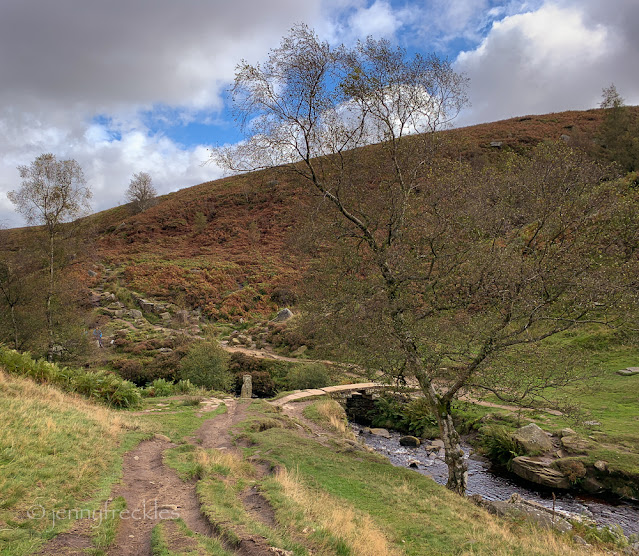
Then it was back down to Haworth, via the stream, bridge and small waterfall that they call Brontë Falls - another location that the novel-writing sisters, who lived in the parsonage in Haworth, are known to have visited quite often on their walks. 


Monday, 11 October 2021

Peace and sunshine

There was some lovely light on Saltaire's Victoria Hall as I walked past. The 'Peace' lion seemed to be enjoying the warm, late summer sunshine, and was licking his paw contentedly (though he does that in the snow too!) 

The gardens in front of the Hall were looking good as well, with colourful bedding plants and lots of berries on the rowan trees. I'm sure Sir Titus would approve. 

Sunday, 10 October 2021

Canal patterns

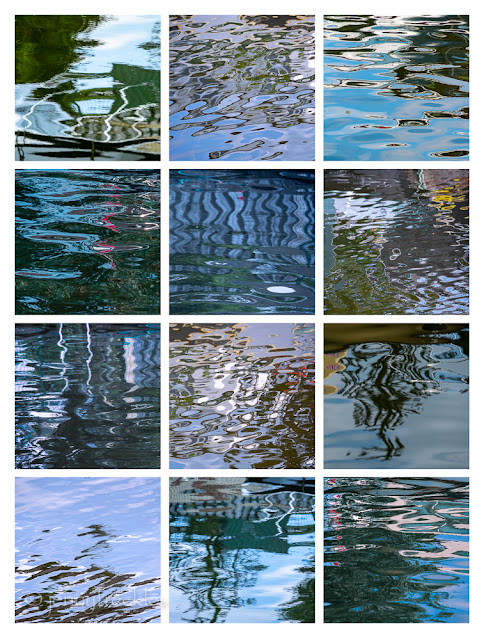
I love all the patterns made by reflections on the canal. The area just beyond Bingley's Five Rise Locks is a rich hunting ground for these. There are always boats moored there with different colours to add interest, though I did tweak a few of these to suit an overall blueish theme. 

Saturday, 9 October 2021

Within All Saints

Here's a selection of images of things that caught my eye within Harewood's church of All Saints. The alabaster tomb figures are very fine carvings of lords and ladies from the 15th century. I believe the lady shown above is Elizabeth Aldborough, wife of Richard Redmond, and is dated 1426. 

There are a few beautiful and vibrant stained glass windows in the church. I really loved this one, depicting the Annunciation: 

The tomb figures would originally have been painted, though the paint has now gone. As if in remembrance the church’s stained glass throws luscious colour onto them. This one is William Rayther. 

Knights are often depicted with their feet lying on dogs or lions. This one - a little lion, I think - had a cute expression! 


On the oldest tomb, Lady Elizabeth Mowbray, wife of Sir William Gascoigne, has a very elaborate headdress. 

I loved the patterns thrown by the sunshine through the windows:


Friday, 8 October 2021

All Saints Church, Harewood

Set in the grounds of Harewood's vast estate, All Saints Church dates back in part to Norman times, was rebuilt in the 15th century and then altered in the 18th century. It is not now used for worship, but is cared for by the Churches Conservation Trust. Its graveyard is nicely overgrown with grasses and wildflowers, and holds some very old memorials. 

The church's interior is chiefly renowned for its fine collection of alabaster tombs, dated between 1419 and 1510, depicting lords and ladies from the families who owned the Harewood and neighbouring Gawthorpe estates in the 15th and 16th centuries. 

I think it's a beautiful space, at its best when the sunshine pours through its windows, casting patterns. 


The figures above are, I believe, William Gascoigne and Margaret Percy, dated 1487. 

The current owner of Harewood House is David Lascelles, the 8th Earl. His grandfather, the 6th earl, married Princess Mary, the Princess Royal, the only daughter of King George V and Queen Mary and an aunt of our present Queen Elizabeth II. There is a memorial plaque in the church and I believe there is a family vault. 


Thursday, 7 October 2021

Below stairs at Harewood House

I've recently been doing a fair bit of research on my family tree and have come across a couple of female ancestors who worked 'in service' as housemaids or nursemaids to wealthy families. It was one of few avenues open to young, unmarried women to earn a living, before the two World Wars began to change everything. The families they worked for were not nearly as well-to-do as the Lascelles of Harewood House. Nevertheless it was interesting to get a glimpse 'below stairs', at the kitchens with their huge ranges and gleaming copperware, the sculleries and the servants' hall, where the servants would have had their meals, men at one table presided over by the Butler and women at another, under the watchful eye of the Housekeeper.   

There are two call bell systems, one a Victorian system of wires and pulleys and an electronic one from the 1930s, which the gentry used to summon their servants. 


There are also cupboards of exquisite china and glassware on display. I just loved this delicate painted glass. 

There are a few costumes displayed too. This is Princess Mary's wedding dress (or at least a replica of it, since the original is too fragile to have on display), dating back to her wedding to Viscount Lascelles (later the 7th Earl) in Westminster Abbey in 1922. 

Harewood House is often used for TV and film productions, from Victoria to Mary Berry to Downton Abbey, as well as the long-running TV soap, Emmerdale, which has a permanent set on the estate. HRH Princess Mary and her husband actually featured in the Downton Abbey movie, along with the fictitious Crawleys of Downton. It was partly filmed here in 2018, so some of the costumes and a table setting are from that. You can see the place settings for Lady Mary Crawley and the Earl of Grantham: 


Wednesday, 6 October 2021

Inside Harewood House

'I would not exceed the limits of expense that I have always set myself. Let us do everything properly and well, mais pas trop.' So said Edwin Lascelles to Robert Adam, when he commissioned the renowned interior architect to design his new, grand mansion in 1759.  More than 250 years of history and huge wealth (made on the backs of slaves in the Caribbean sugar plantations) mean that the interior of Harewood House is as lavish and opulent as they come. The results are certainly trop - too much - in my eyes, but I can appreciate the beauty and craftsmanship nevertheless.   

The interior tour begins in the Music Room (above), with a glorious Adam ceiling, a lush chandelier and some incredible works of art around the walls.  We progress on to the State Dining Room, full of Chippendale furniture (again, no expense spared) and  portraits of Lascelles family members, some very old and some more contemporary. This room is still used for dinners and private functions. It was extensively remodelled by Sir Charles Barry in the 1840s; the original Adam fireplace and ceiling ripped out! 

The Adam ceiling in the Gallery - the largest room in the house - is quite magnificent (and impossible to photograph as a whole without a specialist technique. My photo shows just a small section.) More photos can be seen on the Harewood House website HERE

The Main Library is rather cosily arranged, with huge mahogany bookcases designed by Sir Charles Barry but retaining the lovely Adam plasterwork. I could quite happily have settled here or in the adjoining Spanish Library to explore the rather wonderful old books - some Italian art books were dated 1598! Or how about 'The History of the Fan' or a complete set of back copies of Punch magazine, to keep you amused. 

Because of Covid, some of the narrower passageways and smaller rooms in the house have had to be closed so that social distancing can be maintained. Even so, you get a good idea of how the landed gentry lived in past centuries. For all the grandeur, I often find I notice and prefer the more modest artefacts, like this charming bust of a young girl: 


Tuesday, 5 October 2021

Orpheus

This magnificent statue of Orpheus, a bronze created by the artist Astrid Zydower and installed on Harewood's Terrace in 1985, is one of my favourite artworks. It suits its location so well and is such an impressive and beautiful piece, with the Greek God depicted supporting a leopard on his outstretched arms. It's usually surrounded by water but for some reason the pool has been drained. 

Elsewhere on the Terrace there are more sculptures, of sweet little cherubs:

and some sphinxes - mythical creatures with the head of a woman, the body of a lion and the wings of a bird.  Fearsome!