Earlier posts

Earlier posts
This blog is a continuation of an older one. To explore previous posts please click the photo above.

Friday, 14 March 2025

Spring bulbs in Ilkley


I took my new camera on an outing to Ilkley, on what was promised to be a warm and bright early spring day. It took me nearly an hour to get there (usually a half hour journey) owing to the many roadworks and temporary traffic lights along the route. When I arrived, it proved not to be very warm or very bright over there. Hey ho...

Never mind, I had a little stroll, finding lots of spring bulbs. I've always liked the row of houses on Wells Road, and the green in front was scattered with crocus and snowdrops. Up in Darwin Gardens there were more snowdrops, a broad river running alongside the path. 


The daffodils were a little behind, just coming into flower - by now, these will be gorgeous. 


Incidentally, an apartment in this fine house called 'Hillside', on the edge of Ilkley Moor, was where in 1859 Charles Darwin and his family stayed while awaiting the publication of his book 'On the Origin of Species', which proposed the theory of natural selection in evolution. Darwin's health was poor and he came to Ilkley to benefit from the hydropathic spa, whose spring water was believed to cure illness. 

Thursday, 13 March 2025

'The Necessity of Seeing'


The second exhibition I went to see in Bradford was at the Impressions Gallery. It was a photographic display: 'Nationhood: Memory and Hope'. Portraits made by several photographers across the UK: England, Scotland, Wales and Northern Ireland, celebrate the diversity of modern Britain and how we try to shape our identities and communities to make the world a better place. 

Alongside those were some photographs by Ethiopian photographer Aïda Muluneh, 'The Necessity of Seeing', commissioned for the UK City of Culture 2025 and shot in Bradford, Belfast, Glasgow and Cardiff. They were very powerful images, strongly coloured and full of symbolism. I liked them a lot, though I'm not sure I could fully grasp the whole of the underlying thrust: 'stories of a nation negotiating between the weight of its past and the challenges of its present'.


Read HERE the artist's own statement about the exhibits. 'Every frame reflects the whispers of quiet truths that linger beneath the surface, waiting to be seen.'


The heavily made up figures, with whited faces, were powerful in that the stylisation removed the sense of the woman as a personality, each making a statement beyond that of an individual... though we did ponder the irony that 'blackface' in performance art is no longer culturally acceptable (to the extent that even our traditional Morris Dancers these days tend to eschew it) but 'whiteface' here seems to be - and maybe that's precisely one of the statements Aïda is making in her art. 

Wednesday, 12 March 2025

Hockney at the Media Museum


The main exhibition I wanted to see in Bradford was at the Science and Media Museum. It's an interesting building with five or six levels and a sweeping and dramatic glass foyer at the front. It was closed all last year for a revamp... but I couldn't really see a lot of difference from how it used to be! Thankfully it has now reopened, to coincide with the City of Culture.  

There's a large sculpture of Wallace and Gromit's arch enemy Feathers McGraw hanging in the entrance. (See also HERE). Given the success of the latest film from Aardman Animations, 'Vengeance Most Fowl', I think that will be enjoyed by some of the younger visitors. 


One of the galleries has a new exhibition of David Hockney's work, 'Pieced Together', which draws parallels between his current nine-camera-video installations (which I mentioned before, HERE) and his much earlier, photographic 'joiner' collages made in the 1980s. (An example is below, an image of Hockney's mother, in the rain, seated on a tombstone at Bolton Abbey.) The artworks are accompanied by various videos and interviews with Hockney, exploring concepts of time, space and perspective in art and photos and how we 'see' them. I found it very interesting, though I was rather disappointed that there were very few actual works on show - just a couple of 'joiners' and a more recent video installation of 'The Four Seasons, Woldgate Woods'.


By the way, if you look back to my first photo, you will see I was intrigued by the effect of the angled glass, which in itself created almost a 'joiner' photo of the surrounding buildings. 

On leaving the museum, it was evident there'd just been a sharp rain shower, so the statue of novelist and playwright J B Priestley was gazing at a beautiful rainbow.  


'I mean, photography is alright if you don't mind looking at the world 
from the point of view of a paralysed Cyclops - for a split second. 
But that's not what it's like to live in the world.'
David Hockney

Tuesday, 11 March 2025

City of Culture


Bradford is the UK City of Culture for 2025, with many events and exhibitions planned. I tend not to go into the city centre very much these days but, if there are some interesting things to see, I will take the opportunity. I went along recently, with a friend, to see a couple of exhibitions. It was a day of sunshine and showers. Luckily we managed to miss the showers! 

The wet flagstones made for a good reflection of the hot pink 'Ramadan Pavilion'. This structure, conceived by Zarah Hussain and Fatima Mejbil, celebrates the Islamic holy month of Ramadan. It marries together the architecture of Bradford's Victorian heritage (all those gothic arches) with the colonnaded courtyards and sacred geometry of Islamic design. Why pink? No idea... it did give it a touch of Barbie/Disney as far as I was concerned, but it was kind of pleasing anyway. 


My friend persuaded me to allow a rare photo of myself under the arches. Three score and ten plus... but not a bad vintage! 

Looking in the opposite direction, the shallow mirror pool in City Park was just beginning to be filled by the fountains. (It's drained overnight and then refills during the day, unless the dry space is needed for an event.) In the background, the former Odeon cinema, an iconic Bradford landmark with its twin towers, was proudly proclaiming its news... After a shaky period when the original developers pulled out, it has just been taken over by Trafalgar Entertainments. Much of the revamp has been finished, with substantial investment from Bradford Council. The new managers will complete the internal refit to create a live music and entertainment venue, seating 3000+. It's promised to be ready by the autumn, hopefully starting the next chapter for the historic building, which has been languishing unused and deteriorating for many years. I used to go and watch films there when I was at university in the 1970s. 


We took the opportunity for a coffee and chat in the café in the former Wool Exchange, where Bradford's great and good (Sir Titus Salt among them) used to meet to trade wool and textiles. It's a magnificent Victorian building, designed by Saltaire's architects Lockwood and Mawson. It's now a large branch of Waterstones Bookshop, possibly one of the finest locations for a bookshop in the entire UK. 

Monday, 10 March 2025

The moor road


It's a drive of about 16 miles to my daughter's, by the direct route. The direct route is over the high moors that divide the Calder valley from the Aire valley. It can be beautiful up there. It's also rather bleak and the weather can be very different up there from down in the valleys. It's often foggy, or conversely often windy, can be snow and ice up there even when there's none lower down. Even though I have winter tyres on my car, I would never choose that way if I thought it would be dangerous or beyond my driving capability - though the two alternatives also have quite steep hills to navigate, as well as being longer.

When I drove over the other day, the weather wasn't a problem. When I got home I noticed, however, some posts online about a 4x4 that had been driving dangerously up and down the road and deliberately ramming other cars! Thankfully I didn't meet them. It's so remote in parts that it can be quite lawless. You regularly see fly-tipped rubbish - and indeed my photo above shows something left by the side of the road. One time I drove along there and there had been a whole load of used tyres dumped in piles along the route! 

On a good day though, it's exhilarating to see those moors stretching for miles and I love the way the rolling scenery fades away into the distance, through various recessionary tones. Sadly there are few safe places to stop to take photos. The best views are always from the sections where you can't stop! 

Sunday, 9 March 2025

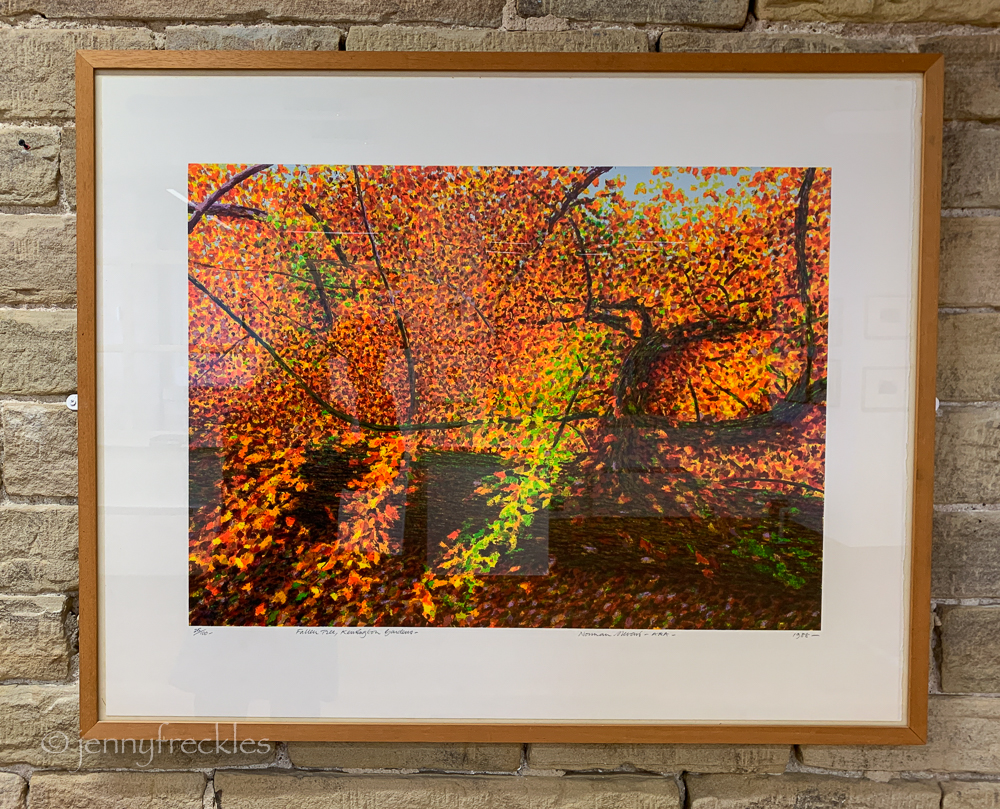
Norman Stevens at Salts Mill


In a small room just off the entrance lobby in Salts Mill, there's a new exhibition - easy to walk past, but very worth seeing if you happen to be visiting. 

It's a collection of prints by Norman Stevens (1937-1988). He was a contemporary of Hockney's at Bradford School of Art in the mid-1950s and later at the Royal School of Art. He then taught art until in 1973 he became a full-time printmaker, specialising in mezzotint

My lack of understanding of the variety of different printing techniques can be a source of frustration to me occasionally. I studied these quite closely and they display a great richness of tone. I'd never heard of the artist before but I did like his work very much. 


(Please forgive any reflections and distortion in my photos; I was trying to avoid the bright strip lights that were a bit of a nuisance.) 


Saturday, 8 March 2025

Rainy day in Saltaire


There's plenty to do in Saltaire even on a rainy day, at least on the days that Salts Mill is open (usually Wednesdays to Sundays). I can happily while away a couple of hours browsing the bookshop and galleries, forgetting the rain and the dire state of the world! Coming down the stairs in the mill offers this view, looking over the Victoria Road railway bridge to the shops and houses beyond. Any spots on the image are from the dirty window and the rain, rather than my camera sensor!

Friday, 7 March 2025

Saltaire's almshouses


I stood for ages waiting for a little bit of light to illuminate the almshouses. This is just one side of the square, which has around 45 small cottages, originally for the elderly and infirm. Residents were initially selected by Sir Titus Salt himself and later a Board of Trustees, and could live here rent-free, with a small pension. Some are now privately owned but others are still reserved as social housing. Until fairly recently, you could barely see them for foliage but they have felled a couple of large trees on the green (Alexandra Square), which has lightened the whole scene a great deal and must have made them brighter inside too. The almshouses were constructed in 1868, towards the end of the creation of Saltaire. They are at the top end of the village, so you can appreciate the lovely backdrop of Baildon Moor and Hope Hill.

Thursday, 6 March 2025

Quackers


A new mural has been painted alongside the canal on the way into Shipley. It's quackers! (I couldn't get a better angle on it or I'd have fallen in the canal.) I'm not sure whether it's commissioned or simply graffiti but it raised a smile from me. 


Further along I came across this one. I love the look on that alpaca's face! I'm amused to see the octopus sculpture, which adorns the canalside in Saltaire, immortalised as a hat! 


Meanwhile, the long-standing artwork under the roadbridge is deteriorating rapidly, now covered in mould. It's a bit whacky too... I've never been sure what the story is. It's some kind of fantasy banquet. 


Not a mural but another source of amusement for me were these two swans, upended so dramatically that you'd have thought they might do a complete somersault. I don't know what was so tasty down there but something held their attention for a long time. 

Wednesday, 5 March 2025

Thornton


I had intended to have a good wander around the village of Thornton. By the time I'd walked from my car to the Brontë birthplace, however, I was freezing cold, despite wearing a thick, hooded coat and gloves. The winter sun was weak and the temperature barely above freezing so I decided to leave my exploration for a better day. I seem to feel the cold a lot more these days. Yet another of those things no-one ever tells you about getting older... 

I took a few photos along Market Street, where the Brontës lived during their time in Thornton. It used to be the main street through the village before the turnpike road (now the main Thornton Road) was constructed in 1829. Like most places, the older buildings have been infilled with newer ones and it's all a bit of a hotch-potch - and I think any 'market' and its site are long gone. Back Field (above) is a narrow alley, with cobbles and a central drain. The road surface must be higher than at one time, as further up there are old windows and doors, partially covered over:


The unusual building below is known locally as 'Coffin End' for obvious reasons. In the 1800s it was The Star Inn, one of three alehouses in the village. One of its former landlords was transported to Australia for the crime of stealing ten shillings. The structure illustrates the way the builders managed the steep terrain. At the lower end the building has three storeys whilst, behind, the adjoining cottages are much smaller.

Tuesday, 4 March 2025

Brontë birthplace


Not far from the Brontë Stone (see yesterday), in the village of Thornton itself, lies the house where the Brontës lived when father Patrick was the minister of the Bell Chapel. In my photo above, the house is on the left and you can see in the far distance the spire of St James' Church, which replaced the Bell Chapel after Patrick's time. [For more about the Bell Chapel, see my post HERE.]

Four of the Brontës' children were born in this house, in front of the fire in the parlour so it's said, before the family moved to Haworth in 1820.


In the intervening years the house has always been in private ownership. For a while it was a butcher's shop, which is why it has been extended out at the front. In the late 1990s through to 2007, it was restored and opened as a museum by crime novelist Barbara Whitehead. It then became a coffee shop but that closed during the Covid pandemic. Now, a community group, supported by private donations and a grant from Bradford's City of Culture fund has managed to purchase the property and it is currently undergoing restoration. They intend to open it as a café and holiday accommodation, dedicated to preserving the heritage and memory of the famous literary family. 

One of the four Brontë Stones, the Charlotte Stone has been placed against the wall here:


Two verses of a poem by Dame Carol Ann Duffy, a former Poet Laureate, have been inscribed. The poem in its entirety can be read HERE. The inscription reads: 

'The vice of this place clamps you; daughter; father who will not see thee wed, 
traipsing your cold circles between needlework, bed, sleep's double-lock. 
Mother and siblings, vile knot under the flagstones, biding. 

But the prose seethes, will not let you be, be thus;
bog-burst of pain, fame, love, unluck. True; enough.
So your still doll-steps in the dollshouse parsonage.
So your writer's hand the hand of a god rending the roof. '

Across the road from the birthplace, in what was once apparently a shop front, a whimsical mural alludes to the Brontës' lives and writings. 


Monday, 3 March 2025

Brontissimo


After finding the Anne Stone in Haworth (see HERE), I went on the trail of the others. This one, commemorating all the Brontë sisters, is situated in Thornton Cemetery. 

The poem, carved by Pip Hall, is written by Jeanette Winterson and reads:

'BRONTESAURUS
Fossil record of a miracle
Bone by Bone
Word for Word
Three Women writing the Past into the Future
Line by Line
Listen to the Wildfell of your heart
Do not betray what you love
The earth opens like a book
You are come back to me then? 
BRONTISSIMO' 


 (After seeing the way the Anne Stone faces a wall, I'm not hugely impressed by the way these markers have been sited. This one is in a lovely setting on a ridge with the hills behind - but the carved face points north, meaning that it is always going to be silhouetted by the backlight. It makes it hard to read and photograph, even on a not very sunny day.)

Sunday, 2 March 2025

Practice


Where better to try out my new camera than my happy place, Bolton Abbey? We were blessed with a pleasant day: dry and mild, with some weak sunshine and almost a hint of spring in the air. It takes me about an hour to walk to the Strid and back from the Cavendish car park, though I do stop a lot, to take photos and simply to breathe and drink in the peacefulness. I don't always stop for refreshments when I'm on my own. It's always more fun to chat with a friend over a coffee. This time, however, I was hungry so I treated myself to a pot of tea and a cherry bakewell tart in the Cavendish Pavilion. Those tarts are so sweet and synthetic but the combination of almond frangipane, cherry jam and fondant icing makes them my guilty pleasure! 


As for my camera, well, I'm liking it. Its small size is taking some adjusting to, but it feels solid in my hand and the main controls are easy to use. It seems to tend towards slight overexposure but I'm sure I'll be able to remedy that (and it can be adjusted in post-processing). Where I'm having a bit of difficulty so far is with the more detailed features. I tried to use the macro setting for close-ups but I couldn't get the focus right. So, back home, I can read the manual and practice that until it becomes familiar. I always prefer to research once I've hit a snag. That way I remember it better, rather than simply trying to read the information and get it to stick in my mind. 


Anyway, I had an enjoyable afternoon (much better than the morning, which I spent at the dentist!) 
A trip to Bolton Abbey always lifts my spirits. 
 

Saturday, 1 March 2025

Hirst Mill Crescent


On my local walks, I often cross the Leeds-Liverpool canal by the narrow swing bridge adjacent to Hirst Lock. On the far side, an unmade road leads to Old Hirst Mill on the riverbank, once a water-powered corn mill and then a fulling mill, now converted to residential use. The old mill forms part of a crescent of residential buildings, quite a mish-mash of styles but all dating, it seems, to the mid 19th century. (The original mill buildings were rebuilt in the 19th century). The largest of them, Hirst House (right of my photo above) looks quite grand. The building on the left of the photo below, now two houses, was, it seems, a coach house for Hirst House, originally a long barn-like building. The single storey cottage (above left) is believed to have started life as a workshop or storage area for Hirst Mill. 


I've been meaning to take photos there for ages but there are almost always several large cars and SUVs parked there. For once, I happened to be there when it was clear of vehicles! 

The outlook to the front is currently very messy: a partially cleared and overgrown site where there used to be a small garden centre. It's been contentious for several years. The local council ordered the site to be cleared of broken glass and rubble as it was dangerous. The site's owners have been trying to get planning permission for housing there, which has been refused several times. The only access is over the single track swing bridge over the canal. I understand that planning permission has recently been granted for three houses there. 


In case anyone is wondering, there was a 'New Hirst Mill', also a fulling mill, sited by the river at the far end of Hirst Woods. It was demolished and nature has largely reclaimed the area. See my blog post HERE.  'Fulling' was a process associated with the textile trade, where lengths of wool cloth were pounded in water (or urine) to remove oils and impurities, and to shrink them to make them smoother, thicker, warmer and more water-resistant. Such cloth was often used for coats (like duffel coats) and blankets.