Earlier posts

Earlier posts
This blog is a continuation of an older one. To explore previous posts please click the photo above.

Friday, 20 October 2023

More from Beningbrough's gardens


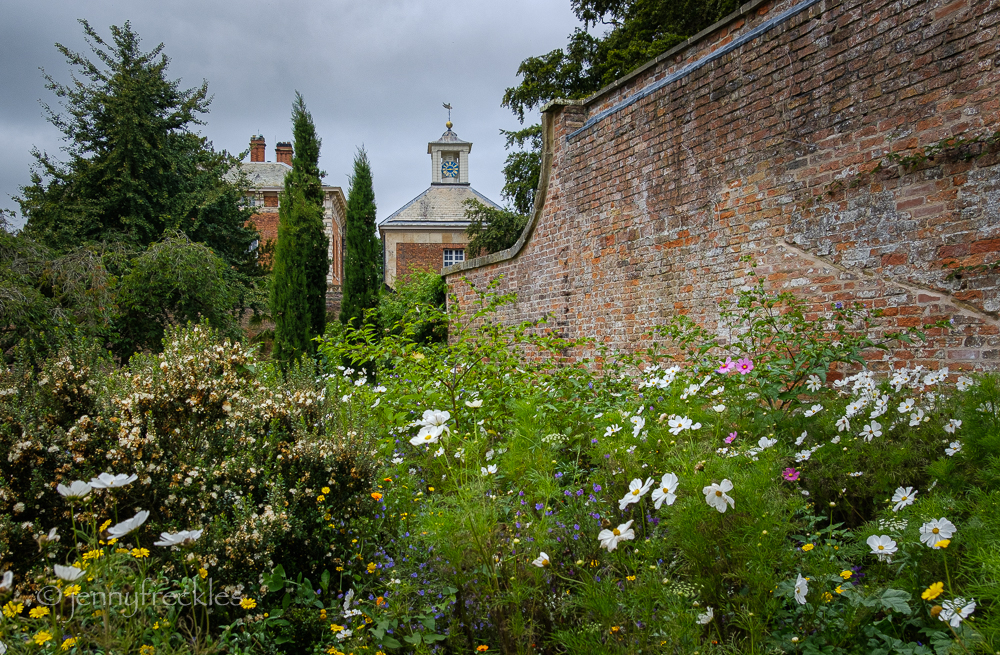
Even on such a gloomy day, there was lots to enjoy in the gardens surrounding Beningbrough Hall. The mellow old brick walls provided a softly textured backdrop to the loose planting that so many of our gardens now seem to favour.  


There are a couple of ornamental ponds, with waterlilies in bloom. 

Alchemilla mollis or Lady's mantle, always seems to attract raindrops and dew. I'm not sure why the beads of moisture persist so long but they make this low, ground-covering plant an attractive choice. 


Lace-cap hydrangeas looked good even as the flowers were dying. 


A passion flower climbing vine had a lot of buds and its unusual flowers, said to symbolise the passion of Christ in Christian theology.   


Thursday, 19 October 2023

Beningbrough #2


The external plan of Beningbrough Hall has the house itself at the centre, flanked by outbuildings on either side that are accessed via archways from the square at the front. Consequently there are some interesting views and hidden courtyards. It was a really gloomy day with little light but no strong shadow either. My photos make it look like there was no-one else about but in fact it was fairly busy with families and I had to wait ages until there was no-one in my pictures!


Looking up above the front door, you can see the Bourchier family heraldry, including 'the Bourchier Knot' on either side of the entwined initials of John and his wife Mary. I'm not sure of the significance of the laughing face. 


There are extensive gardens, with big plans for a new area of planting: a 'Mediterranean garden' designed by Andy Sturgeon, six times gold medallist at the RHS Chelsea Flower Show. 


Tucked away to the side of the house is an area that would have held the domestic services for the mansion. There's a brewhouse and a well-equipped laundry. Many of my own female ancestors would have been familiar with this kind of hardware - a fire boiler to heat the water, dolly tubs and possers, mangles. With our electric irons and washing machines, we are so fortunate these days. 

Wednesday, 18 October 2023

A return visit to Beningbrough Hall


Built in 1716 on the site of an Elizabethan house, Beningbrough Hall is one of the National Trust's finest Georgian mansions. It was the vision of a young man, John Bourchier, who inherited the hall aged just 16. Influenced by his grand tour of Europe in 1704, he commissioned William Thornton as his chief craftsman. The result is a beautiful house in the 'Yorkshire Baroque' style, with stunning mouldings and sweeping staircases. 

I last visited in 2018 and since then it has been closed for refurbishment. It was used during WWII as a base for the RAF and then the Royal Canadian Airforce. After that, its then owner, Lady Chesterfield, lived there until her death in 1957, when it was given to the National Trust in lieu of death duties. There is very little original furniture left and the hall lacks the cosy family feeling of many of our grand houses. The revamp has created exhibition space on the first floor, the Reddihough Galleries. That was what I went to see - an exhibition of black and white photos by Kate Somervell, some of Venice and some of Beningbrough itself. 


The staircases are elegant and the ceilings ornately shaped and moulded, giving wonderful plays of light and shadow, especially with the new LED lighting. It's a good house for photography in that respect. When aircrew were billeted here, all sorts of capers were dreamed up to relieve mission stress. If you could run from the bar, the full length of the house, up the stairs, along the top floor and then back down to the bar in one minute, you won a free pint. At bar opening time, there was a mad rush to get downstairs, usually on push bikes, and on at least one occasion, a motorbike to try and win the pint!


I rather liked the intimate Victorian conservatory that had been added. 


Views of the gardens through the windows were lovely too. 

Tuesday, 17 October 2023

I can paint for miles and miles...


I've noticed over recent weeks or so that all the railings around Salts Mill have had 'Wet Paint' signs around them. Then I caught one of the painters 'in the act' so to speak, adding gold detailing to the fancy finials on the canal side. He works for Bagnalls, who are a big painting and decorating business in this area and often chosen for larger projects. (I seem to remember it was they who refurbished the interior of my church.) 

This is a big task too - there are miles of railings around the Mill. Anyway, they are doing a good job. The elaborate metalwork looks a lot smarter and it will help preserve it, which is important in this World Heritage Site. We should be grateful to the Silver family, who continue to invest so much into the Mill and thus the village. Sadly, the matching railings across the road around Saltaire's URC church are in much poorer condition. 

Monday, 16 October 2023

A Sunday stroll


In the past few days the temperature has dropped by about 10°C. High pressure temporarily brought sunshine and dry weather, with a sharp frost overnight. It was too gorgeous to stay at home but before I went out I had to find a padded jacket, hat and gloves, packed away since last spring. 

Sir Titus' statue in the park has a reassuring air about it, unchanging and paternal. 


Residents on the Coach Road estate had a fine crop of sunflowers. They always lift my spirits. 


Water was crashing over Hirst Weir, thanks to rain in the past few days but further along the riverbank all was calm, apart from the splashing of oars as a couple of rowers (not pictured) from Bradford Amateur Rowing Club enjoyed their Sunday morning exercise. 


Dappled light through the trees was delightful. 

The canal, when I reached it just beyond the aqueduct, was equally calm, with beautiful reflections in its surface. 


I chose to walk back through Hirst Woods, to see how the autumn colour is coming along. Really, it isn't. Most of the trees still have a predominantly green hue, albeit heading towards the yellow end of the spectrum. There are fallen leaves but mostly just brown and dry looking. Autumn seems late this year, I suppose because it's been so mild. I think the leaves need a few frosts to shock them into transition. 


Returning to Saltaire along the canal towpath, I was visually assaulted by this monstrosity. I suppose it's meant as a bit of fun and to catch people's eye. These blow-up figures are usually to be found outside car washes but this is on the ice-cream boat, itself a bit of an eyesore as far as I'm concerned. How this is allowed in the middle of a World Heritage Site is anyone's guess. It makes me cross because residents in Saltaire have to abide by a host of listed building rules and regulations as to what they're allowed to do with their property - and I'm sure having a yellow blow-up creature on the roof would soon be jumped on! I'm obviously well into the grumpy old woman phase of life. 

Sunday, 15 October 2023

Hockney


David Hockney's joyful, 90m long frieze depicting 'A Year in Normandie' remains on display in the roof space at Salts Mill until October 29th this year. I've walked around it several times now and always notice some new detail. It really is delightful. There has been a series of programmes on Sky Arts recently, compilations of interviews with David Hockney and Melvyn Bragg. I found them very interesting; fascinating to hear Hockney's thoughts about art and the process of making art, and what he is experimenting with (even now in his 80s). The Normandie frieze consists of 220 iPad paintings he made of his current home, during the Covid lockdown, all blended into one long painting. He says he was inspired by both Chinese scrolls and the Bayeux Tapestry. Walking round the huge art work enables the viewer to experience the story of the whole year in one artwork. This is typical of the exploring that Hockney has done for many years around capturing the passage of time, and the effect of differing viewpoints, in one artwork. He tried this with his 'joiner photographs', the most famous of which is possibly his 'Pearblossom Highway' (1986). 


In the roof space there is also this lovely 'Water Lilies in the Pond with Pots of Flowers'. (Not given to short titles, is he?) This is 'six iPad paintings, comprising a single work printed on two sheets of paper' and was made between 8 and 22 June 2021. 


Elsewhere in Salts Mill, Hockney's earlier iPad paintings 'The Arrival of Spring in Woldgate' are displayed. These were painted in Yorkshire in 2011, when he lived for a few years in Bridlington. They were later displayed in a blockbuster exhibition at the Royal Academy in London. I went to see them then and could hardly get close for the crowds. It's a huge privilege - and much nicer - to sit and reflect on them in Salts Mill's quiet space. 


In the same gallery, this video installation plays in a loop. It was filmed with nine separate cameras all recording on a rig on a Land Rover as it drove along the wintery lanes in North Yorkshire. Again, it explores both time and different viewpoints in one artwork. It is both beautiful and mesmerising to watch. It is one part of four similar video installations that make up 'The Four Seasons, Woldgate Woods'. (See also HERE for a short clip of the video sequences.) 


Saturday, 14 October 2023

Old Town and Chiserley


Old Town, on the hillside above Hebden Bridge, is one of those small settlements, typical to the area, that started as a farming community and then grew because of a textile mill that was built there in the mid-1800s. Old Town Hall (above) seems possibly to have been built in the 1700s around an earlier timber-framed house. Since then it has had numerous alterations and additions. It may at one time have been where the owners of Old Town's mill used to live. Anyway, it isn't the civic 'town hall', that's for sure. 


Other buildings in the village seem to be originally agricultural buildings that have been converted for residential use or cottages that were built for millworkers. 


The mill itself is currently being developed, rather imaginatively by the looks of it, into residential accommodation. 


Standing tall on the hillside, apartments there are going to enjoy some spectacular views, over to Heptonstall on the other side of the valley and across to Stoodley Pike to the south-east.  


On the edge of Chiserley, the adjacent village, another chapel has been converted, with balconies at roof level also enjoying the amazing views.